
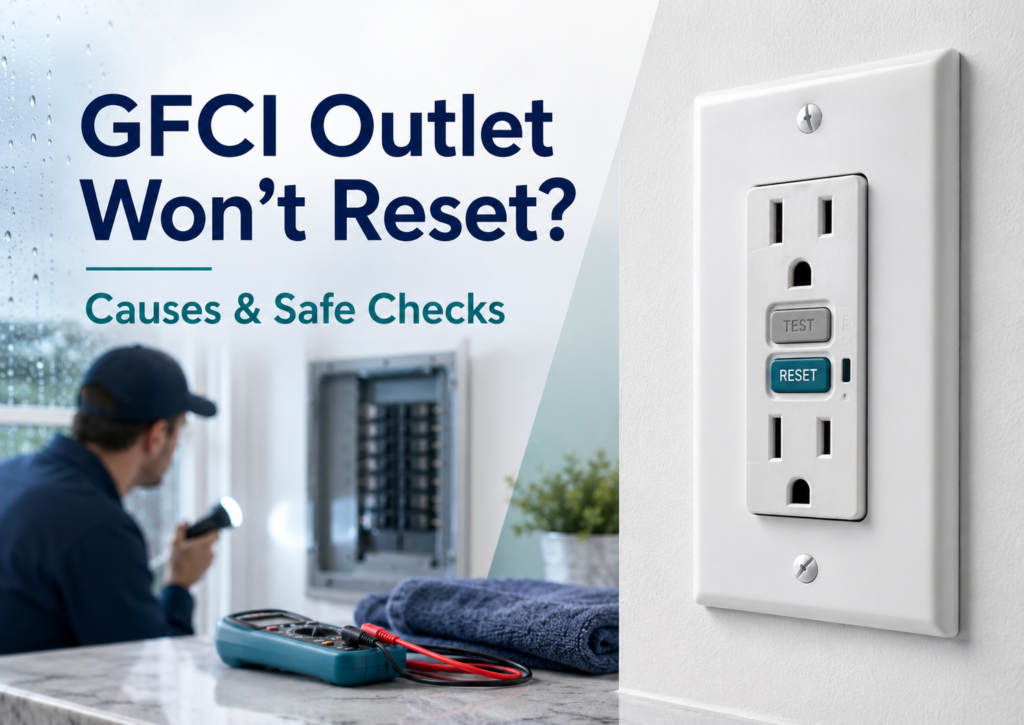
What This Guide Helps With
This guide explains why a GFCI outlet will not reset, the most common upstream and electrical causes, and the safe checks a homeowner can do before calling a licensed electrician.
Quick Answer
If a GFCI outlet will not reset, the most common reasons are an upstream GFCI that has tripped (the one you are looking at may not be the actual GFCI on that circuit), a tripped circuit breaker, moisture in the outlet box, or an end-of-life GFCI device. Start by finding all other GFCI outlets in bathrooms, kitchens, garages, and outdoor areas and resetting them first.
Safety First
GFCI outlets exist because the circuit can be dangerous. Approach with care.
- Do not remove the outlet cover, expose wiring, or disassemble the GFCI yourself.
- If the outlet feels warm, shows scorching, or smells like burning plastic, leave it alone and call a licensed electrician.
- If water is visible inside or near the outlet, do not press reset. Shut off the circuit breaker first.
- If a breaker keeps tripping along with the GFCI not resetting, the issue is in the wiring or a connected device — not the outlet itself.
- Never bypass a GFCI by replacing it with a standard outlet. It exists for a code-required reason.
The Single Most Misunderstood Fact About GFCIs
One GFCI outlet often protects several other regular outlets downstream. If you have three outlets in a bathroom and only one has the test/reset buttons, that one GFCI protects all three. If the GFCI trips, every outlet on that line goes dead — including ones in other rooms that share the circuit.
This means the outlet you are trying to reset may not be the actual GFCI on the circuit. The real GFCI is somewhere else in the home and has tripped.
Look for the actual GFCI in these places:
- Bathrooms (most common location)
- Kitchen counter outlets
- Garage outlets
- Outdoor outlets near patios or pools
- Basement or laundry area
- Inside the electrical panel (some homes have GFCI breakers instead of outlets)
Common Causes a GFCI Will Not Reset
| Cause | How to identify it | What to check |
|---|---|---|
| Upstream GFCI tripped | Reset button on target outlet does nothing or clicks but pops back | Find and reset every GFCI in the home |
| Tripped circuit breaker | No power to outlet at all; reset button won’t engage | Check breaker panel for any tripped or “middle position” breakers |
| Moisture in the box | Outdoor or bathroom outlet after rain or shower | Let it dry; shut off breaker until completely dry |
| Failed GFCI device | Reset button feels loose, sticks, or test button does not click | Device is over 10 years old; needs replacement |
| Connected appliance fault | GFCI resets only when nothing is plugged in | Unplug everything and reset; plug back in one by one |
| Wiring fault on circuit | Reset works briefly then trips immediately | Stop testing; call an electrician |
| Reverse wiring | Newly installed GFCI never works | Line and Load terminals reversed; call an electrician |
What to Do First
- Unplug everything on the circuit. Pull out all cords from the dead outlet and any related outlets. A faulty hair dryer, charger, or appliance can prevent reset.
- Locate every GFCI outlet in the home. Walk through bathrooms, kitchen counters, garage, laundry, basement, and outdoor outlets. Press reset on every one.
- Check the breaker panel. Look for any breaker that is in the OFF or middle position. Push it fully OFF, then fully ON.
- Press reset firmly. A working GFCI gives a distinct click. If the button does not click, the device may be faulty.
- Use the test button. Press test — the reset button should pop out and you should hear a click. If this works, the GFCI is functional.
- Plug devices back in one at a time. If reset works without anything plugged in but trips when you plug in a specific device, that device is faulty.
- Check for moisture. Outdoor and bathroom outlets often will not reset until completely dry, sometimes 24 hours after exposure.
What Not to Do
- Do not remove the outlet plate to inspect or “fix” wiring.
- Do not hold the reset button down for long periods — this does not force it to reset and can damage the device.
- Do not bypass the GFCI with a regular outlet. It is required by electrical code in wet or kitchen areas.
- Do not ignore a GFCI that resets but trips again within minutes. This is a sign of an active fault and needs professional attention.
- Do not use the outlet if you smell burning or see any discoloration around the device.
Related Guides
- Breaker Keeps Tripping: Causes and Safe Checks
- Smoke Alarm Beeping Every 30 Seconds: What to Do
- Electrical, Lighting & Smart Home
Safe DIY Checks
- Walk through the entire home and reset every GFCI outlet, not just the dead one.
- Check the breaker panel for tripped breakers — push fully OFF then ON.
- Unplug all devices and test reset with nothing connected.
- Press the test button — a working GFCI clicks distinctly.
- If outdoor or bathroom-related, wait 24 hours for moisture to dry.
- Check the age of the GFCI — older than 10 years means replacement is due.
When to Call a Licensed Electrician
Call a licensed electrician if:
- You have reset all GFCIs and the breaker, and the outlet still has no power.
- The GFCI trips immediately every time you reset it, even with nothing plugged in.
- The reset button feels loose, broken, or does not click.
- You smell burning, see scorching, or feel warmth around the outlet.
- Multiple outlets on the same circuit are dead and resets do not help.
- The outlet was recently installed and never worked correctly.
- Water reached the outlet area and it has not recovered after 24 hours of drying.
How GFCIs Work (Quick Explainer)
A GFCI (Ground Fault Circuit Interrupter) monitors the current going out on the hot wire and coming back on the neutral. If they differ by more than 5 milliamps, the device assumes the current is leaking — possibly through a person — and trips in milliseconds. This is what makes them required in wet areas.
When a GFCI trips, it can mean:
- An actual ground fault occurred (water, faulty appliance, damaged cord)
- A “nuisance trip” from an aging device or transient surge
- The internal mechanism has worn out and is over-sensitive
After about 10 years, the internal sensing mechanism becomes less reliable and may trip without a real fault or fail to reset. Replacement is the fix — and it is an electrician’s job in most jurisdictions.
Prevention Tips
- Press the test button on every GFCI monthly. This confirms the safety feature is working and exercises the mechanism.
- Cover outdoor GFCI outlets with in-use weatherproof covers, not just snap covers.
- Keep bathroom and kitchen GFCIs away from water as much as practical.
- Note the installation date — plan replacement around the 10-year mark.
- If your home was built before 1975, ask an electrician to inventory GFCI coverage in wet locations.
Recommended Next Step
If the outlet does not reset after checking all upstream GFCIs and the breaker panel, do not keep pressing reset. Repeated unsuccessful attempts will not fix a wiring fault or a failed device. Stop, leave the affected circuit unused, and schedule a licensed electrician.
Frequently Asked Questions
Why does my GFCI reset but trip again within seconds?
This usually means an active fault — either in the wiring, in a connected device, or in the GFCI itself. Unplug everything on the circuit and try resetting with nothing connected. If it still trips, the issue is in the wiring or the GFCI is faulty. Stop testing and call an electrician.
Can a GFCI go bad without tripping?
Yes. A failed GFCI may stop providing protection while still allowing power to pass through. This is why monthly testing with the test button matters — it confirms the device is still doing its job. If pressing test does not cause the reset button to pop, the GFCI is no longer protecting that circuit.
Why won’t my outdoor GFCI reset after a rainstorm?
Moisture inside the outlet box is the most likely reason. Shut off the circuit breaker and let the outlet dry completely — sometimes 24 hours or more. If it still will not reset after drying, the device may need replacement or the box may need a weatherproof cover upgrade.
Should every kitchen outlet be a GFCI?
Modern electrical code requires GFCI protection for any outlet within 6 feet of a sink and for any outlet on a kitchen counter. This does not mean every outlet must have test/reset buttons — they can be protected by an upstream GFCI on the circuit.
What is the difference between a GFCI outlet and a GFCI breaker?
A GFCI outlet has the test/reset buttons built into the receptacle. A GFCI breaker is installed in the electrical panel and protects the entire circuit — every outlet on that circuit is protected without needing GFCI receptacles. Both meet code; GFCI breakers are common in newer homes.