Quick Answer
The most important first step: determine whether all fixtures are affected or only one. Whole-house low pressure and single-fixture low pressure have almost completely different causes. Misidentifying which you have sends you in the wrong direction entirely.
Whole House or Single Fixture? — The First Check
| What you observe | Likely cause | Where to check |
|---|---|---|
| All faucets, showers, and toilets affected | Main supply, PRV, or municipal issue | Main shutoff, PRV, neighbor comparison |
| Hot water pressure only — everywhere | Water heater scale or closed outlet valve | Water heater hot-side shutoff; hot water guide |
| Only one fixture affected | Clogged aerator or local shutoff partially closed | That specific fixture only |
| One floor or wing only | Branch shutoff partially closed or corroded | Zone shutoff for that area |
| Pressure declining slowly over months | Progressive pipe corrosion or hidden leak | Licensed plumber — pressure test |
| Fluctuates throughout the day | Municipal peak demand or failing PRV | Neighbor check; call utility |
Safety First
- Sudden whole-house pressure loss with wet spots, a spinning water meter with nothing running, or the sound of running water with all fixtures off — shut the main valve and call a plumber immediately.
- Discolored water alongside a pressure drop may mean a main break — do not drink and call the utility.
- Do not adjust a pressure-reducing valve without measuring actual pressure first. Over-pressurizing stresses appliances and fixtures throughout the home.
Check 1 — Main Shutoff Valve (Most Overlooked Cause)
The main shutoff was partially closed during a past repair and never fully reopened. This is more common than most homeowners expect.
- Gate valve (round handle): fully open means turned counter-clockwise as far as possible.
- Ball valve (lever handle): fully open means the lever is parallel to the pipe — not just partway open.
- Also check the meter shutoff near the water meter if any utility work was recently done in the street or at the property line.
Check 2 — Aerator Cleaning (Single Fixture Only)
Mineral buildup from hard water gradually clogs the mesh screen in faucet aerators and showerheads — the most common cause of one weak fixture while all others are normal.
- Unscrew the aerator counter-clockwise from the faucet tip. Use pliers with a cloth to protect the finish.
- Inspect the screen for white or gray deposits.
- Soak in white vinegar for 30 to 60 minutes. Scrub with an old toothbrush.
- For showerheads: submerge the head in a bag of vinegar tied around it overnight.
Check 3 — Measure Actual Pressure at a Hose Bib
A pressure gauge attached to an outdoor hose bib costs $10 to $15 and gives you the actual system pressure. Normal is 45 to 80 PSI. Below 40 PSI is noticeably weak.
- Pressure normal at the hose bib but low inside the home: problem is between the meter and your fixtures — PRV, shutoff valves, or internal pipe corrosion.
- Pressure low at the hose bib: the problem is upstream. Call your water utility to check for main pressure issues or meter problems.
Check 4 — Pressure-Reducing Valve (PRV)
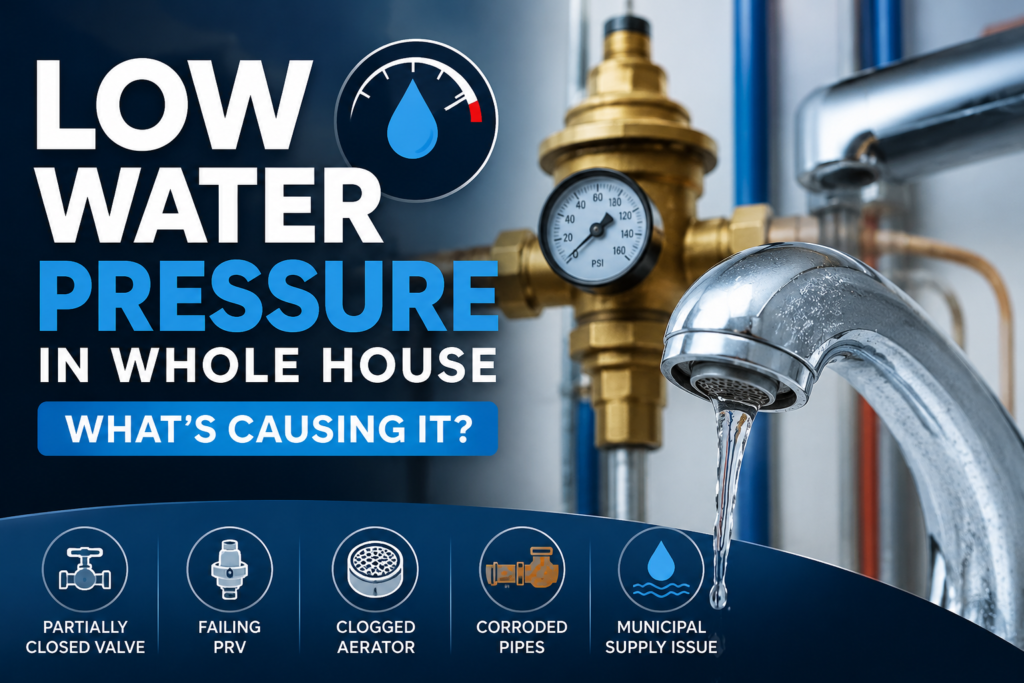
A bell-shaped device on the main supply line near where it enters the home. It reduces incoming municipal pressure (often 80–120 PSI) to a safe residential range. PRVs last 10 to 20 years and fail by sticking in a low-pressure position.
Signs of a failing PRV: whole-house pressure newly low with no other explanation; PRV older than 10 to 15 years; pressure that fluctuates without upstream changes; a hissing sound near the PRV location. PRV replacement is a licensed plumber job.
What Not to Do
- Do not increase the PRV adjustment without measuring actual outgoing pressure — you may over-pressurize a system already within normal range.
- Do not clean aerators with metal tools — the fine mesh tears easily.
- Do not ignore gradually declining pressure. Progressive loss over months is often developing pipe corrosion or a slow leak that will eventually become a major problem.
Related Guides
- Dripping Faucet: Faucet Repair by Type
- Hot Water Only Lasts 5 Minutes: Water Heater Diagnosis
- Outdoor Faucet Dripping: Hose Bib Issues
Safe DIY Checks
- Walk through the home and confirm whether all fixtures or just one are affected.
- Check that the main shutoff valve is fully open.
- Clean aerators and showerheads on the affected fixture.
- Attach a pressure gauge to a hose bib and measure actual PSI.
- Ask a neighbor whether they have the same issue — confirms municipal cause.
- Confirm hot-only vs all-water — if hot only, check the water heater outlet shutoff.
When to Call a Licensed Plumber
- Pressure is normal at the meter but low inside — problem is between the meter and your fixtures.
- PRV is over 10 years old with unexplained whole-house pressure loss.
- Pressure has been declining steadily over several months.
- You hear water running when all fixtures are confirmed off.
- Discolored water accompanies the pressure drop.
Prevention Tips
- Clean aerators and showerheads annually — more frequently in hard water areas.
- Know where the main shutoff valve is and test it annually. Shutoffs can seize in position over time if never operated.
- Have the PRV inspected in homes 15 years or older that have never had the PRV serviced.
- Homes with galvanized steel pipes (gray, magnetic, pre-1960) face corrosion-driven pressure loss as a known long-term issue. Budget for eventual repiping.
Recommended Next Step
Confirm whole-house vs single-fixture. If single fixture: clean the aerator — two minutes, often resolves it. If whole-house: check the main shutoff valve first, then measure PSI at a hose bib. That single reading tells you whether the problem is upstream of your meter or inside your home’s plumbing.
Frequently Asked Questions
What is normal residential water pressure?
Standard is 45 to 80 PSI. Below 40 PSI is noticeably weak at fixtures. Above 80 PSI stresses appliances, fixture seals, and washing machine hoses. The ideal range for performance and longevity is 50 to 70 PSI.
Why is my shower pressure good but the adjacent sink is weak?
They share supply lines but have separate aerators and local shutoff valves under the sink. A clogged aerator or a partially closed local shutoff valve are the most common causes of one fixture being noticeably weaker than a neighboring one.
My neighbor has normal pressure. Why is mine low?
If neighbors are unaffected, the problem is on your side of the water meter: most likely the PRV, a partially closed main shutoff, or progressive pipe corrosion inside your supply line.
Does a tankless water heater require minimum water pressure?
Yes. Most tankless units require 20 to 30 PSI minimum to activate the flow sensor and fire the burner. Below this threshold, the unit will not ignite — making low pressure an HVAC problem as well as a comfort issue.
Can I adjust the PRV myself?
Only after measuring actual outgoing pressure with a gauge and confirming the adjustment screw is accessible without disassembly. Stay within the safe range (under 80 PSI). When in doubt, a licensed plumber can adjust and verify in a single visit.