
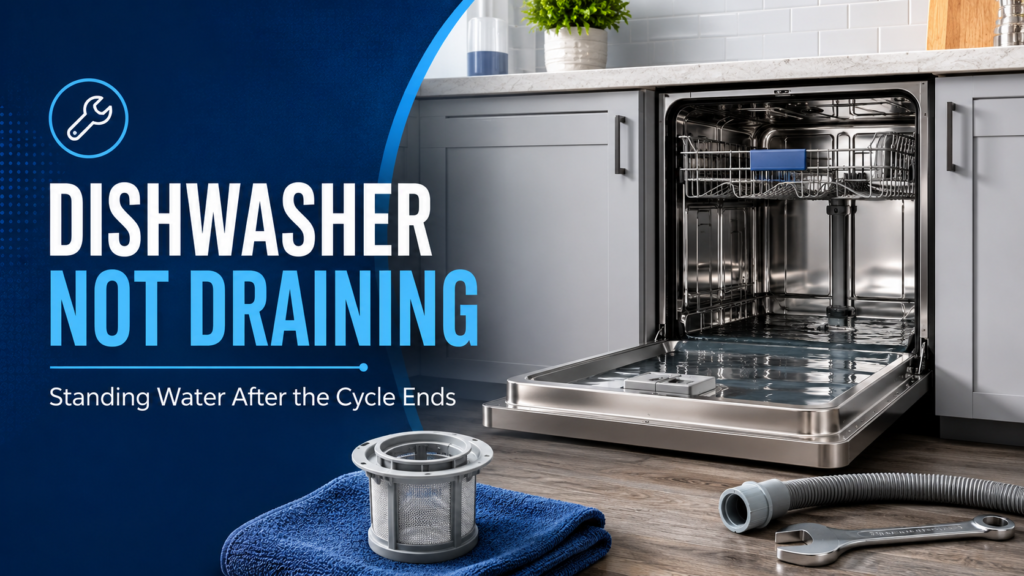
Quick Answer
Standing water in a dishwasher after a cycle ends is most commonly caused by a clogged filter (the most overlooked maintenance item on any dishwasher), a kinked drain hose, or a garbage disposal knockout plug that was never removed after a new disposal was installed. All three are homeowner-fixable in minutes. A failed drain pump is the less common cause and requires a technician.
Safety First
- Turn off the dishwasher and cancel any active cycle before inspecting.
- Unplug the dishwasher or flip the dedicated circuit breaker before reaching into the tub or accessing the filter.
- Water at the bottom of a recently completed cycle is hot — wait 15 minutes or wear rubber gloves.
- Do not tilt the dishwasher with standing water inside — overflow can reach electrical connections below the unit.
- If the dishwasher trips the circuit breaker when running, do not reset and retry — call an electrician.
Cause Diagnosis Table
| Cause | Likelihood | How to identify | Fix |
|---|---|---|---|
| Clogged filter | Very common | Food debris visible in filter at tub bottom | Remove and clean — 2 minutes |
| Kinked drain hose | Common | Hose behind unit bent or crushed against the wall | Reposition hose |
| Disposal knockout plug not removed | Common after new disposal install | New disposal recently installed; dishwasher worked before | Remove knockout plug |
| Air gap clogged (if installed) | Moderate | Round cap on countertop or sink rim; debris inside | Remove cap and clear debris |
| Failed drain pump | Less common | Humming or silence during drain cycle; no other cause found | Technician replacement |
Check 1 — The Filter (Start Here)
Most dishwashers made in the past 10 years have a removable filter at the bottom of the tub. If it is clogged, water cannot pass through to the drain pump regardless of what else is working correctly.
- Look at the tub bottom near the back or center. The filter is a cylindrical piece that twists counter-clockwise to remove.
- Rinse it under running water. Scrub the mesh with a soft brush.
- Clean the filter housing in the tub floor — debris also accumulates there.
- Reinstall and run a short cycle to test.
Clean the filter monthly in heavy-use households. This single maintenance step prevents the majority of dishwasher draining problems.
Check 2 — The Garbage Disposal Knockout Plug
When a new garbage disposal is installed, the inlet port where the dishwasher hose connects has a factory knockout plug. It must be removed before connecting the dishwasher drain hose. If left in, the drain line has nowhere to go. See our garbage disposal guide for the full disposal connection context.
- Look under the sink. The dishwasher drain hose connects to a port on the side of the disposal body.
- If the disposal is new: disconnect the hose at the disposal, insert a flat screwdriver into the inlet hole, and tap firmly to knock out the plug. Retrieve the plug from inside the disposal grind chamber before reconnecting the hose.
Check 3 — Drain Hose Position
- Pull the dishwasher slightly forward (unplugged). Inspect the drain hose for kinks or tight bends where it exits the unit.
- Confirm the hose forms a high loop secured to the underside of the countertop, or connects to an air gap on the counter. This prevents water siphoning back into the tub after draining.
- Disconnect the hose at the disposal or drain connection and blow through it to confirm it is clear of debris.
What Not to Do
- Do not run the dishwasher repeatedly hoping the water drains — the tub will overfill further.
- Do not pour chemical drain cleaner into the dishwasher — these products damage rubber seals, the pump mechanism, and the tub coating.
- Do not skip the filter check because you always rinse dishes — starch, grease, and fine food particles accumulate in the filter regardless.
Related Guides
- Garbage Disposal Not Working: The Dishwasher Connection
- Washing Machine Not Draining: Similar Appliance Diagnosis
- Kitchens, Bathrooms & Major Appliances
Safe DIY Checks
- Remove and clean the filter — most common cause, two-minute fix.
- Check the disposal knockout plug if a disposal was recently installed.
- Inspect the drain hose for kinks and confirm a high-loop or air gap connection.
- Check the countertop air gap for debris if one is installed.
When to Call an Appliance Technician
- Filter is clean, hose is unkinked, disposal connection is confirmed — and water still does not drain after a full cycle.
- No sound during the drain cycle — the drain pump is running when it should hum.
- Error codes appear on the display related to draining — look up your model number and code.
- The unit is over 8 to 10 years old with multiple symptoms — repair vs replacement evaluation applies.
Prevention Tips
- Clean the filter monthly — the single most impactful dishwasher maintenance step.
- Run the dishwasher weekly even when not full. Letting it sit idle allows food residue to harden in the filter and drain.
- Run a dishwasher cleaning tablet cycle monthly to clean the interior, spray arms, and drain components.
- Run hot water at the kitchen sink for 30 seconds before starting the dishwasher — the unit starts with hot water instead of cold from pipes.
Recommended Next Step
Start with the filter — it takes two minutes to remove and clean and resolves the majority of draining problems at zero cost. If water still remains after cleaning the filter, check the disposal connection and drain hose. All three checks together cover the vast majority of dishwasher draining failures.
Frequently Asked Questions
Is a small amount of water at the tub bottom normal?
Yes — 1 to 2 cups of water remaining at the very bottom of the tub is intentional on many models to keep the door seal from drying out. An inch or more of standing water after a full cycle is not normal.
Why did my dishwasher suddenly stop draining after years of working fine?
The filter accumulated debris slowly until it reached full blockage. Clean it and the problem typically resolves immediately and completely.
Can a slow kitchen sink drain block the dishwasher from draining?
Yes. The dishwasher drain line connects to the same drain as the kitchen sink. A partial or full kitchen sink clog creates back pressure that prevents dishwasher drainage. Resolve the kitchen sink drain first.
What is an air gap and does my dishwasher need one?
An air gap is a countertop or sink-mounted fitting that prevents contaminated water from siphoning back into the dishwasher. Many plumbing codes require it as the alternative to a high drain-hose loop. If yours is clogged, remove the cap and clear debris inside.
How long should a dishwasher last?
Average lifespan is 9 to 12 years. For units older than 8 to 10 years with draining problems, compare the repair estimate to 50% of replacement cost — that is the standard threshold where replacement often makes more financial sense.