What This Guide Helps With
This guide explains why a mini-split or ductless heat pump stops cooling effectively, the safe checks a homeowner can do on the indoor and outdoor units, and when the problem needs a licensed HVAC technician rather than a DIY fix.
Quick Answer
A mini-split that isn’t cooling most commonly has one of these causes: a dirty indoor filter restricting airflow, a blocked or dirty outdoor condenser unit, an iced-over indoor coil, a remote or control setting on the wrong mode, or a refrigerant leak. Unlike central air, each indoor head cools only its own zone, so if one room is warm while others are fine, the problem is almost always local to that specific unit rather than the whole system.
Safety First
- Always turn off power to the unit at the breaker before removing any panel or filter for cleaning.
- Never attempt to open the refrigerant lines or add refrigerant yourself — this requires EPA certification and specialized equipment.
- If you notice a burning smell, sparking, or the outdoor unit is unusually hot, shut off power and call an HVAC technician before continuing.
What to Do First
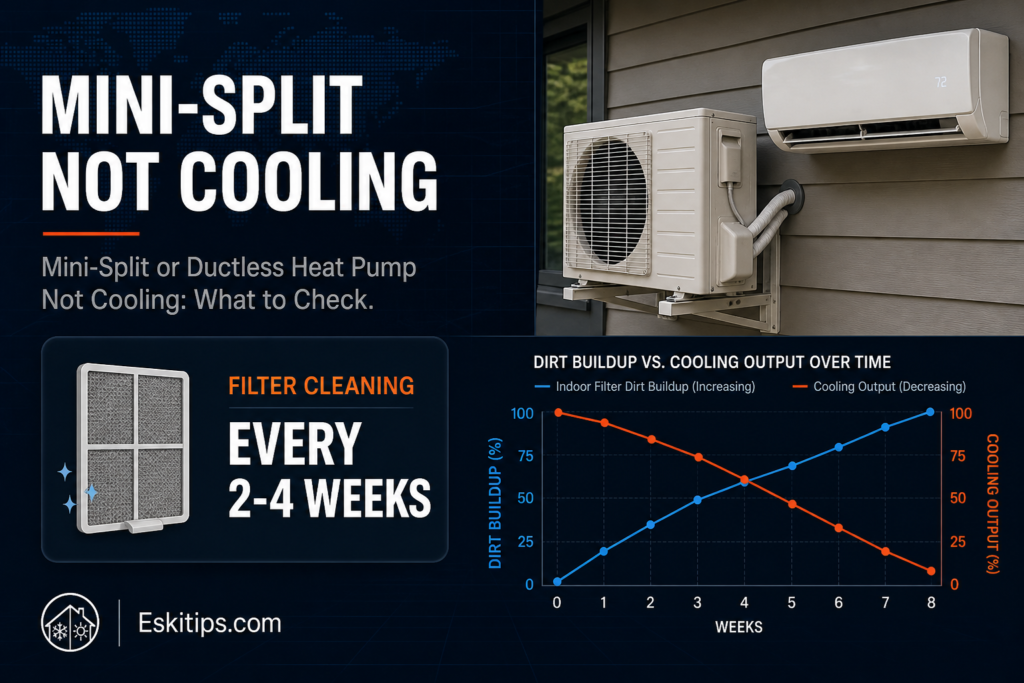
- Check the indoor unit’s filter — most mini-splits have a washable filter behind the front panel that should be cleaned every 2 to 4 weeks during heavy summer use. A clogged filter is the single most common cause of reduced cooling.
- Confirm the mode and settings on the remote. Some remotes default back to fan-only or dry mode after a power blip, which will move air without actually cooling.
- Check the outdoor condenser unit for blocked airflow — leaves, grass clippings, spider webs in the coil fins, or anything within 12 inches of the unit restricts heat exchange.
- Look at the indoor coil (visible when the front panel is open) for ice buildup — if present, turn the unit off and let it thaw fully before running it again.
- Check that the indoor unit’s drain line isn’t clogged — a backed-up condensate drain can trigger a safety shutoff on some models, which looks like the unit “not cooling” when it’s actually protecting itself.
- Compare zones if you have a multi-zone system — if only one indoor head is affected, the problem is almost always at that specific head, not the outdoor compressor.
What Not to Do
- Do not run the unit continuously if you see ice on the indoor coil — this can lead to compressor damage.
- Do not spray water directly into the electrical components while cleaning the outdoor unit — rinse the coil fins gently from the top down and keep water away from the control box.
- Do not ignore a warm room in a multi-zone system by assuming “the whole system needs service” — check that specific head first.
- Do not attempt to remove the outdoor unit’s protective housing to inspect refrigerant lines or the compressor.
Common Mini-Split Cooling Problems and What They Mean
| Symptom | Likely cause | What to do |
|---|---|---|
| Airflow feels weak but not cold | Clogged indoor filter | Clean or replace the washable filter |
| One zone warm, others cooling fine | Local issue at that indoor head — filter, coil ice, or remote setting | Check that unit specifically before assuming a system-wide fault |
| Ice visible on the indoor coil | Restricted airflow or low refrigerant | Turn off and let thaw fully; call a technician if it recurs |
| Outdoor unit running but little cool air inside | Blocked outdoor coil, low refrigerant, or failing compressor | Clear debris around the unit; call an HVAC technician if it continues |
| Unit shuts off shortly after starting | Clogged condensate drain triggering a safety sensor | Check and clear the drain line; call a technician if it persists |
Safe DIY Checks
- Clean the washable indoor filter every 2 to 4 weeks during peak cooling season.
- Keep at least 12 inches of clearance around the outdoor condenser, free of plants, leaves, and debris.
- Confirm the remote is set to cool mode, not fan or dry mode, and that the temperature setpoint is actually below room temperature.
- Check the condensate drain line outside for a steady drip when the unit is cooling — no drainage at all can indicate a clog.
When to Call a Professional
Call a licensed HVAC technician if:
- The indoor coil ices over repeatedly even after cleaning the filter and confirming clear airflow.
- The outdoor unit runs but the system still won’t cool after checking filters, settings, and clearance.
- You suspect a refrigerant leak — reduced cooling combined with ice buildup or a hissing sound are common signs.
- A specific zone has never cooled properly since installation, which can point to an installation or sizing issue.
Prevention Tips
- Clean the indoor filters on a regular schedule through the cooling season rather than waiting for reduced performance.
- Have the outdoor unit’s coil professionally cleaned annually, in addition to your own visual debris checks.
- Keep landscaping trimmed back from the outdoor unit as it grows through the season.
- Schedule a professional refrigerant and performance check every year or two, especially for systems more than five years old.
Recommended Next Step
Start with the indoor filter and the remote settings — these resolve the majority of “not cooling” complaints on mini-split systems. If a specific zone stays warm after that, check the outdoor unit for blockage and the indoor coil for ice. If ice keeps returning or a hissing sound is present, stop running the unit and call a licensed HVAC technician rather than continuing to cycle it.
Related Guides
- AC Running but Not Cooling: Causes and Safe Checks
- Central AC Freezing Up in Extreme Heat
- Thermostat Not Working: What to Check
Frequently Asked Questions
Why does only one zone on my mini-split system stop cooling?
Because each indoor head has its own filter, coil, and blower, a problem usually stays local to that specific zone rather than affecting the whole system. Check that unit’s filter, remote settings, and coil for ice before assuming the outdoor compressor is at fault.
How often should I clean a mini-split’s indoor filter?
Every 2 to 4 weeks during heavy summer cooling use, more often in dusty environments or homes with pets. A clogged filter is the most common cause of reduced cooling performance on these systems.
Can I clean the outdoor unit of my mini-split myself?
Yes, gently clearing debris and rinsing the coil fins from the top down with a garden hose (power off) is a reasonable DIY task. Avoid spraying water into the control box, and leave deeper coil cleaning or any refrigerant-related work to a licensed technician.