
Quick Answer
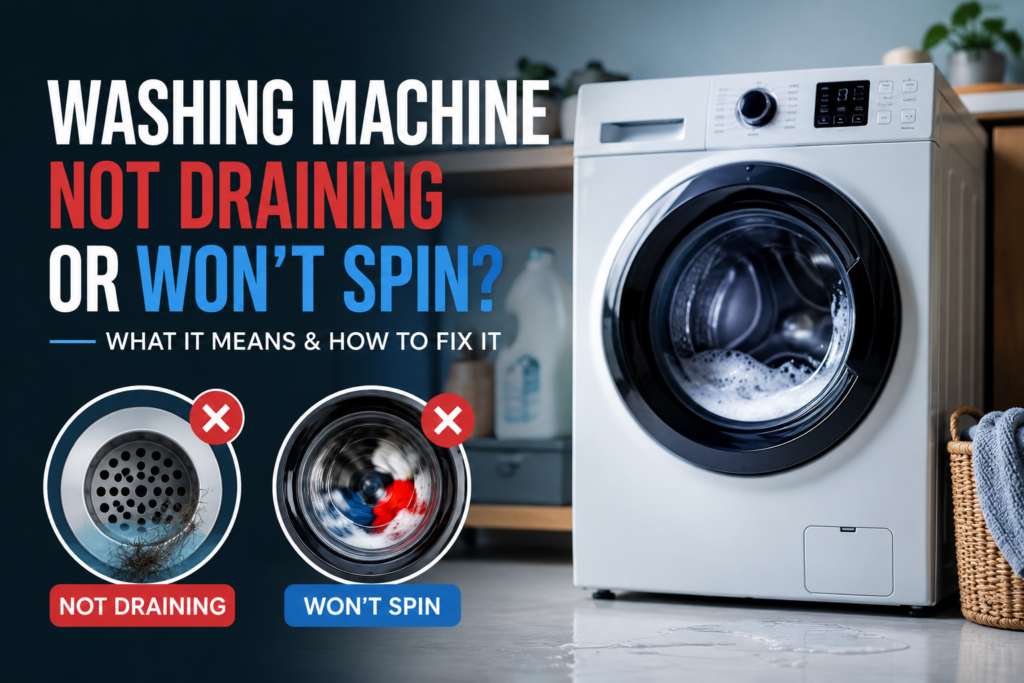
A washing machine that will not drain and a machine that will not spin are related problems but they have different causes. Not draining: most likely a clogged pump filter on front-loaders, a kinked drain hose, or a standpipe height problem. Not spinning: most likely an unbalanced load — by far the most common spin failure — or a triggered lid switch or door latch safety mechanism. Identify which problem you have before starting any check.
Safety First
- Unplug the washing machine before accessing the pump filter, lint trap, or any internal component.
- A machine full of water is very heavy — do not try to move it without draining it first.
- Front-loader door locks are electronic safety devices that release 2 to 3 minutes after a cycle ends, or when power is removed. Do not force the door open — forcing it breaks the latch mechanism.
- If the machine trips the circuit breaker when running, do not reset and retry — call an appliance technician.
Not Draining — Cause Diagnosis Table
| Cause | How to identify | Fix |
|---|---|---|
| Clogged pump filter (front-loaders) | Small access panel at the lower front of the machine; debris visible in filter | Remove and clean filter — homeowner DIY |
| Kinked drain hose | Hose at the back of the machine bent or crushed against the wall | Reposition hose with adequate bend radius |
| Drain hose inserted too deep in standpipe | Hose goes more than 8 inches into the wall standpipe; water siphons back | Limit insertion to 8 inches; use a high-loop clamp |
| Coin or small object in pump | Rattling noise during drain attempts; debris in filter | Remove filter and clear pump inlet |
| Failed drain pump | Drain cycle attempts but no water movement; motor hums without drainage | Technician replacement |
Not Spinning — Cause Diagnosis Table
| Cause | How to identify | Fix |
|---|---|---|
| Unbalanced load | Machine stops mid-spin; sometimes an error code; single heavy item or one-sided load | Redistribute load evenly; run spin-only cycle |
| Lid switch failure (top-loaders) | Machine fills and agitates normally but will not enter spin; no audible click when lid presses the switch | Lid switch replacement |
| Door latch failure (front-loaders) | Door does not click firmly shut; machine will not start or will not enter spin | Door latch replacement |
| Tub not draining before spin attempt | Standing water in tub when spin cycle should begin; machine stops | Fix the draining issue first — spin will not work with a full tub |
| Worn or broken drive belt | Motor hums but drum does not rotate; burning rubber smell | Drive belt replacement — technician or experienced DIY |
Draining Fix 1 — Pump Filter (Front-Loaders)
- Place towels and a shallow pan beneath the access panel at the lower front of the machine. There will be water — typically 2 to 3 cups at minimum.
- Open the access panel and slowly unscrew the pump filter cap counter-clockwise. Allow water to drain into the pan gradually.
- Remove the filter completely and rinse it under running water. Clear any coins, hair, lint, or small items from both the filter and the filter housing recess.
- Reinstall the filter, tighten the cap, and run a drain-only cycle to confirm drainage is restored.
Clean the pump filter every 2 to 3 months on front-loaders. The majority of front-loader performance and draining problems originate from a neglected filter.
Spinning Fix 1 — Redistribute the Load (Most Common Spin Failure)
- Open the machine and manually redistribute the laundry — heavy items spread evenly around the drum, not clustered on one side.
- Avoid washing a single very heavy item (one comforter, one heavy jacket) without adding several towels to balance the weight distribution.
- Close the lid or door and run a spin-only cycle.
- If balance errors occur frequently even with normal loads, check whether the machine is level. Adjust the leveling feet at the machine’s base — an unlevel machine rocks during spin and triggers false imbalance detection.
Draining Fix 2 — Drain Hose Inspection
- Pull the machine slightly forward (unplugged) and inspect the drain hose at the back for kinks, tight bends, or crushing against the wall.
- Where the hose enters the wall standpipe: limit insertion to no more than 8 inches. Inserting it deeper creates a seal that causes siphoning — water drains out and immediately gets siphoned back in.
- The standpipe itself should be 34 to 36 inches tall from the floor. Too short causes siphoning; taller than the pump can push water to prevents drainage.
What Not to Do
- Do not force the front-loader door open during or immediately after a cycle. The electronic door lock is a safety feature — forcing it typically destroys the latch mechanism and creates an additional repair.
- Do not overload the machine. Overfilling is a primary contributing cause of both poor draining and repeated spin balance failures.
- Do not ignore a burning rubber smell — it indicates the drive belt is slipping against the drum or has broken, and the motor is running against resistance.
- Do not leave wet clothes sitting in a machine with standing water for more than a few hours — transfer them and address the draining problem promptly.
Related Guides
- Dishwasher Not Draining: A Related Appliance Diagnosis
- Refrigerator Not Cooling: Symptom Diagnosis by Type
- Kitchens, Bathrooms & Major Appliances
Safe DIY Checks
- Redistribute the load and run a spin-only cycle — the most common cause of spin failure, the fastest check.
- Clean the pump filter on front-loaders — most common cause of draining failure.
- Inspect and reposition the drain hose; confirm insertion depth in the standpipe.
- Level the machine using the adjustable feet if balance errors are frequent.
- Test the lid switch by pressing the plunger manually — you should hear a distinct click.
When to Call an Appliance Technician
- Pump filter is clean, hose is correctly positioned, and water still does not drain after a full cycle attempt.
- No sound is produced during the drain cycle — the pump is silent when it should be running.
- The drum does not rotate with a balanced load and the lid switch or door latch appears intact.
- You smell burning rubber — drive belt or motor coupling failure.
- Error codes appear on the display that the above checks do not resolve.
Prevention Tips
- Clean the pump filter every 3 months on front-loaders.
- Empty all pockets before loading — coins are the most common object that damages the pump.
- Use the correct amount of detergent — excess suds create sensor interference and can affect draining on some models.
- Leave front-loader doors ajar between uses to dry the drum interior and prevent odor and mold buildup in the door seal.
- Run a drum cleaning cycle monthly using a washing machine cleaning tablet.
Recommended Next Step
Determine which problem you have: draining or spinning. For draining: start with the pump filter. For spinning: redistribute the load and run a spin-only cycle. These two checks resolve the majority of cases with no tools and no cost.
Frequently Asked Questions
My machine stops mid-cycle with a tub full of water. What do I do?
First run a drain-only cycle. If water drains, the machine likely detected an imbalance or load issue — redistribute and resume. If water does not drain, check the pump filter and drain hose.
How do I manually drain a washing machine?
Front-loaders: open the access panel, place a pan underneath, and slowly unscrew the pump filter cap — water drains out. Top-loaders: disconnect the drain hose at the wall and lower the hose end into a bucket below the machine’s pump level — gravity starts the flow.
My top-loader fills and washes normally but will not spin. What is causing this?
This is the classic lid switch failure pattern on top-loaders. The machine will not enter spin mode unless it detects the lid is closed. Press the lid switch plunger manually — you should hear a distinct click. No click means the switch has failed and needs replacement.
My machine is 4 years old. Should I repair or replace?
Four years is well within the useful life of a washing machine (average 10 to 12 years). Repair is almost always the correct choice for a machine this age unless the repair involves the motor or control board. A pump filter cleaning, lid switch, or drain hose reposition is a sound investment.
Does overloading the machine cause long-term damage?
Yes. Chronic overloading strains drum bearings, the drive belt, and the motor coupling — accelerating wear on all three. It also creates repeated imbalance detection that triggers false stops. Washing at 75 to 80% capacity maximizes machine longevity.