
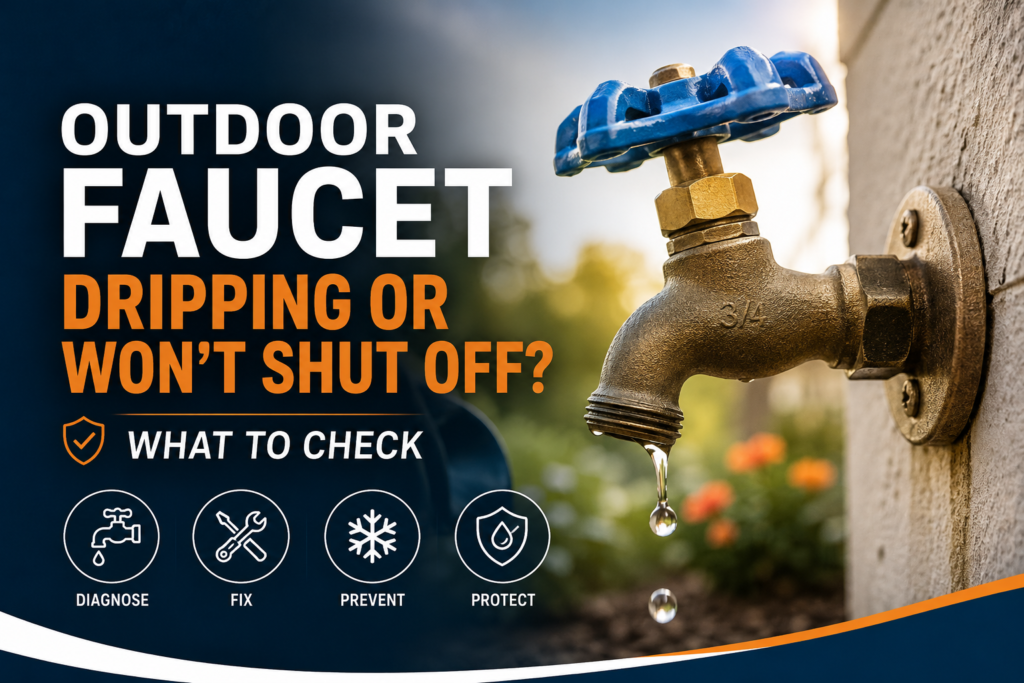
Quick Answer
An outdoor faucet (hose bib or sill cock) dripping from the spout with the handle fully closed usually has a worn stem washer at the far interior end of the long stem. A faucet leaking around the handle stem when the water is on has a failed packing washer. Water appearing inside the home behind the faucet mounting point indicates a cracked pipe from freeze damage — a plumber call. The location of the leak determines the part and the fix.
Outdoor Faucets Are Different From Indoor Faucets
Modern outdoor faucets are frost-free sill cocks. The actual shut-off point is located 8 to 12 inches inside the wall above the frost line — not at the exterior handle. When you turn the handle off, a long stem moves all the way back to a valve seat inside the warm wall. This design keeps water away from the freezing exterior.
This means: leaving a garden hose connected in winter traps water at the outdoor end, where it can freeze and crack the pipe even on frost-free models. And the stem you remove during repair is much longer than any indoor faucet stem.
Safety First
- Close the interior shutoff valve for the outdoor faucet before any disassembly. This valve is usually inside the home — in the basement, crawl space, or utility room — on the wall closest to the outdoor faucet location. Turn clockwise to close.
- If no interior shutoff exists, shut off the home’s main water supply.
- Water appearing inside the home behind the faucet mounting location is urgent — it indicates a cracked pipe inside the wall causing hidden water damage. Stop using the faucet and call a plumber promptly. See our guide on finding hidden water leaks.
- Water pooling at the foundation directly below an outdoor faucet contributes to the basement moisture issues covered in our basement moisture guide.
Where Is the Leak? — The Diagnosis Table
| Where it leaks | Cause | Fix |
|---|---|---|
| From the spout with handle fully off | Worn stem washer at the interior end of the long stem | Replace stem washer — homeowner DIY |
| Around the handle stem when water is running | Failed packing washer or worn packing material around the stem | Tighten packing nut first; replace packing if needed |
| From inside the home behind the faucet | Cracked pipe from freeze damage or a failed joint inside the wall | Plumber — pipe repair required |
| From the vacuum breaker cap on top of the faucet | Failed rubber disc or spring inside the vacuum breaker | Replace the vacuum breaker cap — $5 to $8 part |
| At the connection where the garden hose attaches | Worn washer inside the hose coupling | Replace the hose washer — $1 part |
Fix 1 — Spout Drip: Replace the Stem Washer
- Close the interior shutoff valve. Open the outdoor faucet handle to release remaining pressure from the line.
- Remove the handle — usually a screw under a decorative cap at the center of the handle.
- Use a wrench to unscrew the large packing nut directly behind the handle.
- Pull the stem straight out. It is much longer than an indoor stem — often 8 to 12 inches — because it reaches inside the wall to the valve seat.
- At the interior end of the stem: a rubber washer held by a brass screw. Remove the screw and replace the washer with an exact match. Take the stem to the hardware store for a size match.
- Apply silicone-based plumber’s grease to the new washer. Reinstall the stem, packing nut, and handle.
- Open the interior shutoff slowly. Test for leaks at the spout and at all connections.
Fix 2 — Handle Stem Leak: Tighten or Replace Packing
If water weeps around the stem when the faucet is running:
- Try tightening the packing nut (the large nut just behind the handle) one-quarter turn clockwise while the water is on. This alone often stops the leak.
- If tightening does not stop it: close the interior shutoff, remove the handle and packing nut, and replace the packing material — a rubber washer or graphite packing rope that creates a waterproof seal around the stem.
Fix 3 — Vacuum Breaker Cap
The vacuum breaker (a round cap on top of the faucet body) prevents contaminated water in a connected hose from siphoning back into the home’s supply. When the rubber disc or spring inside fails, it drips when the faucet is running.
- Unscrew the cap counter-clockwise. Inspect the small rubber disc and spring inside.
- If either is cracked, flattened, or corroded, replace the entire cap. These are available by faucet brand for $5 to $8. Screw the new cap on and test.
Freeze Damage — When Last Winter Is the Culprit
A frost-free faucet that worked fine in fall but has no water flow in spring — or produces water inside the home when opened — has freeze damage from the previous winter. This occurs when a garden hose was left connected during freezing temperatures, preventing the pipe from draining properly. See our guide on frozen pipe damage and prevention. Freeze damage inside the wall requires a plumber for repair.
What Not to Do
- Do not leave garden hoses connected to outdoor faucets during freezing weather — the single most preventable cause of outdoor faucet freeze damage, even on frost-free models.
- Do not overtighten the packing nut to stop a stem leak — overtightening crushes the packing material and makes the handle stiff and difficult to operate.
- Do not ignore a dripping outdoor faucet — water pooling at the foundation contributes directly to basement moisture problems.
- Do not assume the interior shutoff valve is functional without testing it first. Shutoff valves that have never been operated can seize in the open position.
Related Guides
- Dripping Indoor Faucet: Repair by Faucet Type
- Frozen Pipes: What to Do Before They Burst
- Low Water Pressure: Whole House Diagnosis
Safe DIY Checks
- Identify the leak location from the diagnosis table above.
- Close the interior shutoff valve before any disassembly.
- Try tightening the packing nut one-quarter turn for a stem leak.
- Replace the vacuum breaker cap for a top-of-faucet drip — a $5 to $8 fix.
- Replace the hose washer inside the garden hose coupling — a $1 fix for that connection point.
When to Call a Licensed Plumber
- Water appears inside the home behind the faucet mounting location — pipe is cracked inside the wall.
- No water flows from the faucet despite the interior shutoff being confirmed open — freeze damage or a failed valve seat inside the wall.
- The interior shutoff valve does not close fully or leaks when operated.
- The faucet body is visibly cracked, severely corroded, or has separated from its wall connection.
Annual Winterizing Steps — The Prevention Sequence
- Disconnect all garden hoses before the first hard freeze each fall — even on frost-free faucets.
- Close the interior shutoff valve for the outdoor faucet.
- Open the outdoor faucet handle to drain any remaining water from the pipe section inside the wall.
- Leave the outdoor handle in the open position all winter. The water is now shut off inside the wall above the frost line, and the exterior pipe section is fully drained.
- In spring: close the outdoor handle first, then open the interior shutoff valve to restore water. Test the faucet and inspect for any dripping before connecting hoses.
Recommended Next Step
Use the leak location table to identify which component has failed. A spout drip or stem leak are homeowner-fixable repairs in 20 to 30 minutes with basic hand tools. A vacuum breaker cap replacement takes 5 minutes and costs under $10. Any water appearing inside the home means stop using the faucet immediately and call a plumber.
Frequently Asked Questions
What is the difference between a hose bib, spigot, and sill cock?
These terms are used interchangeably in common usage. Hose bib and spigot refer to any threaded outdoor faucet. Sill cock specifically refers to a faucet mounted through the exterior wall. Frost-free sill cock is the precise term for the anti-freeze design used in most modern construction in freezing climates.
How do I know if my outdoor faucet is frost-free?
View the faucet from the side profile. A frost-free model has a noticeably extended body — typically 8 to 12 inches from the exterior wall to the handle stem — because the valve mechanism is inside the wall. A standard non-frost-free model has a much shorter body with the valve seat right at the wall surface.
My outdoor faucet only drips when the garden hose is connected. Is that a faucet problem?
A connected hose creates back pressure that can reveal leaks in the faucet body that are not visible otherwise. Check the rubber washer inside the hose coupling first — a worn hose washer causes this exact symptom and costs $1 to replace. If the drip continues with the hose disconnected, the stem washer is the next item to check.
Can I replace an outdoor faucet myself?
Complete faucet replacement requires cutting the supply pipe inside the wall and making a new connection — soldering copper, threading galvanized, or pushing PEX depending on your pipe material. This is a plumber’s job for most homeowners. Replacing the stem washer, packing, and vacuum breaker on the existing faucet body are homeowner-accessible repairs.
My outdoor faucet handle is extremely stiff and hard to turn. What causes this?
Stiffness in a frost-free sill cock usually means the packing nut is too tight, the packing material has dried out, or the long stem has developed corrosion along its length. Try applying silicone-based plumber’s grease around the stem at the packing nut location. A faucet that requires significant force to operate should be inspected and the packing or stem replaced — operating with excessive force stresses the stem and can crack the valve seat inside the wall.