
Quick Answer
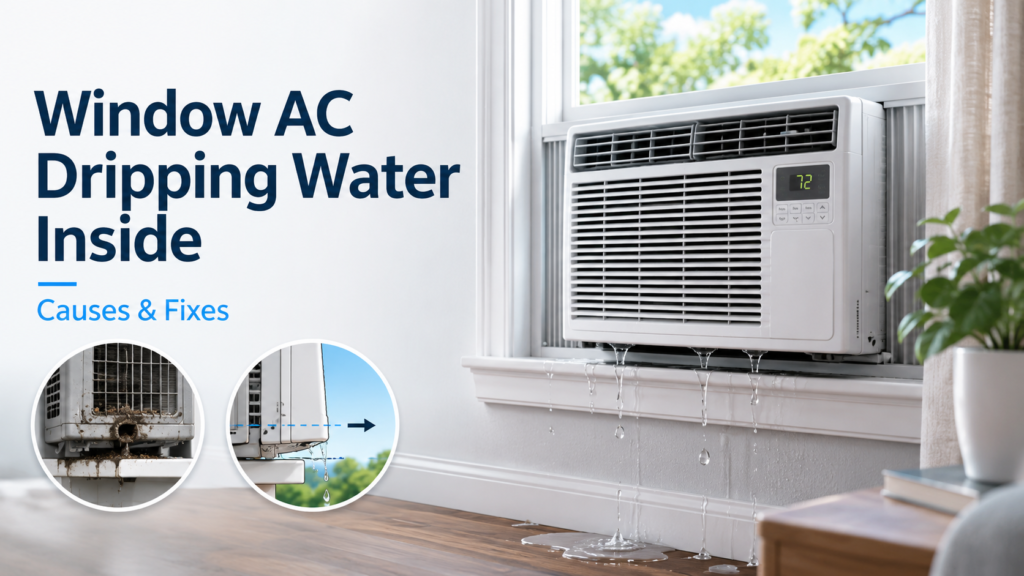
A window AC unit dripping water inside the room almost always has one of two causes: a clogged condensate drain hole at the unit’s rear, or the unit is installed tilted slightly toward the interior instead of the exterior. Both are homeowner-fixable. Water dripping from the front of the unit inside your home is not normal and should be corrected promptly — prolonged dripping onto walls or floors causes water damage and mold.
Why This Is Different From a Central AC Dripping Problem
Window AC units collect condensation on their evaporator coils just like central AC systems, but they drain differently. There is no condensate drain line to a floor drain — the water is supposed to drip from a small hole or holes at the rear exterior of the unit, where it falls outside. If that drainage path is blocked or the unit tilts the wrong way, water goes inside instead of out.
Safety First
- Do not reach into the interior of a running AC unit. Turn it off and unplug it before any inspection or cleaning of the drain area.
- Water dripping onto or near the electrical outlet, power cord, or extension cord is a serious shock hazard. Dry the area and do not plug the unit back in until it is dry and the dripping is resolved.
- Do not use extension cords with window AC units — most require a dedicated circuit. A GFCI outlet is required in some jurisdictions for outdoor and window AC circuits.
- If the unit is more than 15 years old and making unusual sounds alongside the dripping, the issue may be a failing component — have a technician assess before continued use.
Dripping Location — The Diagnosis Split
| Where it drips | Most likely cause | Fix |
|---|---|---|
| From the front of the unit into the room | Unit tilted forward; or drain hole blocked and overflow goes forward | Re-level unit; clear drain hole |
| From the bottom rear outside | Normal condensate drainage — this is correct | No action needed |
| From the side seams into the room | Heavy condensate load exceeding drainage capacity; or gasket seal gaps | Clear drain; improve side sealing; check installation fit |
| Dripping from the front in cool/humid weather even at low settings | Evaporator coils icing and then melting — unit is either too large for the room or filter is clogged | Replace filter; let ice melt; resize or cycle unit properly |
Fix 1 — Check and Correct the Unit’s Tilt
A window AC unit should tilt very slightly (about 1/4 inch) toward the exterior — just enough for condensate to drain backward and out. If a unit is level or tilts forward, water runs into the room.
- Turn off and unplug the unit.
- From inside, look at the window sill on both sides of the unit. Place a small level on top of the unit.
- The rear of the unit should be very slightly lower than the front — 1/4 to 1/2 inch total difference across the unit width.
- To adjust: add a thin shim (wood wedge or folded cardboard) under the front of the unit on the sill, raising the front slightly so the back tilts down. Do not tilt so much that the unit becomes unstable.
- Confirm the unit is still securely seated in the window and the window is locked against the unit per the installation brackets.
Fix 2 — Clear the Condensate Drain Hole
- Unplug the unit.
- Look at the rear of the unit (exterior side, or from outside if accessible). There should be a small hole or slot near the bottom where water exits. On some units it is on the bottom of the chassis.
- Use a thin wire, pipe cleaner, or compressed air to clear any debris, dirt, or algae from the drain hole.
- Older units may have a drain hole that has closed with paint, rust, or accumulated debris — carefully clear with a small drill bit turned by hand, or a nail.
- Wipe out the drain pan inside the unit (accessible after removing the front cover on most units) with a cloth to clear standing water and slime.
Fix 3 — Replace or Clean the Air Filter
A severely clogged filter restricts airflow over the evaporator coil. The coil gets too cold, moisture freezes on it rather than dripping into the pan, and then when the unit cycles off, the ice melts suddenly — producing more water than the drain pan can handle at once.
- Remove the front panel and slide out the filter.
- Wash with warm soapy water, rinse thoroughly, and let it dry completely before reinstalling.
- Replace the filter if it is torn, permanently discolored, or older than one season.
- Clean the filter monthly during heavy use periods.
What Not to Do
- Do not tilt the unit toward the inside to “reduce vibration” — this sends all condensate into the room.
- Do not seal the drain hole. Condensate must have a path out of the unit.
- Do not run the unit in fan-only mode to “dry it out” without first fixing the drainage issue — fan-only does not produce condensate but does not resolve the blockage.
- Do not use a towel or bucket as a permanent solution under the unit. The dripping is a maintenance issue that should be corrected.
- Do not ignore frost or ice accumulating on the evaporator coil — let it melt fully with the unit off before restarting, and address the airflow restriction causing it.
Related Guides
- Central AC Running But Not Cooling: What to Check
- Thermostat Not Working: HVAC Controls
- Black Spots on Ceiling: Moisture Check
Safe DIY Checks
- Check the unit’s tilt — rear should be slightly lower than front.
- Clear the condensate drain hole at the rear or bottom of the unit.
- Clean the filter — monthly during peak use.
- Wipe the drain pan inside the unit when accessible.
- Check that the unit is properly sealed against the window frame on both sides.
When to Call an HVAC Technician
- Drain hole is clear, tilt is correct, filter is clean — and water still drips inside.
- Ice forms on the evaporator coil even with a clean filter — may indicate low refrigerant or a failing component.
- The unit is over 12 to 15 years old with multiple issues — repair vs replacement evaluation.
- You smell a sweet or chemical odor from the unit — possible refrigerant leak, which requires a certified technician.
Prevention Tips
- Clean the filter every 2 to 4 weeks during continuous summer use.
- At installation each spring: confirm the tilt before running the unit.
- Flush the drain pan with a small amount of diluted bleach at the start of each season to prevent algae buildup that blocks the drain.
- Store the unit properly in winter — clean and dry, covered, or removed from the window. Moisture sitting in the drain pan all winter causes rust and algae.
Recommended Next Step
Unplug the unit. Check the rear tilt and the drain hole first — these two checks resolve the majority of window AC dripping problems. If both are correct and dripping continues, clean the filter and drain pan. For ice on the coil, turn the unit off until the ice melts fully, then check the filter before restarting.
Frequently Asked Questions
How much should a window AC unit tilt toward the outside?
The standard recommendation is 1/4 to 1/2 inch of rear-lower tilt across the unit’s width. Most manufacturer installation guides specify this. Too much tilt makes the unit unstable; too little allows condensate to run forward. A small level on top of the unit confirms the angle.
My window AC is new and already dripping inside. Is it defective?
More likely it was installed level or slightly forward rather than tilted toward the exterior. Check the installation first — it is the most common cause of inside dripping on new units. A small shim under the front of the unit on the sill corrects it.
Is the water dripping from a window AC unit clean?
Condensate is distilled water — initially clean. However, after sitting in a dirty drain pan with dust and organic material, it picks up bacteria and algae. Do not let condensate drip onto interior surfaces or furniture. Condensate dripping outside is normal and harmless to the exterior foundation if directed away from the wall.
Can a window AC unit leak refrigerant and drip water?
Refrigerant leaks and water dripping are different issues. A refrigerant leak reduces cooling capacity and can cause the coil to ice over, which produces excess meltwater when the unit cycles off. This is identified by: reduced cooling, ice on the coil, and sweet or chemical smell. This requires a licensed HVAC technician — do not attempt refrigerant work yourself.
How often should I clean my window AC unit?
Filter: monthly during heavy use. Drain pan: at the start and end of each season. Full unit cleaning including coil fins: annually or every two seasons for most users. A clean unit runs more efficiently, cools more effectively, and is less likely to drip.