What This Guide Helps With
This guide helps you tell the difference between mold and a water stain on your bathroom ceiling, the safe checks you can do at home, and when professional assessment is the right call. It does not provide medical advice — it focuses on identification and homeowner-safe action.
Quick Answer
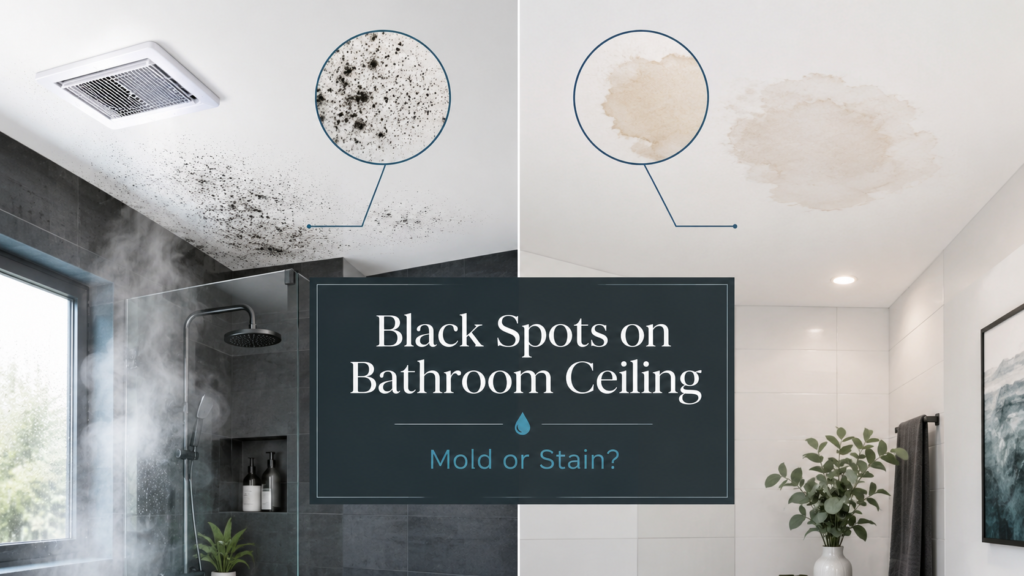
Black spots on a bathroom ceiling are usually one of three things: surface mold (most common, from humidity and poor ventilation), mildew (lighter and easier to remove), or a water stain that just looks dark. The fastest way to tell: clean a small area with diluted hydrogen peroxide. A stain becomes lighter and stays lighter. Mold may clean up but returns within days because the moisture source is still active.
Mold vs Stain — Visual and Physical Differences
| Test | Mold | Water Stain |
|---|---|---|
| Texture | Raised, slightly fuzzy or 3D | Flat, follows ceiling surface |
| Spread pattern | Radial — spreads outward in clusters | Defined edge, often ring-shaped |
| Smell | Musty, earthy | None |
| Color | Black, dark green, sometimes pink or orange | Yellow-brown, sometimes dark brown |
| After cleaning | Returns within days to weeks | Stays gone |
| Location | Above shower, near exhaust fan, corners | Anywhere — usually a defined spot |
Safety First
- For small surface areas (less than about 1 square meter or 10 square feet), homeowner cleaning is generally appropriate.
- For large areas, recurring growth despite cleaning, or growth that appears to be in the drywall rather than just on the surface, professional assessment is recommended.
- If anyone in the household has respiratory sensitivity, asthma, or a compromised immune system, talk to your doctor before cleaning mold yourself.
- Wear an N95 mask, gloves, and eye protection during cleaning.
- Ventilate the bathroom heavily — open windows and run the exhaust fan throughout.
- If the ceiling is soft, sagging, or stained beyond just the dark spots, there may be a hidden water source — see our guide on water stains with no visible leak.
Common Causes of Bathroom Ceiling Mold
| Cause | Why it leads to growth | Fix |
|---|---|---|
| Poor ventilation during showers | Humid air sits on the ceiling and condenses | Run exhaust fan during shower + 20 minutes after |
| Exhaust fan vents into attic | Moist air dumped above ceiling instead of outside | Re-route fan to exterior vent (contractor work) |
| Exhaust fan undersized or weak | Cannot move enough humid air | Replace fan with higher CFM model |
| No window or vent at all | Humidity cannot escape | Install fan or window per code |
| Cold ceiling above (poor insulation) | Warm humid air condenses on cold surface | Improve attic insulation above bathroom |
| Plumbing leak above | Constant moisture from hidden source | Find leak; see our hidden leak guide |
| Roof or flashing leak | Rain intrusion drips into ceiling | Roofer inspection |
What to Do First
- Identify whether it is mold or a stain. Use the comparison table above. The cleaning test is the most reliable indicator.
- Improve ventilation immediately. Run the exhaust fan during every shower and for 20 minutes after. If you do not have a fan, open the window during and after showering.
- Test the exhaust fan. Hold a square of toilet paper against the fan grill while it runs. It should stick. If it falls, the fan is too weak or the duct is blocked.
- Check where the fan duct ends. In the attic, follow the duct from the fan. It should terminate at a roof vent or sidewall vent — not just end in the attic.
- Clean small areas. Mix one part 3% hydrogen peroxide with one part water in a spray bottle. Spray the affected area, wait 10 minutes, gently wipe with a microfiber cloth. Avoid scrubbing into the drywall.
- Photograph and date. Take photos before cleaning, after cleaning, and at one-week intervals. This shows whether the issue is resolved or returning.
- Check the source area. Walk into the attic to inspect the area above. Look for any wet insulation, water staining on rafters, or daylight visible through the roof deck.
What Not to Do
- Do not paint over visible mold without removing and treating it first. The mold continues to grow under the paint and will reappear, often worse.
- Do not use chlorine bleach on drywall. It does not penetrate porous surfaces and can damage the drywall paper while leaving mold roots intact.
- Do not sand or scrape mold without proper protective equipment — this releases spores into the air.
- Do not assume “kitchen and bath” paint will prevent return. It only resists growth; it does not address the moisture source.
- Do not ignore recurring growth. If mold returns within days of cleaning, there is an ongoing moisture problem that needs identification.
- Do not use space heaters or hair dryers to “dry out” the ceiling. The moisture is coming from a source that needs to be addressed.
Why It Keeps Coming Back
If you clean the spots and they reappear within days or weeks, the cleaning method is not the problem — the moisture source is. Three most common reasons growth returns:
- Exhaust fan does not vent outside. The fan moves humid air a few feet into the attic, where it then condenses on the cold roof deck and drips back through the ceiling. This is more common than people realize, especially in older homes.
- Fan is too weak for the bathroom size. Building code recommends roughly 1 CFM per square foot of bathroom area. A small fan in a large bathroom cannot keep up.
- Hidden water source. A slow plumbing leak, condensation on a cold water pipe in the attic, or roof flashing failure creates ongoing moisture independent of shower steam.
The first two are improvable. The third is a separate investigation — see our detective guide for ceiling water stains.
Related Guides
- Water Stain on Ceiling but No Leak Found
- How to Document Water Damage at Home
- Kitchens, Bathrooms & Major Appliances
Safe DIY Checks
- Test the exhaust fan with a toilet paper square.
- Follow the fan duct in the attic to its termination point.
- Use the hydrogen peroxide test on a small area.
- Photograph before, after, and at weekly intervals.
- Run the bathroom fan during every shower and 20 minutes after.
- Measure humidity with a simple hygrometer — bathroom should drop below 60% within an hour of showering.
- Check above-bathroom area for water damage signs.
When to Call a Professional
Call a contractor, mold professional, or your insurance company depending on the situation:
- Affected area is larger than about 10 square feet (1 square meter).
- Mold returns within a week despite cleaning and improved ventilation.
- You suspect the moisture comes from a hidden leak.
- The drywall is soft, sagging, or crumbling.
- The exhaust fan does not vent outside and needs re-routing.
- Anyone in the household has respiratory symptoms that started or worsened with the appearance of the spots.
- Black spots appear on multiple walls or extend behind tile.
Prevention Tips
- Run the bathroom exhaust fan during every shower and for 20 minutes after — set a timer if needed.
- Keep the bathroom door open after showering if conditions allow.
- Wipe down the ceiling and walls with a microfiber cloth every few weeks during humid months.
- Use mold-resistant paint when next repainting the bathroom ceiling.
- Have the exhaust fan duct inspected during any roof or attic work.
- Consider an upgraded exhaust fan with a humidity sensor that runs automatically.
Recommended Next Step
Test the exhaust fan, then do the hydrogen peroxide cleaning on a small area. Photograph and date. If the spots stay gone for a month, improved ventilation solved it. If they return, the next step is either a fan upgrade, duct rerouting, or investigation of a hidden moisture source. For large areas or recurring growth, professional assessment is the right call.
Frequently Asked Questions
Is bathroom ceiling mold dangerous?
This guide does not provide medical advice. Surface mold in bathrooms is common and generally manageable with cleaning and improved ventilation. If anyone in the home has respiratory symptoms, asthma, allergies, or a weakened immune system, consult your doctor about exposure and the right approach.
Why does the mold come back even after I scrub?
Almost always because the moisture source is still active. The exhaust fan may be too weak, may not vent outside, or there may be a hidden leak. Cleaning treats the symptom; reducing humidity treats the cause.
Can I just paint over the spots?
Not effectively. Paint over visible growth seals it temporarily but the mold continues underneath and will return through the paint, usually faster than before. Remove and treat first, then repaint with mold-resistant paint.
How do I know if my exhaust fan vents outside?
The most reliable check is in the attic. Find the fan from below, then locate the duct from the top side. Follow it to where it ends. It should terminate at a vent on the roof or through a sidewall — not just open into the attic space. If it ends in the attic, it is venting humid air directly into your roof structure.
What humidity level should a bathroom be at?
A small handheld hygrometer can tell you. Bathroom humidity will spike during showers — that is normal. The important question is how fast it drops afterward. With good ventilation, humidity should return to under 60% within an hour. If it stays elevated for hours, ventilation needs improvement.