
What This Guide Helps With
This guide helps homeowners read foundation cracks by width, direction, and pattern. It explains which cracks are likely cosmetic, which deserve monitoring, and which warrant urgent professional assessment by a structural engineer.
Quick Answer
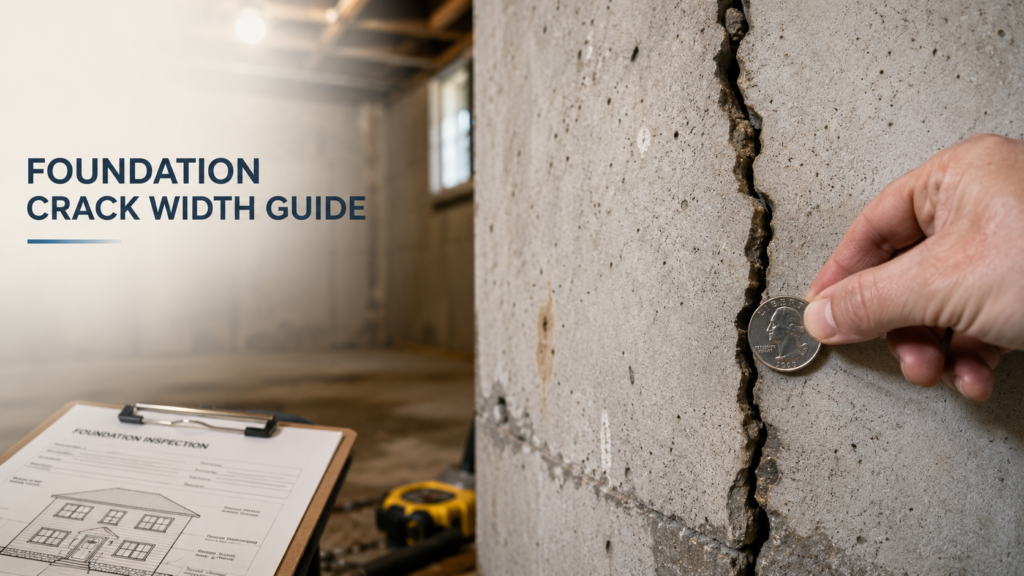
Hairline cracks thinner than the edge of a US quarter (about 1/16 inch / 1.6 mm) and running vertically are usually concrete shrinkage and cosmetic. Horizontal cracks of any width, diagonal cracks wider than 1/8 inch (3 mm), and any actively expanding crack should be assessed by a structural engineer — not a basement waterproofing contractor.
Width Reference You Can Use Right Now
You do not need special tools. Common coins and bills are your reference.
| Reference object | Approximate width | What this width means |
|---|---|---|
| Edge of a sheet of paper | About 1/100 inch | Hairline — usually cosmetic shrinkage |
| Edge of a US quarter | About 1/16 inch / 1.6 mm | Threshold for monitoring |
| Two stacked quarters / edge of a dime | About 1/8 inch / 3 mm | Get professional assessment |
| Edge of a credit card laid flat | About 1/16 inch | Same as quarter edge |
| A pencil width | About 1/4 inch / 6 mm | Urgent professional assessment |
The Crack Decision Chart
| Direction | Width | Likely cause | Action |
|---|---|---|---|
| Vertical | Less than 1/16 inch | Concrete shrinkage as it cures | Monitor and seal cosmetically |
| Vertical | 1/16 to 1/8 inch | Minor settling, common in homes 5+ years old | Monitor monthly; seal if you see water seepage |
| Vertical | Wider than 1/8 inch | Significant settling or movement | Structural engineer assessment |
| Horizontal | Any width | Lateral pressure from soil or hydrostatic pressure | Structural engineer urgently — do not wait |
| Diagonal (45 degrees) | Less than 1/8 inch | Differential settling | Monitor; engineer if expanding |
| Diagonal | Wider than 1/8 inch | Active differential settling | Structural engineer assessment |
| Stair-step (in brick or block) | Any width | Foundation movement under wall | Structural engineer assessment |
| Any crack actively expanding | Any width | Active foundation movement | Urgent professional assessment |
Safety First
- If you see a horizontal crack with the wall bowing inward, treat this as urgent and avoid the area below or beside the wall. This is a sign of lateral pressure that can fail.
- Doors and windows that suddenly stick, gaps appearing around door frames, or floors that have noticeably sloped are red flags requiring professional assessment.
- Do not attempt to “fix” a structural crack with caulk or hydraulic cement. This hides movement signs and does not address the cause.
- If a crack is allowing active water entry during rain or as basement flooding begins, prioritize the water response first, then assess the crack.
- Structural assessment is the engineer’s job — not a basement waterproofing contractor’s. Waterproofing addresses water; engineers address structure.
What to Do First
- Measure the width. Use coins as reference. Take a photo with the coin next to the crack at multiple points along its length.
- Note the direction. Vertical, horizontal, diagonal, or stair-step. Each has a different meaning.
- Mark the end points. Use a pencil to make a small tick at each end of the visible crack. Write today’s date next to one tick.
- Photograph the whole crack. Wide-angle plus close-ups. Include the marks and the coin reference.
- Check both sides of the wall. A foundation crack typically appears on both the interior and exterior. Inspect from both sides where possible.
- Check for water entry. Is the crack dry or actively seeping? Touch with a tissue. Wet during rain only? Wet always?
- Walk the rest of the basement. Are there other cracks? Note all of them with the same documentation.
- Re-measure monthly. A stable crack that does not extend or widen over 3 to 6 months is much less concerning than one that is moving.
Red Flags That Mean Call Now
Any of these warrant immediate structural engineer assessment, not a wait-and-see approach:
- Horizontal crack across a foundation wall, especially with any wall bowing
- Crack wider than 1/4 inch (pencil width)
- Stair-step crack pattern in brick or block walls
- Crack that has visibly widened since you last looked
- Floor slope changes or new sagging
- Doors and windows that suddenly stick or no longer close properly
- New gaps between walls and ceiling, or wall and floor
- Crack with daylight visible through it from inside
- Active water entry through the crack
What Not to Do
- Do not fill or seal an actively moving crack. You need to be able to see the movement.
- Do not hire a contractor without an engineer’s assessment for any crack that meets the red flag criteria.
- Do not ignore stair-step cracks because “they look like just bricks.” These are foundation movement signs.
- Do not assume a horizontal crack is OK because it is small. Horizontal cracks of any width indicate lateral pressure and are more serious than vertical cracks several times wider.
- Do not let basement waterproofing companies sell you structural fixes. Their scope is water management. A structural engineer is a different professional.
Related Guides
- What to Do If Your Basement Floods
- How to Document Water Damage at Home
- Roof, Exterior & Structural Systems
Safe DIY Monitoring
- Photograph monthly with date and coin reference.
- Mark crack ends with pencil — extension beyond these marks indicates movement.
- Note any change in width using the coin chart.
- Watch for new cracks elsewhere in the basement.
- Inspect doors and windows quarterly — sticking is a sign of foundation movement.
- Check for water seepage during heavy rain.
- Maintain a simple log: date, crack width, water status, other observations.
When to Call a Structural Engineer
Call a licensed structural engineer if:
- Any crack matches the red flag criteria above.
- Multiple cracks have appeared on the same wall or in a short timeframe.
- You see horizontal cracking, especially with wall bowing.
- Doors or windows have started sticking.
- Floors have visibly sloped or have new soft spots.
- A previously stable crack is now widening or extending.
- You are buying or selling the home and want professional documentation.
A structural engineer’s assessment is typically a flat fee for a site visit and written report. This report is what tells you whether you need repair, monitoring, or no action — and is what a contractor would use to scope any actual work.
About Foundation Movement Causes
Foundation movement comes from a few common sources:
- Soil moisture changes. Expansive clay soils swell when wet and shrink when dry, pressing against and pulling away from foundations.
- Hydrostatic pressure. Water in saturated soil creates lateral pressure on basement walls, especially after heavy rain or in poorly drained sites.
- Tree root activity. Large trees near the foundation can pull moisture from soil and cause settling.
- Poor original construction. Insufficient footing depth, inadequate reinforcement, or improper backfill.
- Age and natural settling. Some settling is normal in any home and produces small cracks.
Understanding the cause matters because the same crack can mean different things in different soil and water conditions.
Prevention Tips
- Direct downspouts at least 6 to 10 feet away from the foundation.
- Maintain proper grading — soil should slope away from the home at about 1 inch per foot for the first 10 feet.
- Keep large trees a reasonable distance from foundations.
- Address water management issues promptly — see our sump pump troubleshooting guide.
- Inspect the perimeter foundation annually, including a walk inside the basement.
- Photograph any new cracks and date them — early detection allows monitoring before they become serious.
Recommended Next Step
Measure and document the crack today with a coin photo and pencil marks. If it falls in the cosmetic category and is not actively moving, schedule a monthly re-check. If it falls in the assessment category, contact a structural engineer for a site visit and report. Do not start with a contractor — the engineer’s report is what guides any repair scope.
Frequently Asked Questions
Are cracks in new homes normal?
Yes. Concrete shrinks as it cures, and almost every poured foundation develops some hairline vertical cracks within the first 1 to 3 years. These are cosmetic. The concern is cracks that appear later, are wider than 1/16 inch, run horizontally, or are actively expanding.
Should I fix small cracks or leave them alone?
A confirmed-stable hairline vertical crack can be sealed with a flexible polyurethane or epoxy injection for cosmetic and water-resistance reasons. This is a homeowner-friendly fix for cosmetic cracks. Do not seal cracks you have not yet documented or that meet any red flag criteria.
How much does a structural engineer assessment cost?
Costs vary by region. A typical assessment includes a site visit, measurements, and a written report. This is an essential investment before any major foundation work — and is usually a small fraction of any actual repair cost.
Why a structural engineer instead of a foundation contractor?
Contractors fix what they identify, and they have a financial interest in the work. An engineer is paid for the assessment regardless and is professionally licensed to make structural judgments. The engineer’s report is independent and tells you what is actually needed.
Can a crack appear suddenly and not be serious?
Sudden cracks generally deserve attention even if they look small. A new crack that did not exist a month ago, especially one that runs horizontally or diagonally, is worth professional assessment. Cosmetic shrinkage cracks develop slowly over months; structural cracks can appear in days.