
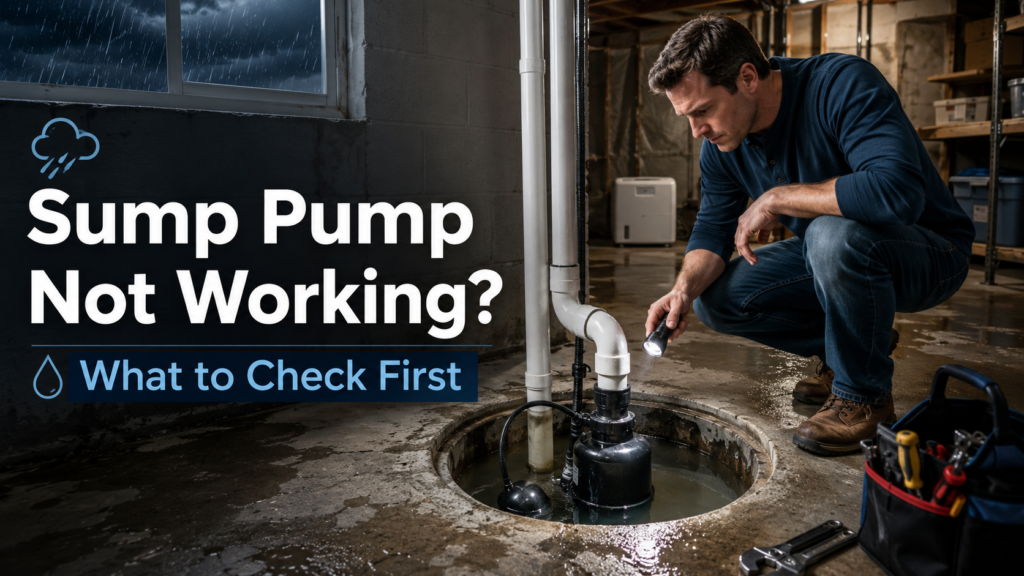
What This Guide Helps With
This guide explains what to check when your sump pump is not running, not moving water, or running constantly without clearing the pit. It covers safe checks homeowners can do, and when to call a plumber — particularly before heavy rain when a working sump pump is critical.
Quick Answer
If your sump pump is not working, first check the power — plug the pump directly into a working outlet to rule out a tripped GFCI or failed outlet. Check that the float switch moves freely and is not stuck against the pit wall. Pour water slowly into the pit to test if the pump activates. If the pump still does not run or run effectively, call a plumber, especially if rain is expected.
Safety First
- Do not put your hands in the sump pit while the pump is plugged in.
- Unplug the pump before handling it, adjusting the float, or inspecting the discharge line.
- If the basement has standing water, check for electrical hazards before entering the area near the pump.
- Do not run a gas-powered pump or generator inside the home or garage — carbon monoxide risk.
What to Do First
- Check the power first. Press the reset button on any GFCI outlet in the basement. Also check the circuit breaker for the outlet the pump is plugged into.
- Plug the pump directly into a different working outlet using a heavy-duty extension cord. If the pump runs when plugged into a different outlet, the original outlet is the problem.
- Check the float switch. Unplug the pump, reach in carefully, and lift the float by hand — it should move freely. If it is wedged against the pit wall, that is why the pump is not triggering.
- Test the pump with water. With the pump plugged in and float clear, slowly pour 5 gallons of water into the pit. The float should rise and trigger the pump.
- Check the discharge line outside the home. The pipe where water exits should be clear of ice, debris, or kinks.
- Listen for the pump running but not moving water. If you hear the motor but the pit is not draining, the impeller may be jammed or the check valve may be faulty.
- Call a plumber if the pump still does not activate, runs but does not drain, or if rain is approaching.
What Not to Do
- Do not reach into the pit while the pump is plugged in.
- Do not ignore a non-working pump before a rain event.
- Do not run the pump dry for extended periods — this can burn out the motor.
Common Causes of Sump Pump Failure
| Symptom | Likely cause | What to check |
|---|---|---|
| Pump does not turn on at all | No power, tripped GFCI, stuck float | Check outlet, reset GFCI, free the float |
| Pump runs but water does not go down | Blocked discharge line, failed check valve, jammed impeller | Inspect discharge pipe; call plumber for internal issues |
| Pump runs constantly but pit never drains | Float stuck in on position, very high water table, undersized pump | Check float position; call plumber |
| Power outage during rain | No electricity to run pump | Battery backup or water-powered backup pump |
| Pump making grinding or loud noise | Debris in impeller, bearing failure | Unplug, inspect impeller for debris; replacement likely needed |
Safe DIY Checks
- Press the reset button on GFCI outlets in the basement.
- Check the circuit breaker for the sump pump outlet.
- Unplug the pump and look into the pit with a flashlight — is the float jammed against the wall?
- Pour water into the pit and watch for activation (with pump plugged in and float free).
- Go outside and look at the end of the discharge pipe — is it blocked by debris, ice, or kinking?
When to Call a Plumber
Call a licensed plumber if:
- The pump does not activate after power and float checks.
- The pump runs but water in the pit is not decreasing.
- You hear unusual sounds from the pump motor.
- The pump is more than 7 to 10 years old and showing signs of wear.
- Heavy rain is expected within 24 hours and the pump cannot be confirmed working.
- You find that the discharge line is broken, frozen, or disconnected.
Prevention Tips
- Test your sump pump every spring before rain season by pouring water into the pit.
- Install a battery backup sump pump — it runs during power outages.
- Clean debris from the pit annually.
- Make sure the discharge line empties at least 6 to 10 feet from the foundation.
- Know the age of your pump — budget for replacement around the 7 to 10 year mark.
Recommended Next Step
If you confirmed the pump works after basic checks, schedule a proper fix for any failing outlet or float issue soon. If the pump still does not work after safe checks, or if rain is approaching, call a plumber today.
Related Guides
Frequently Asked Questions
How often should a sump pump run?
This varies based on your local water table, season, and rainfall. Running every few minutes during a heavy storm can be normal. Running constantly on a dry day is not — it usually means the float is stuck or the pump is undersized.
How long do sump pumps last?
Most submersible sump pumps last 7 to 10 years. If yours is approaching this age, consider proactive replacement rather than waiting for failure during a storm.
Is a battery backup sump pump worth it?
Yes, for most homes with active basements and regular rain. Power outages frequently accompany severe storms — exactly when you need the pump most.
What is the check valve and why does it matter?
The check valve is a one-way valve installed on the discharge pipe. It prevents water that has already been pumped out from flowing back into the pit. If the check valve fails, the pump re-pumps the same water repeatedly and wears out faster. A plumber can replace a faulty check valve.