
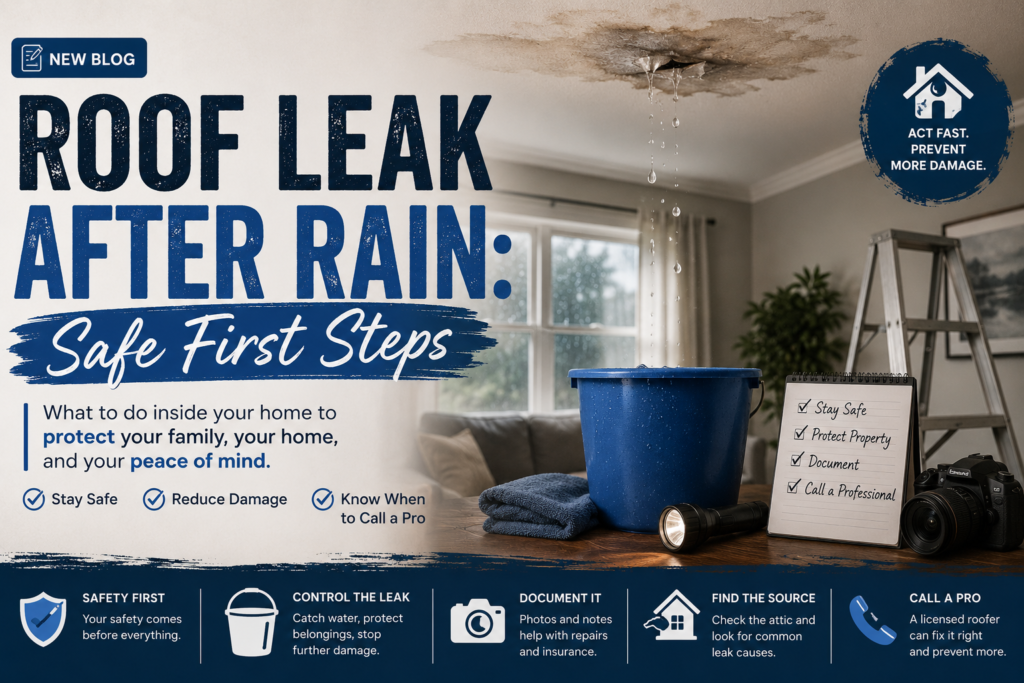
What This Guide Helps With
This guide explains what to do inside your home when your roof is leaking during or after rain. It covers safe immediate steps to reduce damage, what to avoid, how to locate the likely source, and when to call a licensed roofing professional.
Quick Answer
If your roof is actively leaking, move valuables and furniture out of the drip area, place buckets to catch water, and relieve a bulging ceiling bubble with a single puncture before it collapses. Document everything with photos before moving items. Do not climb onto a wet or damaged roof. Call a licensed roofer to inspect and repair the source once conditions are safe.
Safety First
- Do not climb onto a wet, sloped, icy, or visibly damaged roof. Inspect from the ground or through the attic if it is safe to access.
- If a ceiling area is sagging or bulging heavily, stay out of that room — a saturated ceiling section can collapse without warning.
- Keep away from water dripping near light fixtures, outlets, or ceiling fans. Turn off power to the affected room at the breaker if water is near electrical fixtures.
What to Do First
- Protect the room below. Move furniture, rugs, electronics, and valuables away from the drip area. Cover large items you cannot move with plastic sheeting.
- Place buckets or containers to catch drips. Line the floor with towels to catch overflow.
- Address a bulging ceiling. If you see a bubble forming in the ceiling drywall, use a small tool to make a single puncture at the lowest point of the bulge. This controls where the water releases rather than letting the entire section collapse at once.
- Turn off power to the room if water is dripping near light fixtures, ceiling fans, or outlets.
- Document immediately. Take photos and video before moving anything — wide shots of the room, close-ups of drip locations, and any visible ceiling damage.
- Check the attic if it is safe to do so. Look for active dripping, wet insulation, or watermarks on rafters and sheathing.
- Call a licensed roofer as soon as it is safe to inspect from outside.
What Not to Do
- Do not climb onto a wet roof without proper safety equipment and experience.
- Do not ignore a ceiling stain — even after rain stops, water behind drywall continues to spread and can cause mold within 24 to 48 hours.
- Do not apply roofing sealant from the ground — this rarely addresses the actual entry point and may delay proper repair.
- Do not ignore electrical fixtures that have been dripped on — have them inspected by an electrician before restoring power.
Common Causes of Roof Leaks After Rain
| Cause | Signs to look for | What to do |
|---|---|---|
| Damaged or missing shingles | Visible curled, cracked, or absent shingles from ground | Call a roofer to inspect and replace |
| Flashing failure | Leak near chimney, skylight, vents, or roof valleys | Common repair; roofer can reseal or replace flashing |
| Clogged or overflowing gutters | Water backing up at eaves, ice dam in winter | Clear gutters; check downspout flow |
| Damaged vent boot | Leak near a plumbing or HVAC vent pipe | Roofer replaces the rubber boot around the pipe |
| Ridge cap damage | Leak along the peak of the roof | Call a roofer; ridge caps wear with age |
| Attic condensation | Dripping in attic without visible exterior damage | May be ventilation issue; HVAC or roofer can assess |
Safe DIY Checks
- Walk around your home from the ground and look for missing shingles, lifted shingle edges, or visible damage.
- Check your gutters from the ground — are they overflowing, separated from the roofline, or full of debris?
- If you can access your attic safely, look for wet rafters, wet insulation, daylight coming through sheathing, or watermarks.
- Check around skylights, chimneys, and roof vents from inside the attic — these are the most common flashing failure points.
When to Call a Roofing Professional
Call a licensed roofer if:
- You see active dripping during or after rain.
- There are ceiling stains that are spreading or returning.
- Attic insulation is wet or visibly compressed from moisture.
- You can see missing, lifted, or cracked shingles from the ground.
- Flashing around a chimney, skylight, or vent is visibly separated or corroded.
- The roof is more than 20 years old and has not been professionally inspected recently.
Damage Documentation Checklist
- ☐ Wide photos of the affected room showing water extent
- ☐ Close-up photos of ceiling stains, drip points, and any collapsed or bulging areas
- ☐ Photos of visible exterior damage from the ground
- ☐ Photos of wet attic insulation or rafters if accessible
- ☐ Record the date, time, and weather conditions during the leak
- ☐ Save receipts for buckets, tarps, water removal, and professional assessments
Prevention Tips
- Clean gutters at least twice a year — spring and fall.
- Have your roof professionally inspected every 5 years, or after any major storm.
- Trim tree branches that overhang the roof.
- Check attic ventilation — poor ventilation leads to moisture buildup and premature shingle deterioration.
Recommended Next Step
Once the immediate dripping has been controlled and the interior is protected, call a licensed roofer for an exterior inspection. Do not delay — even a small entry point grows quickly when the next rain comes.
Related Guides
- How to Document Water Damage at Home
- What to Do If Your Basement Floods
- Roof, Exterior & Structural Systems
Frequently Asked Questions
Why is the leak inside the house not directly under the roof damage?
Water entering through the roof often travels along rafters, sheathing, or insulation before dripping down. The drip location inside can be several feet away from where water entered. A roofer or an attic inspection can trace the actual entry point more accurately.
Can I use roofing tape or sealant as a temporary fix?
Roofing tape and sealant can sometimes slow an active leak temporarily, but these are not permanent solutions and can make proper repairs harder if applied incorrectly.
How long does it take for mold to grow after a roof leak?
Mold can begin developing within 24 to 48 hours in wet, warm attic or wall cavities. Drying the affected area quickly and repairing the leak promptly reduces mold risk significantly.
Does a brown ceiling stain always mean an active leak?
Not necessarily. An old stain from a past leak may leave permanent discoloration. However, a stain that appears after recent rain, grows in size, or has a soft or bubbling texture is likely from an active leak. Have a roofer inspect if it returns or grows.