
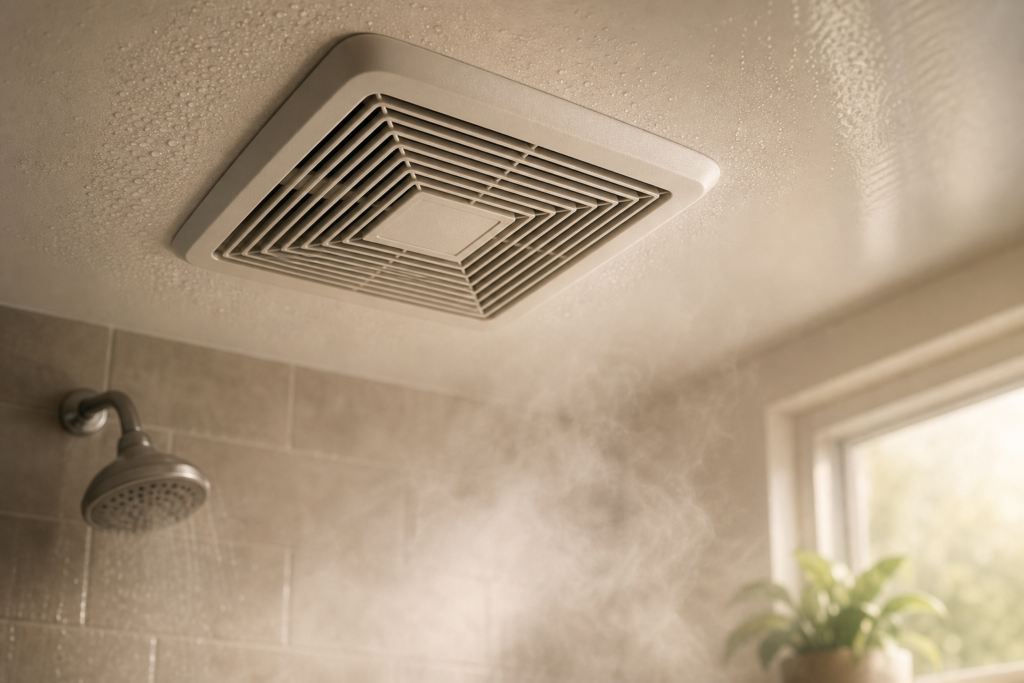
Steamy mirrors that won’t clear, a musty smell that lingers, or paint starting to peel near the ceiling are all signs your bathroom exhaust fan isn’t doing its actual job — moving humid air out of the room. A fan that’s spinning and making noise can still be moving almost no air, which is why “the fan turns on” and “the fan works” are two different things.
Is the Fan Actually Moving Air? A 10-Second Test
Before troubleshooting causes, confirm there’s actually a problem with airflow rather than just a slow-clearing room. Hold a single square of toilet paper or a tissue up to the fan grille while it’s running — a properly functioning fan should hold the tissue against the grille through suction. If the tissue barely moves or falls, the fan isn’t pulling meaningful airflow even though it’s running.
Common Causes of Weak or No Airflow
| Cause | Why It Happens | Fix Difficulty |
|---|---|---|
| Dust and lint buildup in the fan housing | Fans pull in bathroom dust and lint over time, clogging the intake and blades | Easy — DIY cleaning |
| Clogged or crushed exhaust ductwork | Flexible ducting can sag, kink, or get crushed in the attic, blocking airflow even with a clean fan | Moderate — may need attic access |
| Undersized fan for the room | A fan rated below the bathroom’s square footage simply can’t move enough air, no matter how clean it is | Harder — may require a fan upgrade |
| Worn-out motor | Fan motors lose power output as they age, especially past 10 years of daily use | Moderate — motor or full fan replacement |
| Blocked exterior exhaust vent | The outside vent cap can get clogged with debris, nested by insects, or have a stuck flap | Easy to moderate — exterior inspection |
Cleaning the Fan — What Most People Skip
Most bathroom fans are rarely cleaned because the grille looks fine from below even when the housing above is packed with dust. A proper cleaning:
- Turn off power to the fan at the breaker, not just the wall switch, before opening anything.
- Remove the grille cover — most simply pull down or unclip, some have small screws or spring clips.
- Vacuum visible dust from the housing and fan blades using a brush attachment, then wipe blades with a damp cloth if grime is caked on.
- Check the grille itself for a dust film, which alone can meaningfully reduce airflow — wash it in warm soapy water and let it fully dry before reinstalling.
- While it’s open, look for obvious duct disconnection at the fan housing — sometimes flexible ducting simply comes loose from the fan’s exhaust port.
If cleaning noticeably improves airflow on the tissue test, that was likely the whole problem. If airflow is still weak after a thorough cleaning, the issue is more likely ductwork, an undersized fan, or a failing motor.
Checking the Exhaust Path Beyond the Fan
A clean fan with a blocked or damaged duct run will still move very little air. If you have attic access, a visual check of the ducting from the fan to the exterior vent can reveal sagging sections that trap condensation, sharp kinks from insulation being packed against it, or full disconnection at a joint. The exterior vent cap is worth checking too — from outside, confirm the flap opens when the fan runs and isn’t blocked by debris, a bird or insect nest, or paint sealing it shut from a previous exterior paint job.
When to Replace Instead of Repair
Replacement usually makes more sense than repair when the fan is over 10–15 years old (motor efficiency and noise both degrade with age), when it’s clearly undersized for the room, or when the motor itself has failed rather than just being dirty. When choosing a replacement, fan capacity is measured in CFM (cubic feet per minute) — a widely used sizing guideline is roughly 1 CFM per square foot of bathroom floor area, with an added allowance for high-humidity features like a large soaking tub or a walk-in shower with multiple heads. Undersizing a replacement fan reproduces the same weak-airflow problem in a brand-new unit.