An outdoor outlet that worked fine before a rainstorm and stopped afterward isn’t a coincidence — outdoor outlets are specifically designed with moisture protection built in, and when that protection does its job, the outlet is supposed to shut off power rather than let water and electricity mix. The good news is this is usually a simple, safe fix you can do yourself in a couple of minutes.
Why This Almost Always Points to a Tripped GFCI
Nearly all outdoor outlets in North America are required to be GFCI-protected (Ground Fault Circuit Interrupter) — a safety device that instantly cuts power if it detects even a tiny imbalance in current, which can happen when moisture creates a path for electricity to leak to ground. This is exactly the scenario a rainstorm creates: water intrusion, even a small amount, is a very common GFCI trip trigger, and the outlet losing power afterward is the safety feature working correctly, not a failure.
Step 1: Find the GFCI Outlet or Breaker Controlling It
Outdoor outlets are sometimes protected by a GFCI outlet elsewhere on the same circuit rather than at the outlet itself — commonly in a garage, basement, or another outdoor outlet nearby. Look for an outlet with “TEST” and “RESET” buttons; that’s the GFCI protecting the circuit. If you can’t find one, check your electrical panel for a GFCI breaker (it will have its own small test button on the breaker itself) instead.
- Press the “RESET” button firmly on the GFCI outlet — you should hear or feel a distinct click.
- If the outlet doesn’t have a visible GFCI, check your panel for a GFCI breaker and press its reset button the same way.
- Test the outlet with a lamp, phone charger, or outlet tester to confirm power is restored.
If Reset Doesn’t Work or It Trips Again Immediately
A GFCI that won’t reset, or that resets and trips again right away, points to an active problem rather than a one-time moisture trip:
| Symptom | Likely Cause | What to Do |
|---|---|---|
| Won’t reset at all | Water actively inside the outlet or box, or a failed GFCI device | Check if the outlet cover is damaged/missing; dry out visible moisture; don’t force it |
| Resets, then trips again within seconds | Active ground fault — moisture still present, or a wiring fault | Leave off and call an electrician; this isn’t a DIY fix |
| Resets fine but trips again next time it rains | Damaged or missing weatherproof cover (“in-use” cover) | Inspect and replace the outdoor cover — this is the most common repeat-trip cause |
| Outlet looks physically damaged, cracked, or discolored | Water damage to the outlet itself over time | Do not use; needs replacement by an electrician |
Check the Weatherproof Cover — The Most Common Repeat Offender
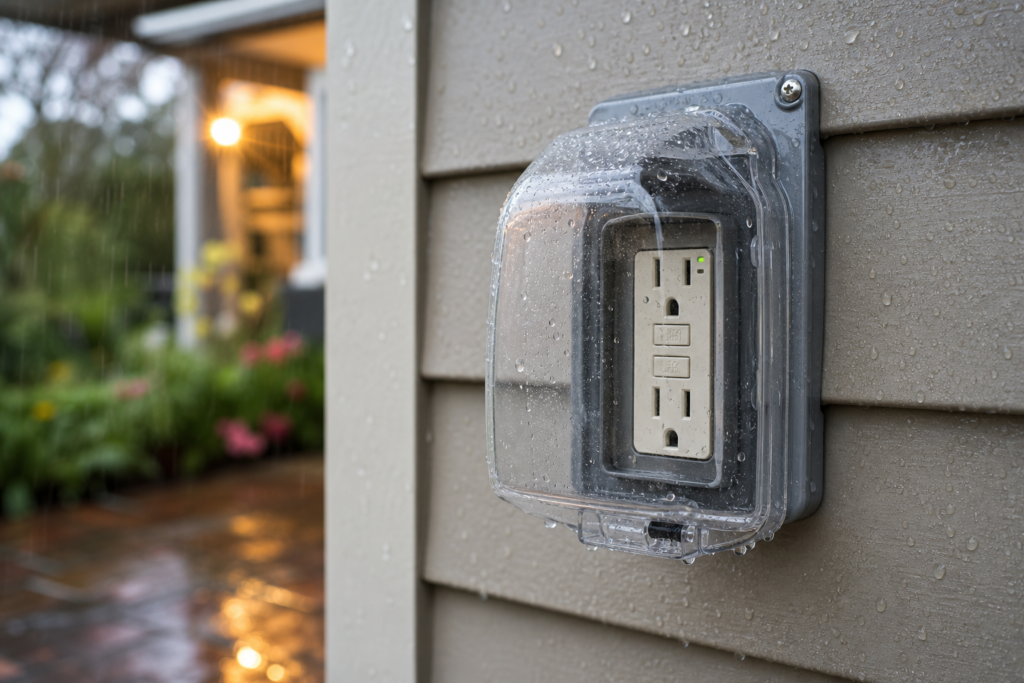
Outdoor outlets are required to have an “in-use” weatherproof cover — the kind with a hinged, bubble-shaped lid that stays closed over whatever’s plugged in, keeping rain off the connection even while something is plugged in and running. If your outlet only has a simple flip-up cover that has to stay open when something’s plugged in, or if the cover is cracked, warped, or missing its gasket, rain has a direct path to the outlet during every storm — which explains a pattern of repeated trips specifically during or after rain rather than a one-time issue.
Replacing a damaged or outdated cover with a proper in-use weatherproof cover is an inexpensive fix that often permanently resolves recurring rain-related trips, and it’s a straightforward swap most homeowners can do themselves with the power off at the breaker.
When to Call an Electrician
Call a licensed electrician if the GFCI won’t reset after the outlet has had time to dry out, if it trips again within seconds of resetting, if you see visible damage or discoloration on the outlet or wiring, or if this is a new, unexplained pattern on an outlet that’s never had issues before. Repeatedly forcing a reset on an outlet with an actual fault — rather than a simple moisture trip — risks shock and fire, and a GFCI that won’t hold a reset is doing exactly what it’s designed to do: refusing to send power through a compromised connection.