
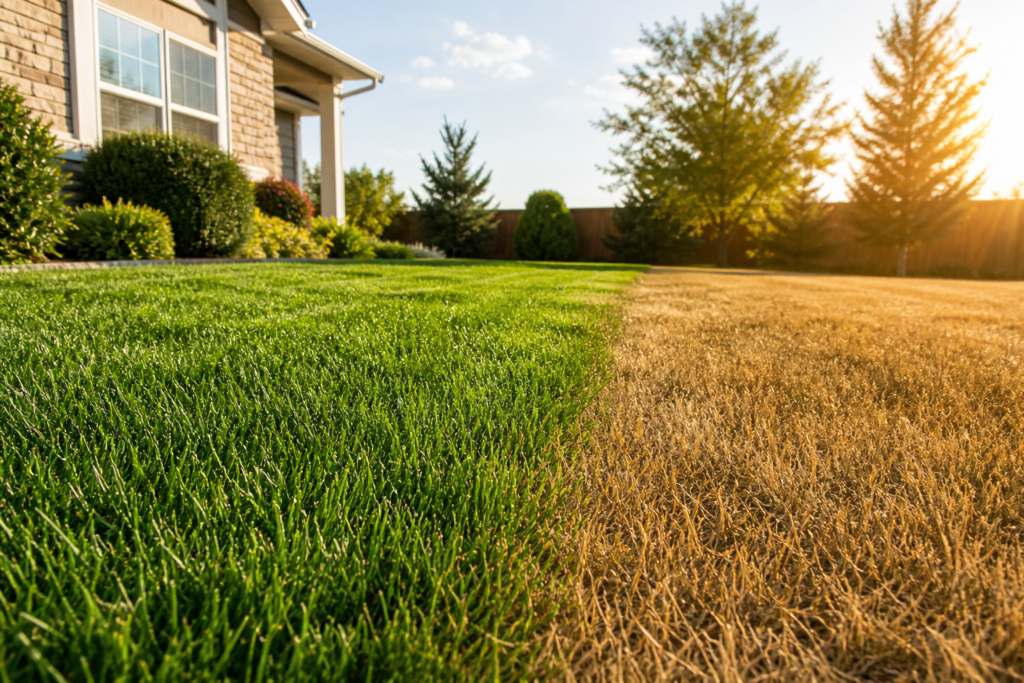
A lawn that was green a few weeks ago turning patchy brown in peak summer heat is one of the most common yard complaints — and one of the easiest to misdiagnose, because heat stress, underwatering, disease, and pests can all produce a similar-looking brown patch. Figuring out which one you’re dealing with changes what actually fixes it.
Heat and Drought Stress: The Most Common Cause
Most cool-season and warm-season grasses go semi-dormant under prolonged heat and low water — this is actually a survival mechanism, not necessarily dead grass. Drought-stressed lawns typically brown fairly uniformly across sunnier areas first, with shadier spots staying greener longer, and the grass blades themselves often look wilted or grayish before fully browning rather than showing distinct spotty patches.
The footprint test is a simple way to check: walk across the lawn and look back — if your footprints stay visibly pressed into the grass instead of springing back up within a few minutes, the grass is dehydrated and needs water. Grass in this state usually recovers within one to two weeks once watering resumes, since dormancy isn’t the same as dying, provided the stress hasn’t gone on for many weeks.
Watering the Right Way in Summer Heat
Counterintuitively, more frequent shallow watering is worse than less frequent deep watering. Frequent light watering encourages roots to stay near the surface, which makes the lawn more vulnerable to the next hot, dry stretch. The generally recommended approach:
- Water deeply 1–2 times per week rather than lightly every day, aiming for roughly an inch of water per session (a simple way to check: place a shallow container on the lawn while watering and time how long it takes to collect about an inch).
- Water early morning rather than midday or evening — morning watering reduces evaporation loss and gives grass blades time to dry before nightfall, which also helps prevent fungal disease.
- Avoid watering during the hottest part of the day, when much of the water simply evaporates before soaking in.
Is It Heat Stress or Something Else? A Comparison
| Pattern | Likely Cause | Key Clue |
|---|---|---|
| Uniform browning, sunnier areas first, blades wilted | Heat/drought stress | Footprints stay pressed in; recovers with consistent watering |
| Circular or irregular brown patches with defined edges | Fungal disease (brown patch, dollar spot) | Patches often have a darker or reddish ring around the edge |
| Small, scattered dead patches that pull up easily like loose carpet | Grub damage (roots eaten) | Grass lifts up in chunks with little resistance; you may see grubs underneath |
| Yellow/brown streaks or spots near a specific structure | Pet urine or chemical spill damage | Localized to specific spots, often with a darker green ring around a dead center |
| Browning in a consistent pattern following a slope or low area | Compacted soil or drainage issue | Grass in the same spots struggles every summer, not just this year |
What Not to Do When a Lawn Is Heat-Stressed
A few common instincts actually make heat-stressed grass worse rather than better:
- Don’t fertilize a heat-stressed lawn. Fertilizer pushes new growth, which requires more water the grass can’t spare during heat stress — wait for cooler temperatures.
- Don’t mow too short. Cutting grass shorter than about 3 inches (for most common lawn species) removes shade the grass provides its own roots and soil, increasing water loss. Raising your mower deck in summer is one of the simplest effective changes.
- Don’t panic and overwater. Soggy soil on top of heat stress can encourage fungal disease, turning a recoverable dormancy into an actual disease problem.
When Brown Grass Won’t Recover
If a section stays brown and doesn’t green up within a couple of weeks after consistent deep watering resumes, especially if the grass pulls up easily or shows the ring patterns described above, the cause is likely something other than simple heat stress — grub damage, fungal disease, or an underlying soil/drainage issue that heat just exposed. At that point, a soil test or a closer inspection (digging up a small dead patch to check the roots and look for grubs) will tell you more than continuing to water and wait.