
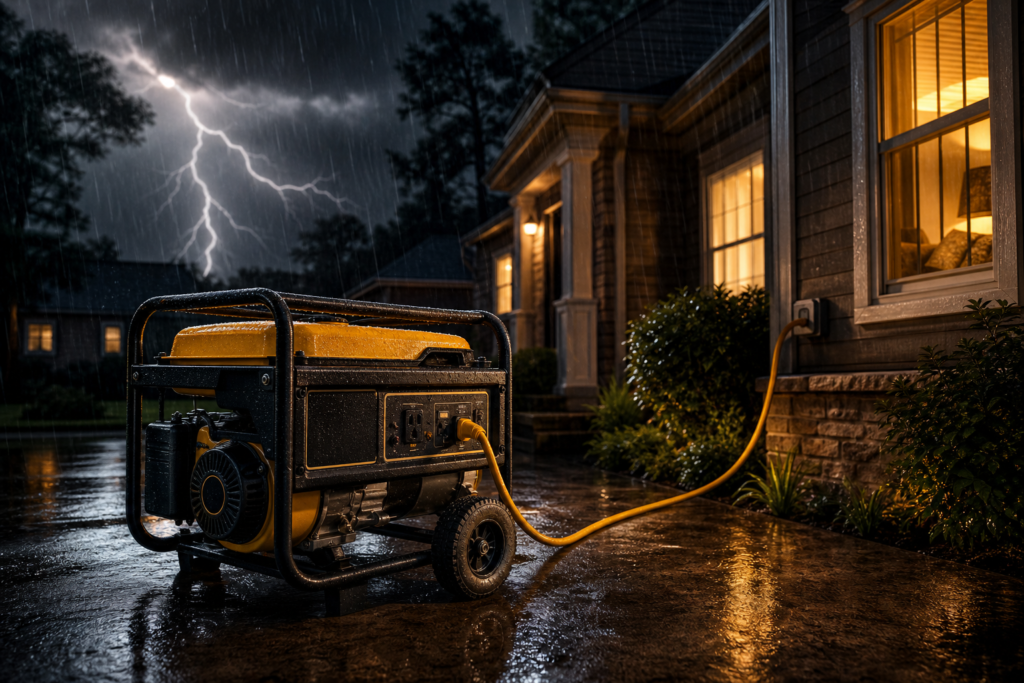
The moment the power goes out is exactly when you need your backup generator to work — and it’s also exactly when a generator that hasn’t been exercised in months decides to fail. Most no-start problems trace back to a small handful of causes, nearly all of which you can check yourself before assuming the unit needs a repair technician.
Check Fuel First — Even If You Think There’s Enough
Fuel issues are the single most common reason a generator won’t start, and not just “empty tank.” For gasoline units, fuel that’s sat for more than a month or two can go stale — gasoline degrades and separates over time, especially without a stabilizer added, and stale fuel won’t combust properly even though the tank isn’t empty. For propane or natural gas units, check that the supply valve is fully open and, for propane, that the tank isn’t actually empty or critically low, since gauges on smaller tanks can be misleading near the bottom.
If you suspect stale gasoline, the fix is draining the old fuel and refilling with fresh gas — running a generator on degraded fuel can also gum up the carburetor, turning a fuel problem into a bigger repair.
Battery and Starting System Checks
Most standby and larger portable generators start electrically, using a small battery similar in concept to a car battery — and like a car battery, it drains over time if the generator sits unused, especially in cold weather. Signs the battery is the issue: the engine cranks slowly or not at all, you hear a single click instead of continuous cranking, or there’s no response at all when you try to start it.
- Check the battery terminals for corrosion — a white or greenish crust on the terminals is a very common, easily fixable cause of no-start issues.
- If your generator has a battery maintainer or trickle charger, confirm it’s plugged in and functioning between uses.
- For portable generators with a pull-start backup, try that method if the electric start fails — this can tell you whether the issue is the battery/starter or something else in the engine.
Automatic Transfer Switch Issues (Standby Generators)
If you have a standby (permanently installed) generator that’s supposed to start automatically during an outage but doesn’t, the problem is sometimes not the generator itself but the automatic transfer switch (ATS) — the component that detects the outage and signals the generator to start. Check whether the ATS is set to “Auto” mode rather than “Manual” or “Off,” since this setting can occasionally get changed accidentally. If the switch is correctly set to Auto and the generator still doesn’t respond, this points toward a controller or sensor issue that generally requires a qualified technician, since ATS troubleshooting involves live electrical connections.
Quick Diagnostic Table by Symptom
| Symptom | Likely Cause | What to Try |
|---|---|---|
| Engine won’t crank at all, no sound | Dead battery, loose connection, or blown fuse | Check battery terminals and connections; check control panel fuse |
| Engine cranks slowly | Weak or partially discharged battery | Charge or test the battery; check for corrosion |
| Engine cranks but won’t catch | Stale fuel, closed fuel valve, clogged fuel filter | Check fuel valve position, fuel age, and filter condition |
| Standby unit doesn’t auto-start during an outage | ATS not set to Auto, or ATS/controller fault | Verify Auto setting; call a technician if it’s already set correctly |
| Starts, then stalls quickly | Low oil shutoff triggered, or fuel delivery issue | Check oil level first — most units won’t run below the minimum |
The Maintenance Habit That Prevents Most of This
The single biggest reason generators fail exactly when needed is that they only get tested during an actual emergency. Most manufacturers recommend running a portable generator for 15–30 minutes every month under a light load, and standby generators typically self-test on a weekly schedule if configured correctly — check your unit’s manual to confirm this feature is enabled, since it’s sometimes turned off during installation and never re-enabled. Running the unit periodically keeps fuel fresh (or confirms your fuel-stabilizer routine is working), exercises the battery, and surfaces small problems while you have time to fix them — not during a storm with the power already out.