What This Guide Helps With
This guide helps homeowners tell the difference between normal and dangerous furnace smells on first startup, by smell type. It covers what to expect from a furnace after it has been off for months, when to shut it off, and when to evacuate.
Quick Answer
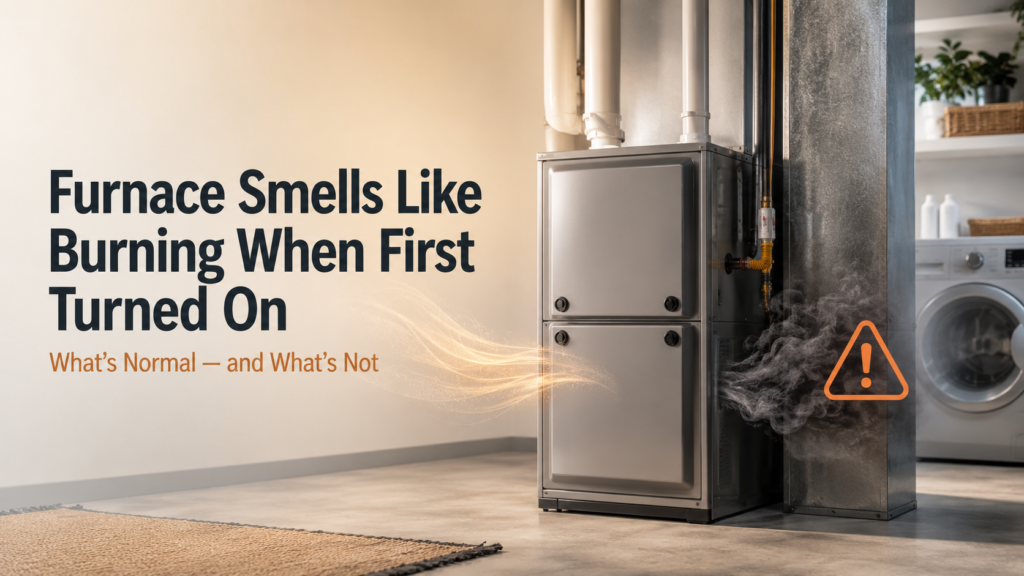
A dusty or slightly burnt smell when the furnace first runs after summer is normal — dust accumulated on the heat exchanger is burning off. This should fade within 30 to 60 minutes. A plastic, chemical, sweet, or rotten egg smell is not normal and is a sign to shut the furnace off and investigate or call a professional. A sulfur or rotten egg smell with no other source could be a natural gas leak — evacuate and call your gas utility.
The Smell-Type Decision Chart
This is the most important table in this guide. Identify the smell first, then act accordingly.
| Smell type | Likely cause | Safety level | Action |
|---|---|---|---|
| Dusty / dry burning paper | Dust on heat exchanger burning off — first startup of season | Normal | Open windows 30 min, let it clear |
| Plastic / rubber | Wiring insulation or component overheating | Urgent | Shut off furnace immediately, call technician |
| Sweet / chemical / formaldehyde | Refrigerant leak (heat pump systems) or heat exchanger crack | Urgent | Shut off, ventilate, call technician |
| Rotten egg / sulfur | Possible natural gas leak (mercaptan additive) | Emergency | Evacuate, call utility / 911 from outside |
| Smoke / oil smoke | Combustion problem or oil furnace issue | Urgent | Shut off, ventilate, call technician |
| Musty / mildew | Moisture in ductwork or filter | Address soon | Replace filter, check humidifier and ducts |
| Metallic / hot metal | Bearing failure, motor overheating, or hot heat exchanger | Urgent | Shut off, call technician |
Safety First
- If you smell rotten eggs or sulfur and have any natural gas appliance in the home, treat it as a possible gas leak. Leave the home, do not flip switches, and call your gas utility from outside.
- If anyone in the household experiences headache, dizziness, nausea, or confusion, leave the home and treat as a possible carbon monoxide event.
- If you see flame, smoke, or hear unusual noises from the furnace, shut it off at the thermostat and at the emergency switch (a red light switch near the furnace).
- Do not try to diagnose internal furnace components yourself. The flame, gas valve, heat exchanger, and electrical components require a licensed HVAC technician.
- Make sure your CO alarms are working before any first-of-season furnace startup. See our guide on smoke and CO alarms.
The Dust Burn — What Is Actually Happening
Over the summer months, dust settles on the furnace heat exchanger, burners, and inside the ductwork. When the furnace fires up for the first time in the fall, this dust burns off the hot metal surfaces. The result is a smell that ranges from dusty to slightly burnt paper.
Characteristics of normal dust-burn:
- Happens only on the first or second startup of the season
- Smell is dry, dusty, mildly burnt — not sharp or chemical
- Fades within 30 to 60 minutes of operation
- No smoke is visible
- No alarms activate
- No symptoms in occupants
Open windows during this period to vent the smell. Replace the air filter if you have not already — running with a clean filter speeds the dust-burn.
What to Do First
- Identify the smell type using the chart above. This determines everything that follows.
- If sulfur / rotten egg: leave the home. Call your gas utility from outside. Do not turn switches on or off.
- If plastic, chemical, smoke, or metallic: shut off the furnace. Set thermostat to OFF. Also flip the emergency switch (red, usually near the furnace).
- If dusty / burning paper: continue but ventilate. Open windows, set fan to ON (continuous), and let it run for 30 to 60 minutes.
- Replace the air filter. A clogged filter restricts airflow and can cause heat exchanger overheating, leading to burning smells.
- Listen for unusual noises. Grinding, squealing, rattling, or popping during operation are signs of mechanical issues.
- Check CO alarms. Test each one to confirm it is working. Replace any older than 7 years.
- Wait for the smell to fully clear. Normal dust-burn should not persist past the first hour of operation.
What Not to Do
- Do not run the furnace with a chemical or plastic smell to “see if it goes away.” Shut it off and have it inspected.
- Do not ignore CO alarms going off during furnace operation. Treat as a real emergency.
- Do not block furnace vents or returns to reduce the smell. This can cause heat exchanger overheating.
- Do not skip your annual furnace inspection. The dust-burn is far less likely after an annual cleaning by a technician.
- Do not use aerosol fragrance to mask a chemical smell. This wastes time and prevents you from tracking the actual smell.
- Do not assume “it always smells weird on first startup.” Each smell type has its own diagnostic value.
About Heat Exchanger Cracks
A cracked heat exchanger is one of the more serious furnace problems because it can release combustion byproducts — including carbon monoxide — into the home’s air. Signs that may indicate a cracked heat exchanger:
- Sweet or chemical smell during operation
- Soot or black dust accumulating near vents
- Frequent CO alarm activations
- Family members feeling dizzy, nauseous, or having headaches when the furnace runs
- Yellow or flickering burner flame (should be blue and steady)
This is not a DIY diagnosis — only an HVAC technician with proper inspection tools can confirm. But if multiple signs are present, schedule the inspection promptly and avoid running the furnace until then.
Related Guides
- Furnace Not Turning On: What to Check First
- Carbon Monoxide Alarm Going Off: What to Do
- Heating, Cooling & Indoor Air
Safe DIY Checks
- Identify the smell type using the chart.
- Replace the air filter (cheap and high impact).
- Open vents in unused rooms — restricted airflow stresses the system.
- Check that all return vents are unblocked.
- Test all smoke and CO alarms.
- Verify the thermostat is functioning (temperature reads accurately).
- Look at the burner flame through the inspection window — should be blue and steady.
When to Call a Licensed HVAC Technician
Call immediately for:
- Any sweet, chemical, plastic, or smoke smell
- Smell that persists more than 1 hour on first startup
- Smell that returns on subsequent startups (should be one-time dust burn)
- CO alarm activation during furnace operation
- Yellow, flickering, or unstable burner flame
- Soot or black dust near vents
- Family members feeling unwell during furnace operation
- Furnace older than 15 years with multiple symptoms
- A repeatedly tripping breaker on the furnace circuit
For natural gas smell: call your gas utility (not just an HVAC technician) before re-entering the home. Most utilities respond at no cost.
Prevention Tips
- Schedule annual furnace maintenance before the heating season starts. The technician cleans the heat exchanger, checks the burner, inspects ductwork, and confirms safe operation.
- Replace air filters every 1 to 3 months during heating season.
- Test smoke and CO alarms monthly.
- Replace CO alarms every 5 to 7 years (sensors degrade).
- Run the furnace for a short test period in late summer — this catches issues early and burns off most dust before the cold weather demands continuous use.
- Keep the area around the furnace clear of stored items and combustibles.
Recommended Next Step
Identify the smell type using the chart. Normal dust-burn vents in under an hour with open windows and continued operation. Any other smell type warrants shutting off the furnace. Call a licensed HVAC technician for inspection — and for any sulfur or rotten egg smell, evacuate and call the gas utility first.
Frequently Asked Questions
How long should the burning smell last on first startup?
Normal dust-burn smell fades within 30 to 60 minutes. If it persists past the first hour, or returns on subsequent startups, the cause is something other than seasonal dust and needs investigation.
Why does my furnace smell like burning even after I cleaned the filter?
A clean filter is necessary but not sufficient. If the smell persists, check for:
- Dust accumulated inside ductwork (especially after construction or remodel)
- Items stored too close to the furnace (combustibles burning off heat)
- Burner issues that produce incomplete combustion
- Heat exchanger problems that need professional inspection
Is it dangerous to run the furnace with a slight burning smell?
Slight dusty smell on first startup is generally not dangerous. Any sharp, chemical, sweet, plastic, sulfur, or smoke smell deserves shutting the unit off until inspected. The risk of running through a non-dust smell is heat exchanger damage, fire, or CO exposure.
How can I tell natural gas from sewer gas?
Natural gas has mercaptan added — it has a strong sharp sulfur smell similar to skunk. Sewer gas smells like rotten eggs combined with stale or musty notes. When in doubt, leave the home and call the utility — both gas leaks and CO exposure are emergencies.
Do new furnaces need a break-in period?
New furnaces do not need a true break-in, but the first few startups may produce mild smells from manufacturing residues — protective coatings, machine oils, or paint curing. This should clear within a few hours of operation. If smells persist or are chemical in nature, contact the installer.