What This Guide Helps With
This guide explains what to check when your furnACe will not turn on or stops heating your home. It covers the most common causes homeowners can check safely, steps to take in order, and when the problem requires a licensed HVAC technician.
Quick Answer
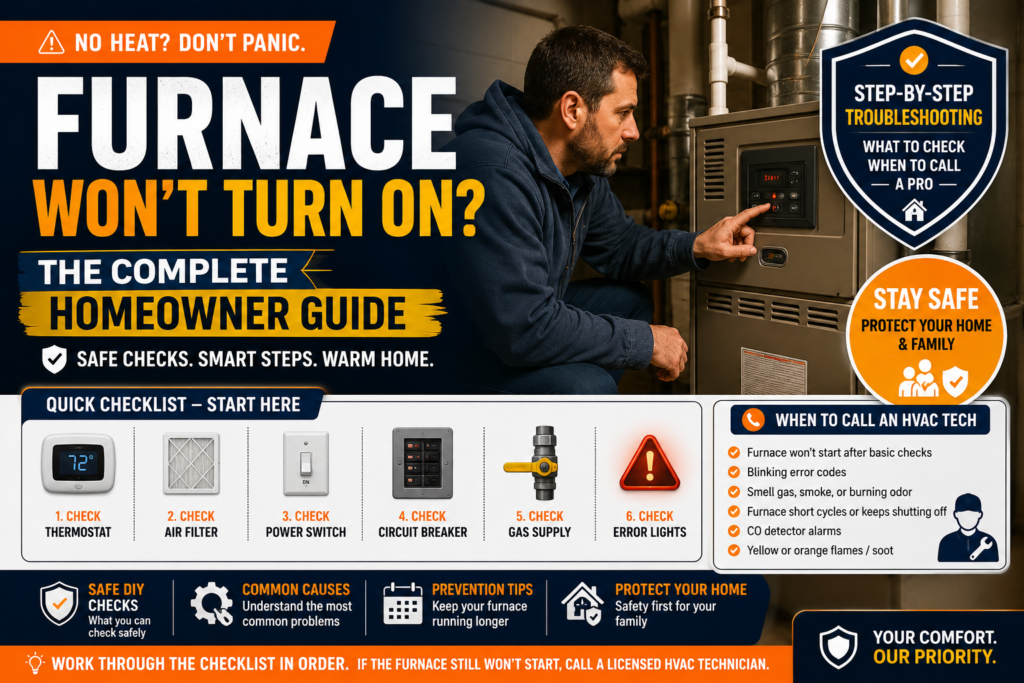
Start with the basics before assuming the furnace itself has failed. Check the thermostat settings, replace the air filter if it is clogged, confirm the furnace power switch is on, and check the circuit breaker. If you have a gas furnace, make sure the gas supply is on. If the furnace still does not start after these checks, or if you see an error code or flashing lights on the unit, call an HVAC technician.
Safety First
- If you smell gas or a rotten egg odor near the furnace, do not attempt any troubleshooting. Leave the home immediately, leave doors open as you exit, and call your gas utility provider or emergency services from outside.
- Do not attempt to open the furnace cabinet, access the burner assembly, or touch electrical components inside the unit.
- Do not use space heaters as a long-term replacement — they increase fire risk if left unattended.
- Carbon monoxide detectors should be working in your home at all times. If a CO alarm sounds, leave immediately and call emergency services.
What to Do First
- Check the thermostat. Make sure it is set to Heat, the temperature is set above current room temperature, and the batteries are fresh if it is battery-powered.
- Check the furnace power switch. There is a wall switch near the furnace that looks like a light switch. Make sure it is in the On position.
- Check the circuit breaker. Find the breaker labeled Furnace or Air Handler in your electrical panel. If it has tripped, switch it fully off then back on once.
- Check the air filter. A severely clogged filter can cause the furnace to overheat and shut off. Pull out the filter and hold it up to light. If you cannot see light through it, replace it.
- Check the gas shutoff valve on the gas line leading to the furnace. The valve should be in line with the pipe (open), not perpendicular to it (closed).
- Look for a blinking light or error code on the furnace control board. Count the blinks — many furnaces flash a code that corresponds to a fault listed on the door label.
- If the furnace starts but the house is still not warming, check that all supply and return vents in rooms are open and unobstructed.
What Not to Do
- Do not try to relight a furnace pilot light unless you have read the manufacturer instructions and confirmed it is safe to do so.
- Do not open the combustion chamber or burner access area.
- Do not bypass safety switches or error lockouts — these exist to protect your home.
- Do not run your furnace if the heat exchanger may be cracked — carbon monoxide can enter living spaces.
- Do not use your oven or stovetop to heat the home.
Common Causes of a Furnace Not Turning On
| Symptom | Likely cause | What to check |
|---|---|---|
| No heat, no fan | Thermostat setting, power switch, breaker | Check all three first before anything else |
| Fan runs but no heat | Ignition failure, gas supply issue, dirty flame sensor | Check gas valve; call HVAC if flame sensor issue |
| Furnace starts then shuts off quickly | Clogged filter, blocked flue, overheating safety shutoff | Replace filter; inspect flue outlet outside for blockage |
| Blinking error light | Specific fault code | Count blinks; check door label for code meaning; call HVAC |
| Furnace runs but uneven heat | Blocked vents, duct issues, dirty filter | Check vents are open; replace filter |
| No pilot light on older furnace | Draft, gas interruption, thermocouple issue | Follow manufacturer relight instructions or call HVAC |
Safe DIY Checks
- Replace the air filter — this is the most common fix for furnaces that short-cycle or stop working.
- Check thermostat batteries and settings.
- Confirm the power switch near the furnace is on.
- Check the gas shutoff valve on the supply line to the furnace.
- Check your home’s other gas appliances — if none have gas, the supply may be interrupted.
- Walk outside and locate the furnace exhaust and air intake pipes — make sure they are not blocked by snow, ice, or debris.
When to Call an HVAC Technician
Call a licensed HVAC technician if:
- The furnace does not start after basic safe checks.
- You see a blinking error code you cannot interpret.
- You smell gas, burning plastic, or smoke near the furnace.
- The furnace starts but shuts off repeatedly within a few minutes.
- The CO detector alarms when the furnace runs.
- You see soot, rust, or yellow or orange flames through the inspection window (flames should be blue).
- The furnace is more than 15 years old and not heating effectively.
Prevention Tips
- Replace your furnace filter every 1 to 3 months depending on filter type and household conditions.
- Schedule annual furnace maintenance each fall before heating season begins.
- Keep the area around the furnace clear of stored items and debris.
- Make sure carbon monoxide detectors are installed and tested regularly.
Recommended Next Step
Work through the checklist above in order — thermostat, filter, power, gas. If the furnace starts after a filter replacement or thermostat fix, you have solved the most common problem at no cost. If the furnace still will not start after all safe checks, or if any safety warning signs are present, call a licensed HVAC technician today.
Related Guides
- Breaker Keeps Tripping: Causes and Safe Checks
- AC Running but Not Cooling: Causes and Safe Checks
- Heating, Cooling & Indoor Air
Frequently Asked Questions
How long should a furnace last?
Most gas furnaces last 15 to 20 years with regular maintenance. If yours is approaching 15 years and starting to need frequent repairs, factor that into repair-versus-replace decisions.
Why does my furnace turn on and then immediately turn off?
This is called short cycling. The most common causes are a severely clogged air filter causing the heat exchanger to overheat, a faulty flame sensor, or a blocked exhaust flue. Start by replacing the filter. If it continues, call an HVAC technician.
What does it mean if the furnace blower runs but there is no heat?
If the fan is blowing but the air is cool or room temperature, the burner is not igniting. Common causes include a failed igniter, a gas supply issue, or a dirty flame sensor. This usually requires an HVAC technician.
Is it safe to use space heaters while waiting for furnace repair?
Space heaters are safe for short-term use if you follow safety guidelines: keep them away from flammable materials, do not leave them unattended, plug them directly into a wall outlet rather than a power strip or extension cord.