What This Guide Helps With
This guide explains what food is safe to keep and what must be thrown away after a power outage, whether from a summer storm, a rolling blackout, or an equipment failure. It covers the refrigerator and freezer time limits, how to tell if food has gone unsafe, and what to do with a full freezer when the power has been out for an extended period.
Quick Answer
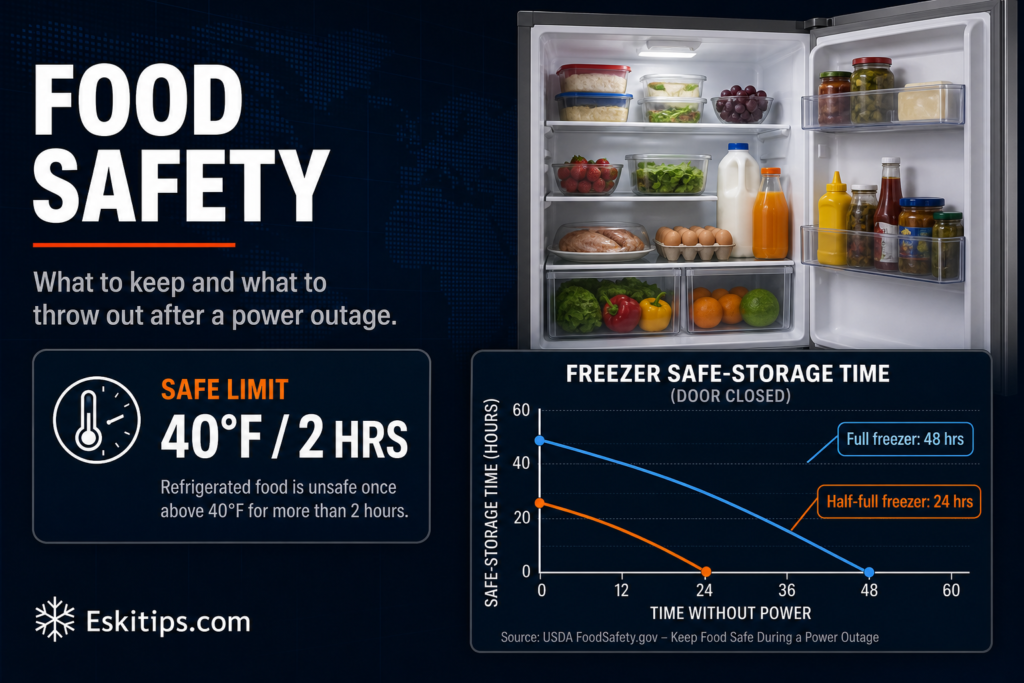
An unopened refrigerator keeps food safely cold for about 4 hours. A full freezer holds a safe temperature for about 48 hours, and a half-full freezer for about 24 hours, as long as the door stays closed. Use an appliance thermometer if you have one: refrigerated food is unsafe once it has been above 40°F (4°C) for more than 2 hours. Frozen food that still has ice crystals and feels cold to the touch can usually be refrozen, but anything that has thawed completely and reached refrigerator temperature should be evaluated item by item — when in doubt, throw it out.
Safety First
Never taste food to decide if it is safe. Bacteria that cause food poisoning do not always change the taste, smell, or appearance of food. Rely on time and temperature, not your senses, for the decision.
- If you have any doubt about how long a food item was above 40°F, discard it rather than risk foodborne illness.
- Discard any perishable food, including meat, poultry, fish, eggs, and leftovers, that has been at room temperature for more than 2 hours (or 1 hour if the ambient temperature is above 90°F).
- If a household member is pregnant, elderly, very young, or immunocompromised, apply the strictest interpretation of these limits.
What to Do First
- Keep the refrigerator and freezer doors closed as much as possible. Every time the door opens, cold air escapes and the safe-storage clock moves faster.
- Check for an appliance thermometer. If you have one in the fridge or freezer, use its reading as your primary guide rather than guessing based on outage length.
- Group frozen items together and, if you anticipate a long outage, move the most temperature-sensitive items (meat, dairy) to the center of the freezer where cold retains longest.
- Use dry ice or block ice if the outage is expected to last more than a few hours — about 50 pounds of dry ice can keep a fully-stocked 18-cubic-foot freezer cold for two days if the door stays shut.
- When power returns, check temperatures before restocking decisions. Refrigerated food above 40°F for more than 2 hours should be discarded; frozen food with ice crystals still present and a cold feel can generally be refrozen or cooked immediately.
What Not to Do
- Do not rely on smell or appearance alone to judge safety — many dangerous bacteria produce no obvious warning signs.
- Do not refreeze food that has fully thawed and warmed to refrigerator temperature, especially raw meat, poultry, or seafood.
- Do not open the freezer repeatedly “just to check” — this is one of the most common ways households lose food that would otherwise have stayed safe.
- Do not assume a short outage is automatically safe if the refrigerator door was opened multiple times during it.
- Do not use a gas grill, camp stove, or generator indoors to try to cook food faster during an outage — see our guide on carbon monoxide safety.
What to Keep vs. What to Throw Out
| Food category | Keep if… | Discard if… |
|---|---|---|
| Raw meat, poultry, seafood | Still below 40°F, or still has ice crystals and feels refrigerator-cold | Was above 40°F for more than 2 hours, or has an odor or slimy texture |
| Dairy (milk, soft cheese, yogurt) | Stayed below 40°F the whole time | Any doubt about time above 40°F — dairy is high-risk |
| Eggs | Stayed refrigerator-cold throughout | Warmed above 40°F for more than 2 hours |
| Hard cheese, butter, condiments | Generally safe even after several hours above 40°F | Visible mold, off smell, or separation not typical of the product |
| Frozen meals, ice cream, frozen vegetables | Still has ice crystals and firm texture | Fully thawed to room temperature or refrigerator temperature |
| Fresh fruits and most vegetables | Generally safe at room temperature for a day or more | Pre-cut produce or anything showing spoilage signs |
Safe DIY Checks
- Keep an appliance thermometer in both the refrigerator and freezer year-round — this removes the guesswork the next time the power goes out.
- After any outage longer than 4 hours, check every perishable item individually rather than making one blanket decision for the whole fridge.
- Note the exact time power went out and came back — this is the number that actually determines safety, not how long you personally noticed the outage.
- If your freezer went above 40°F and refroze, treat any meat or poultry inside as unsafe even though it looks frozen again.
When to Call a Professional
Food safety decisions do not require a professional in most cases, but contact your local health department or poison control if:
- Someone in the household has eaten food you later determine was unsafe and shows symptoms of food poisoning (vomiting, diarrhea, fever).
- You run a business, daycare, or care facility and need documented guidance for regulatory compliance after an extended outage.
Call an appliance technician if the refrigerator or freezer will not return to a safe temperature after power is restored — this points to a mechanical failure separate from the outage itself; see our refrigerator not cooling guide.
Prevention Tips
- Keep a thermometer in the fridge and freezer at all times, not just during emergencies.
- Keep a few frozen gel packs or bottles of water in freezer gaps — a fuller freezer holds cold longer than a half-empty one.
- If rolling blackouts or outages are common in your area, keep a small stock of dry ice sourced ahead of a known heat event — see our planned outage prep guide.
- Keep a cooler and reusable ice packs accessible for exactly this situation rather than buried in storage.
Recommended Next Step
If the power just came back on, check the actual temperature of your refrigerator and freezer contents before deciding what to keep — use the time-and-temperature rule, not appearance or smell. If this happens repeatedly in your area during heat waves, an appliance thermometer and a stocked freezer are the cheapest insurance you can buy against losing groceries again.
Related Guides
- Refrigerator Not Cooling: Diagnose the Cause by Symptom
- Carbon Monoxide Alarm Going Off: What to Do
- Power Outages & Electrical Safety
Frequently Asked Questions
Is it safe to refreeze food that partially thawed?
Food that still contains ice crystals and feels cold to the touch, at or below 40°F, can generally be refrozen safely, though texture and quality may suffer. Food that fully thawed and warmed above 40°F for more than 2 hours should not be refrozen and should be discarded or cooked immediately if still within a safe window.
How can I tell if my freezer stayed cold enough without a thermometer?
Check individual packages: if they still contain ice crystals and feel refrigerator-cold or colder, the freezer likely stayed safe. If everything feels room-temperature or soft, assume the freezer lost safe temperature and evaluate each item using the 2-hour/40°F rule.
Does a full freezer really stay cold longer than a half-full one?
Yes. A full freezer holds a safe temperature for about 48 hours after losing power, while a half-full freezer holds it for about 24 hours, because more frozen mass retains cold longer. Keeping the freezer stocked with water bottles or gel packs during a season with frequent outages is a low-cost way to extend that window.