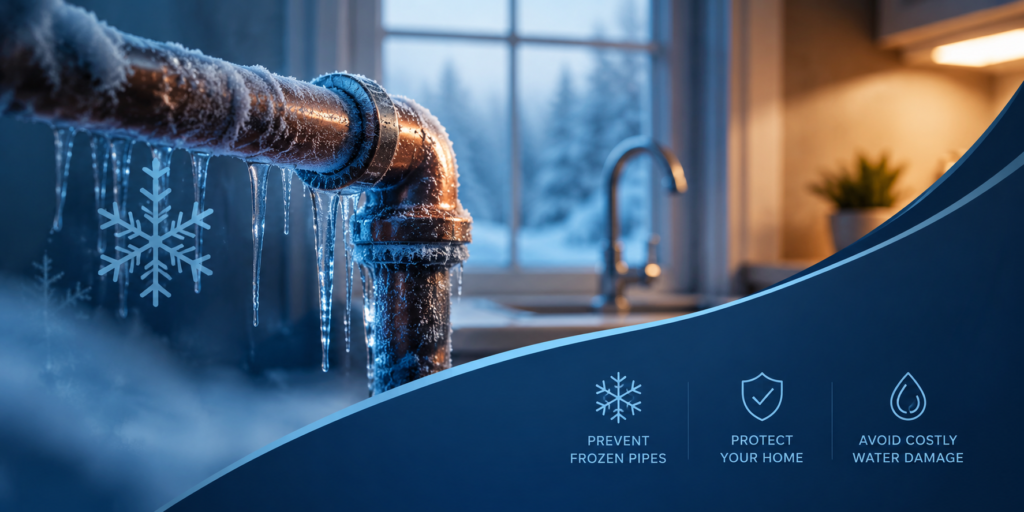
What This Guide Helps With
This guide is specifically about the pre-burst stage — when a pipe is frozen but has not yet burst. Acting in this window prevents most water damage. It covers identification, safe thawing, and when to call a plumber before the situation becomes an emergency.
Quick Answer
If a faucet only trickles or has no water during cold weather, the pipe feeding it is likely frozen — not yet burst. Act now: locate the main shutoff valve (in case the pipe does burst during thawing), open the faucet to let water flow as the pipe thaws, and apply gentle heat starting from the faucet end and working back. Never use an open flame, propane torch, or electric space heater near pipes.
Signs Your Pipe Is Frozen (Not Yet Burst)
| Sign | What it means |
|---|---|
| Faucet runs slowly or only drips | Partial freeze restricting flow |
| No water at all from a fixture | Complete freeze blocking pipe |
| Frost visible on an exposed pipe | Pipe surface is below freezing |
| Strange smells from drain | Drain trap water frozen, allowing sewer gas up |
| Banging or clanking when running water | Ice formation in pipe |
| Only one fixture affected (others normal) | Single pipe frozen, others still flowing |
| Multiple fixtures on same side of home | Multiple pipes frozen on a cold exterior wall |
Safety First
- Locate the main water shutoff valve BEFORE starting any thawing. If the pipe has cracked, water will pour out as soon as it thaws. Knowing where to shut off prevents a frozen-pipe situation from becoming a basement flood.
- Never use a propane torch, open flame, or space heater within several feet of pipes. House fires from frozen-pipe thawing are common.
- Do not use an electric heating device near water or in a wet area without GFCI protection.
- If you smell gas during this process, stop and evacuate — propane and natural gas leaks become more dangerous in cold weather.
- If the pipe is inside a wall and you cannot access it directly, do not cut into the wall. Call a plumber.
What to Do First (When You Know a Pipe Is Frozen)
- Locate your main water shutoff valve. Usually in the basement, crawl space, or utility room near where the water line enters the home. Note where it is. You may need it in the next 30 minutes.
- Open the affected faucet. Both hot and cold handles. As the pipe thaws, water needs somewhere to go — keeping the faucet open relieves pressure.
- Identify the most likely freeze location. Pipes against exterior walls, in unheated basements, crawl spaces, garages, or near uninsulated windows are most likely. Outdoor hose bibs are common freeze points.
- Apply heat to the pipe gently. Use:
- Hair dryer on medium setting (most common)
- Electric heating pad wrapped around the pipe
- Towels soaked in hot water, wrapped around the pipe
- Portable space heater placed in the room (not pointed directly at the pipe)
- Start near the faucet, work toward the frozen section. This allows melted water to exit through the open faucet rather than be trapped behind ice.
- Continue until water flows normally. A trickle becoming a full flow is the signal the thaw is complete.
- Inspect the pipe after thawing. Look for any cracks, bulging, or leaks. Touch dry tissue to joints and along the pipe.
- Take preventive measures for the rest of the cold spell. Once one pipe has frozen, others on the same line or in similar locations are at higher risk for the rest of the freeze.
What Not to Do
- Do not use a propane torch, blowtorch, or any open flame. This is the leading cause of house fires from frozen pipes.
- Do not heat a frozen pipe with the faucet closed. Pressure can build and rupture the pipe.
- Do not pour boiling water on the pipe. Thermal shock can crack the pipe.
- Do not assume “if a pipe froze, water flowing again means it is fine.” Inspect for cracks and bulges — some bursts are slow and develop into leaks over days.
- Do not leave the home while actively thawing a pipe. You need to be present in case it bursts.
- Do not ignore other fixtures in the home. If one pipe froze, others on the same line may also be at risk.
Locations to Check First
| Location | Why it freezes | What to do |
|---|---|---|
| Exterior wall under kitchen or bathroom sink | Cold air enters cabinet from wall | Open cabinet doors to allow warm air |
| Garage utility sink or fridge line | Unheated garage temperature drops | Insulate; consider heat tape |
| Basement perimeter walls | Cold from exterior wall transfers | Insulate; let nearby faucet drip |
| Crawl space | Often unheated and uninsulated | Insulate pipes; close vents in winter |
| Attic plumbing (if present) | Cold air infiltration | Insulate; address air sealing |
| Outdoor hose bibs | External pipe and valve | Disconnect hoses; turn off interior shutoff; drain |
| Pipes near vents or drafty areas | Cold air flow chills pipe | Seal air gaps; reroute if possible |
After Thawing — Inspect Carefully
A pipe that froze and thawed without bursting is not always fully OK. Walk through this inspection:
- Run water for several minutes at full flow. Watch the pipe and joints for any leak.
- Look for bulges or distortion along the pipe. Ice expanding inside can deform copper, PEX, or steel pipes without immediately splitting them.
- Check joints, elbows, and connections. These are stress points where a damaged pipe is most likely to leak.
- Listen for unusual sounds — hissing or dripping in walls.
- Check water meter readings. Note the reading, do not use water for 2 hours, and check again. Any change indicates a hidden leak.
- Take photos of the pipe and any concerning areas — useful if a slow leak develops later.
Related Guides
- What to Do If Your Basement Floods
- How to Document Water Damage at Home
- Emergency Home Fixes & Damage Control
Safe DIY Thawing Steps
- Locate main shutoff first.
- Open the affected faucet (hot and cold).
- Apply hair dryer, heating pad, or hot-water towels.
- Start near faucet, work back to the frozen section.
- Stay present and watch for water flow returning.
- Inspect the pipe and joints after thaw.
- Continue letting that faucet drip for the rest of the cold spell.
When to Call a Licensed Plumber
Call a plumber if:
- The frozen pipe is inside a wall, ceiling, or other inaccessible area.
- Multiple pipes are frozen simultaneously.
- You cannot identify which pipe is frozen.
- You see water pooling, hear water running with no fixtures on, or notice damp walls — this suggests a burst already happened or is in progress.
- The pipe has thawed but you see deformation, bulging, or any leaks.
- Water flow remains weak after thawing seems complete.
- You suspect frozen drain lines (separate issue from supply lines).
- The home is empty or unheated and you are worried about additional pipes.
If the Pipe Has Already Burst
Signs of a burst include water visible on the floor, walls, or ceiling; water running noise with no fixtures on; water meter spinning with everything off. If a pipe has burst:
- Shut off the main water valve immediately.
- Open all faucets to drain water out of the system.
- Photograph the damage before any cleanup — see our documentation guide.
- Call a plumber for the repair and a water damage professional if significant flooding occurred.
- If water reached electrical panels, outlets, or appliances, treat as a serious electrical hazard.
Prevention Tips for the Rest of the Cold Season
- Once a pipe has frozen, that location is high-risk for the rest of winter. Insulate it with foam pipe sleeves immediately after the thaw.
- During temperatures below about 20°F (-7°C), let vulnerable faucets drip slowly overnight.
- Open kitchen and bathroom cabinet doors on exterior walls so warm air reaches pipes.
- Disconnect outdoor hoses and shut off the interior valve to outdoor hose bibs. Drain the line.
- Maintain home heat at 55°F (13°C) minimum even when away.
- Know where your main water shutoff is — and where each appliance shutoff is.
- Seal air leaks around pipes that pass through exterior walls.
Recommended Next Step
If you suspect a frozen pipe right now, locate your main shutoff and open the affected faucet immediately. Apply gentle heat starting from the faucet end. After the thaw, do the post-thaw inspection. If you have multiple frozen pipes, pipes inside walls, or any signs of a possible burst, call a plumber rather than continuing alone. Acting at the frozen stage prevents most water damage events.
Frequently Asked Questions
How cold does it have to be for pipes to freeze?
The general threshold is around 20°F (-7°C) for several hours. But location matters more than temperature. A pipe in an exposed exterior wall can freeze at 25°F if wind exposure is high, while a well-insulated interior pipe may not freeze at 10°F. Wind chill on outdoor pipes accelerates freezing.
How long does it take to thaw a frozen pipe?
With a hair dryer and steady application, typical thaw time is 20 to 45 minutes. Pipes inside walls or with thick insulation can take much longer. The signal you have thawed it is water flow returning to the faucet. Do not rush — gradual thaw is safer than rapid heat that can crack the pipe.
Can plastic pipes (PEX) freeze and burst?
PEX is more freeze-resistant than copper because it can expand slightly without bursting, but it is not freeze-proof. Long or repeated freezing can still crack PEX, and the fittings can fail. Treat all frozen pipes seriously regardless of material.
Should I leave faucets dripping every night in winter?
Not every night — only during deep cold or for specific pipes you know are at risk. Dripping uses water and is unnecessary at most winter temperatures. The threshold is generally below 20°F (-7°C), or for pipes that have frozen before.
Will my insurance cover frozen pipe damage?
This guide cannot tell you what your policy covers — that is your insurer’s role. What this guide can say is that prompt documentation matters. Photograph everything before cleanup, save all receipts, and read your policy or call your insurer for specifics. See our water damage documentation guide.