What This Guide Helps With
This guide explains why a circuit breaker keeps tripping, what each cause usually means, what safe checks you can do yourself, and when repeated tripping is a sign to stop resetting and call a licensed electrician.
Quick Answer
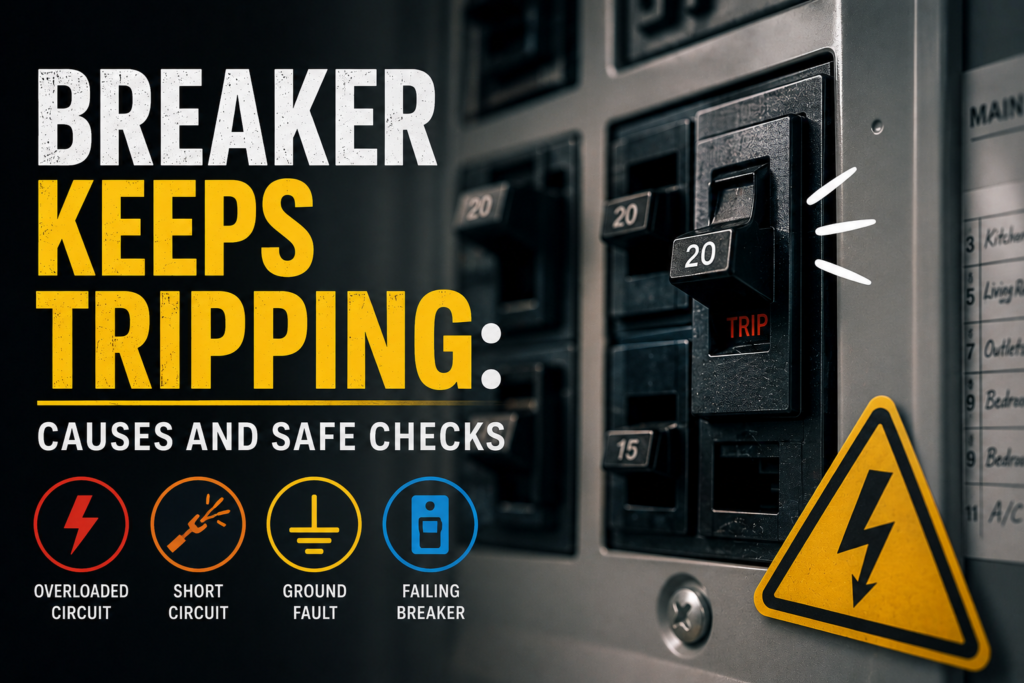
A breaker that keeps tripping means the circuit is being told to stop. The most common reasons are an overloaded circuit, a short circuit from a damaged device or wiring, a ground fault, or a failing breaker. Reset the breaker once after unplugging devices on that circuit. If it trips again immediately or repeatedly, stop resetting it and call a licensed electrician — repeated resets on a problem circuit can create a fire risk.
Safety First
- Do not reset a tripping breaker more than once or twice without finding the cause first.
- If you smell burning, see scorch marks near an outlet, feel heat around an outlet or switch, or hear buzzing, do not reset the breaker. Call a licensed electrician immediately.
- Do not open the electrical panel cover. The area behind the cover contains live wiring that remains energized even when breakers are off.
- If a breaker trips after a new appliance or installation, stop using that circuit until it is checked.
What to Do First
- Unplug or turn off devices on the affected circuit. Go to every outlet and switch on that circuit and unplug or turn off all devices.
- Reset the breaker once. Push the breaker fully to the off position first, then firmly back to the on position.
- If it holds, plug devices in one at a time. Wait a minute or two between each. If the breaker trips when you plug in a specific device, that device is likely faulty or drawing too much current.
- If it trips immediately with nothing plugged in, the problem is in the wiring or the breaker itself. Stop and call an electrician.
- Do not force the breaker to stay on by holding it. If it trips again, it is doing its job.
What Not to Do
- Do not reset a breaker repeatedly without investigating the cause.
- Do not use tape or any object to hold a breaker in the on position.
- Do not ignore a breaker that is warm or hot to the touch.
- Do not open the panel cover or attempt to replace a breaker yourself unless you are a licensed electrician.
- Do not use an extension cord as a permanent fix to add outlets to an overloaded circuit.
Common Causes of a Tripping Breaker
| Cause | What it usually means | What to do |
|---|---|---|
| Overloaded circuit | Too many devices drawing power at once | Unplug devices, distribute load to other circuits |
| Faulty appliance or device | Device has an internal short or is drawing excess current | Identify the device by plugging in one at a time |
| Short circuit | Hot wire touching neutral wire; damaged wiring or faulty outlet | Stop using circuit; call an electrician |
| Ground fault | Live wire contacting ground wire or grounded surface | GFCI outlets protect against this; call electrician if issue persists |
| Aging or failing breaker | Breaker no longer holds rated load reliably | An electrician can test and replace the breaker |
| Moisture in wiring or panel | Water entering outlet boxes or the panel area | Do not reset; call an electrician; address the water source |
Safe DIY Checks
- Check if the affected circuit has a GFCI outlet somewhere on it — press the reset button on the GFCI outlet itself before resetting the breaker.
- Count how many high-draw appliances are on the same circuit (hair dryers, space heaters, microwaves, vacuum cleaners).
- Unplug all devices and reset the breaker — if it holds with nothing plugged in, plug things back in slowly to find the problem device.
- Look at outlets on the circuit for any scorch marks, discoloration, or cracked covers. If you see these, do not use the outlet.
- Check your panel label to confirm which rooms and outlets are on the tripping circuit.
When to Call a Licensed Electrician
Call a licensed electrician if:
- The breaker trips immediately with nothing plugged in.
- You smell burning or see scorch marks near outlets, the panel, or any wiring.
- The breaker or the panel area feels warm or hot.
- The breaker trips on multiple unrelated circuits.
- You have an older home with a Federal Pacific or Zinsco panel — these have known safety issues.
- The problem started after a recent storm, water damage, or pest activity.
- The breaker will not reset or immediately flips back even after unloading the circuit.
Prevention Tips
- Distribute high-draw appliances across different circuits.
- Replace old or damaged power strips with surge protectors that have circuit protection.
- Have your electrical panel inspected every 10 years or before major appliance additions.
- Keep the area around your electrical panel clear and dry.
- Label your panel if it is not already labeled.
Recommended Next Step
If the breaker held after you unplugged and reloaded devices one at a time, you have likely found an overloaded circuit or a faulty device. Stop using the problem device. If the breaker keeps tripping regardless of what is plugged in, or if you noticed any burning smell or heat, stop using that circuit and call a licensed electrician today.
Related Guides
- Carbon Monoxide Alarm Going Off: What to Do
- Furnace Not Turning On: What to Check First
- Electrical, Lighting & Smart Home
Frequently Asked Questions
Is it dangerous to keep resetting a tripping breaker?
Yes. If something is causing the breaker to trip and you keep forcing it back on, you are pushing electricity through a circuit that has a problem. This can overheat wiring and in rare cases cause a fire inside walls where it cannot be seen. Investigate the cause before resetting more than once or twice.
How do I know if a breaker has gone bad?
A bad breaker may trip even with minimal load, feel hot to the touch, smell burnt, or fail to reset. Only a licensed electrician can test and confirm this safely. Do not open the panel to inspect it yourself.
Why does my breaker trip only at certain times of day?
This often points to an overloaded circuit during peak usage — for example, when the microwave, dishwasher, and coffee maker all run at the same time. Try identifying which combination of devices causes the trip and spread them across different circuits.
What is the difference between a tripped breaker and a blown fuse?
Breakers can be reset by switching them. Fuses burn out and must be replaced. Older homes may have fuse panels. If you have fuses and one blows repeatedly, the same rules apply — find the cause before replacing. An electrician can confirm what type of panel you have.