What This Guide Helps With
This guide explains exactly what to do if your carbon monoxide (CO) alarm activates, why you must always take it seriously, what the most common CO sources in a home are, and how to tell a real alarm from a low-battery chirp.
Quick Answer
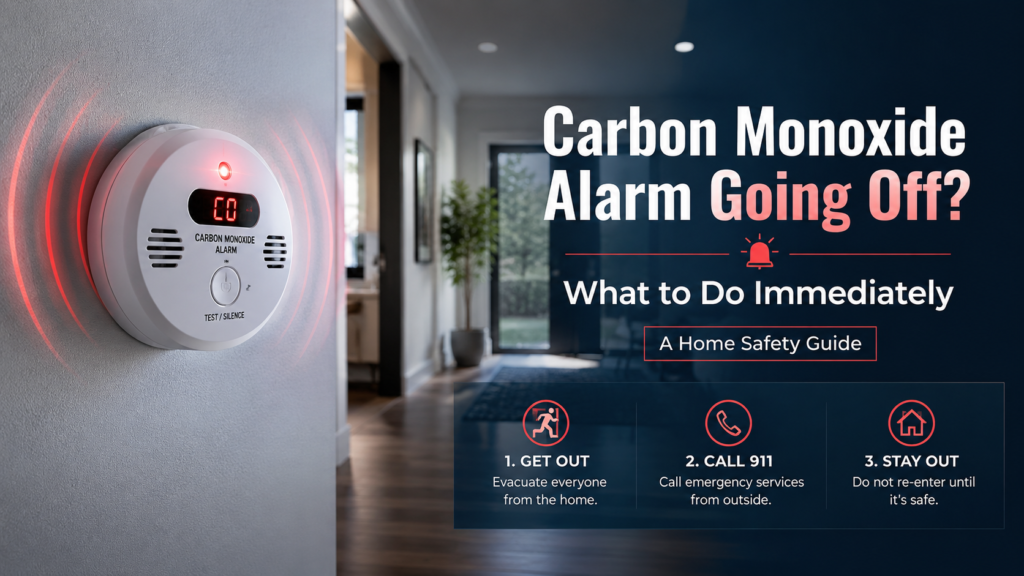
If your carbon monoxide alarm is sounding a continuous alarm, leave the home immediately with everyone inside, including pets. Do not stop to find the source. Do not go back in. Call emergency services (911) from outside or a neighbor’s home. Only return when emergency responders say it is safe. A continuous CO alarm is always treated as a real emergency.
Safety First — Read This Before Anything Else
Carbon monoxide is invisible, odorless, and deadly. You cannot see, smell, or taste it.
- If the alarm is sounding continuously: leave now. Do not try to find the source. Do not open windows first. Do not grab extra belongings. Leave.
- Get everyone out, including pets.
- Leave doors open as you exit to allow some ventilation.
- Call 911 from outside. Emergency responders have CO meters to confirm and find the source.
- Do not re-enter until emergency responders tell you it is safe.
- Seek medical attention if anyone has symptoms: headache, dizziness, nausea, shortness of breath, confusion, or fainting.
How to Tell If It Is a Real Alarm vs. a Low Battery Chirp
| Sound pattern | What it likely means | What to do |
|---|---|---|
| Continuous pattern of 4 beeps, pause, repeat | CO detected — real emergency | Leave immediately, call 911 |
| Single chirp every 30 to 60 seconds | Low battery warning | Replace battery; do not ignore repeated chirping |
| 5 beeps every minute | End of detector life (on some models) | Replace the detector; most CO detectors last 5 to 7 years |
| 3 beeps, pause, repeat | Malfunction alert (on some models) | Replace the detector; do not assume no CO is present |
If you are not certain which pattern is sounding, treat it as a real CO alarm and leave.
What to Do Step by Step
- Alert everyone in the home — shout, knock on doors, make sure everyone is moving toward the exit.
- Leave the home immediately. Do not stop to turn off appliances or collect belongings.
- Leave doors open as you exit to allow air to move through the home.
- Move to fresh air — go outside, away from the home.
- Call 911 from outside. Tell them your address and that your CO alarm has activated.
- Do not re-enter the home for any reason until emergency responders have confirmed it is safe.
- Seek medical help if anyone has a headache, nausea, dizziness, or feels faint.
- After clearance from responders, have a licensed HVAC technician or gas technician inspect all combustion appliances before using them again.
What Not to Do
- Do not stay inside trying to find the source of the CO.
- Do not assume the alarm is false without checking.
- Do not silence the alarm and go back to sleep.
- Do not re-enter the home until emergency responders clear it.
- Do not run any gas-powered engine, generator, or grill inside the home or garage.
Common Sources of Carbon Monoxide in Homes
| Source | Why it can produce CO | Prevention |
|---|---|---|
| Gas furnace or boiler | Cracked heat exchanger, blocked flue, combustion problem | Annual professional maintenance |
| Gas water heater | Blocked venting or combustion issue | Annual inspection; clear flue |
| Attached garage | Car left running, exhaust backing into home | Never idle vehicles in an attached garage |
| Gas fireplace or wood-burning stove | Blocked chimney, closed damper, incomplete combustion | Annual chimney sweep; open damper before use |
| Portable generator | Exhaust enters home through windows, doors, or vents | Never run generators indoors or near openings |
| Gas stove or range | Extended use without ventilation | Ventilate kitchen; never use stove to heat home |
When to Call a Professional
After any confirmed CO event or alarm:
- Call a licensed HVAC technician to inspect your furnace, boiler, and water heater before using them again.
- Have your chimney inspected if you have a fireplace or wood-burning appliance.
- Have a gas technician or your utility provider check gas appliances if the source is unclear.
- Do not use combustion appliances again until they have been cleared by a professional.
Prevention Tips
- Install CO detectors on every level of your home, including near sleeping areas.
- Test CO alarms monthly and replace batteries annually.
- Replace CO alarms when they reach end of life — usually 5 to 7 years after manufacture.
- Never run a generator, grill, or any gas-powered engine indoors or near windows and doors.
- Schedule annual maintenance for your furnace, boiler, and gas water heater.
- Have your chimney swept and inspected every year if you use a fireplace or wood-burning stove.
Recommended Next Step
If your alarm sounded, do not return until emergency responders give the all-clear. Once it is safe, have all combustion appliances professionally inspected before use. Then check the age and placement of all CO detectors in your home and replace any that are past their service life.
Related Guides
- Furnace Not Turning On: What to Check First
- Breaker Keeps Tripping: Causes and Safe Checks
- Home Safety & Electrical Guides
Frequently Asked Questions
Can CO alarms give false alarms?
CO alarms do not produce random false positives the way smoke alarms can from cooking smoke or steam. If a CO alarm sounds its full emergency pattern, it has detected CO above a threshold. Leave first and investigate after emergency responders clear the space.
How many CO detectors does a home need?
The general recommendation is at least one on every level of the home, including the basement, and one within 10 feet of every sleeping area. Check your local regulations for specific requirements.
What does CO poisoning feel like?
CO poisoning symptoms are often mistaken for the flu: headache, dizziness, nausea, shortness of breath, confusion, and weakness. Symptoms that occur when you are home and improve when you leave are a warning sign. Seek emergency medical attention immediately.
How long do CO detectors last?
Most CO detectors have a service life of 5 to 7 years. The manufacture or install date is usually printed on the back of the unit. Replace the entire detector when it reaches end of life — the sensor degrades over time and may not detect CO reliably even with a fresh battery.