What This Guide Helps With
This guide explains why your air conditioner may be running but not cooling your home effectively. It covers the most common causes, what you can safely check as a homeowner, and when the problem needs a licensed HVAC technician.
Quick Answer
If your AC is running but the home is not cooling, start with the basics: check thermostat settings, replace a dirty air filter, make sure all supply vents are open, and confirm the outdoor unit is not blocked or iced over. If the system is blowing warm air, the filter and refrigerant level are the most common culprits — but refrigerant requires a licensed HVAC technician. Do not try to add refrigerant yourself.
Safety First
- Do not open or access the refrigerant lines, compressor, or electrical components inside the air handler or outdoor unit.
- If the outdoor unit is making loud banging or grinding noises, turn it off at the thermostat and call an HVAC technician.
- Do not pour water on a frozen outdoor unit to thaw it — let it thaw naturally with the system in Fan Only mode or off.
What to Do First
- Check the thermostat settings. Confirm it is set to Cool, the temperature setting is below the current room temperature, and the fan is set to Auto rather than On.
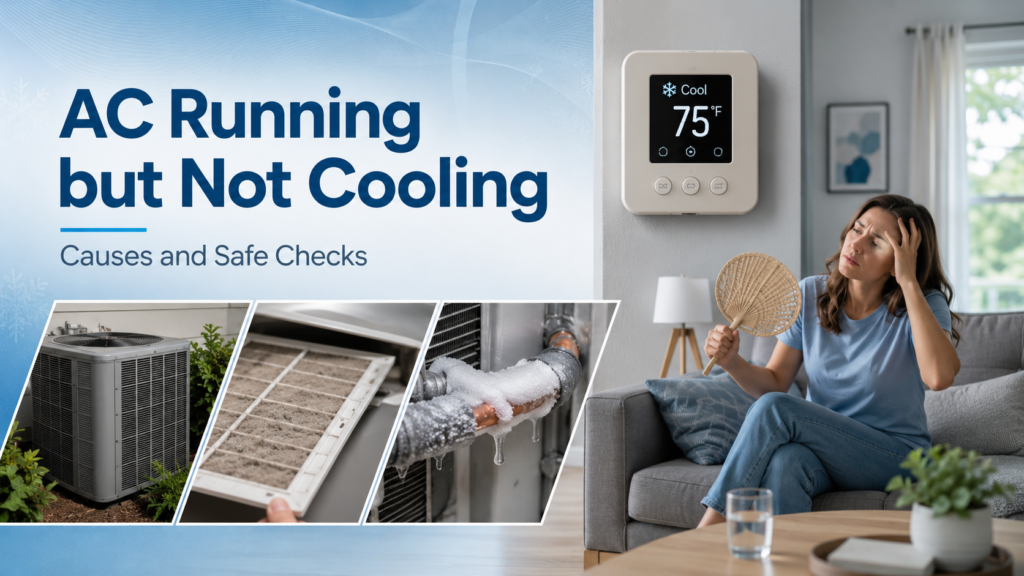
- Check the air filter. A severely clogged filter restricts airflow and is one of the most common causes of poor cooling. If you cannot see light through it, replace it now.
- Check the outdoor unit (condenser). Make sure the unit is running. Clear any debris, leaves, or vegetation within 2 feet of the unit.
- Check for ice on the indoor or outdoor unit. Ice on the refrigerant lines or the outdoor coil means the system has frozen up. Turn the system to Fan Only or Off and let it thaw for 2 to 3 hours before restarting.
- Check all supply vents and return air vents. Make sure they are open and unobstructed by furniture, rugs, or curtains.
- Check the condensate drain line. Some systems shut off cooling when the condensate drain pan is full. Look for a drip pan under the air handler — if it is full of water, the drain is likely clogged.
- If none of these checks resolve the problem, call an HVAC technician.
What Not to Do
- Do not try to add refrigerant yourself — refrigerant handling requires EPA certification and specialized equipment.
- Do not operate the system with ice on the coils or lines — this can damage the compressor.
- Do not pour water on a frozen unit to speed thawing.
- Do not block the outdoor unit with fencing, plantings, or furniture.
- Do not set the thermostat to an extremely low temperature expecting it to cool faster — it will not, and it can cause the system to freeze.
Common Causes of AC Running but Not Cooling
| Symptom | Likely cause | What to check or do |
|---|---|---|
| AC runs but blows room-temperature air | Thermostat setting, low refrigerant, compressor issue | Check thermostat; call HVAC for refrigerant/compressor |
| Weak airflow from vents | Dirty filter, blocked vents, duct issue | Replace filter; open vents; call HVAC if airflow stays weak |
| Ice on refrigerant lines or outdoor unit | Dirty filter, low refrigerant, restricted airflow | Turn off, let thaw, replace filter, restart; call HVAC if it refreezes |
| Outdoor unit not running but indoor fan is | Tripped breaker, failed capacitor, disconnect issue | Check breaker once; call HVAC if outdoor unit still does not start |
| Dripping inside from the air handler area | Clogged condensate drain | Locate drain line and check for clog; call HVAC if unclear |
| AC runs but temp never drops | System undersized, extreme heat, refrigerant leak | Consider HVAC assessment |
Safe DIY Checks
- Replace the air filter — use the correct size and MERV rating for your system.
- Check and open all supply and return vents in the home.
- Clear debris from around the outdoor condenser unit.
- Check the thermostat — cool mode, correct temperature, fan set to Auto.
- Look for ice on refrigerant lines running to the outdoor unit or on the air handler coil.
- Check the circuit breaker for the outdoor unit.
- Inspect the condensate drain pan under the air handler for standing water.
When to Call an HVAC Technician
Call a licensed HVAC technician if:
- The outdoor unit is not running after checking the breaker.
- The system refreezes within a few hours of thawing — this usually means low refrigerant.
- The system blows warm air despite a clean filter, open vents, and running outdoor unit.
- You hear unusual noises from the outdoor unit or air handler.
- The condensate drain pan is full or overflowing repeatedly.
- The system is more than 10 years old and performance has declined noticeably.
Prevention Tips
- Replace your air filter every 1 to 3 months.
- Schedule annual HVAC maintenance each spring before cooling season begins.
- Keep the area around the outdoor unit clear of plants, fencing, and debris year-round.
- Make sure condensate drain lines are cleared annually.
Recommended Next Step
Start with the filter, thermostat, and outdoor unit checks in that order — these resolve a large portion of cooling problems at no cost. If the system refreezes, blows warm air with a clean filter and running outdoor unit, or makes unusual sounds, call an HVAC technician. Continuing to run a system with an unresolved refrigerant or compressor problem can cause more expensive damage.
Related Guides
- Furnace Not Turning On: What to Check First
- Breaker Keeps Tripping: Causes and Safe Checks
- Heating, Cooling & Indoor Air
Frequently Asked Questions
Why is my AC blowing cold air at the vent but the room stays warm?
If the air is cold at the vent but the room is not cooling, the issue may be insufficient airflow from partially blocked vents, a home that is poorly insulated or has significant air leaks, or an undersized system for the space.
How do I know if my AC is low on refrigerant?
Signs of low refrigerant include ice on the refrigerant lines, the system blowing warm or barely cool air despite running for a long time, hissing or bubbling sounds near the refrigerant lines, and higher than usual electricity bills. Low refrigerant usually means a leak — a licensed HVAC technician needs to find and repair the leak before recharging the system.
What MERV rating filter should I use for my AC?
Most residential systems perform best with filters rated MERV 8 to 11. Higher MERV ratings filter more particles but also restrict airflow — which can hurt your system’s performance. Check your system’s manual if you are unsure.
How long should it take for AC to cool a home?
A properly sized, functioning AC system should lower room temperature by about 1 to 2 degrees Fahrenheit every 15 minutes under normal conditions. If it has been running for several hours with minimal change, something is likely wrong.