What This Guide Helps With
This guide explains why a central air conditioner freezes up during extreme heat, how to tell the difference between a low-refrigerant freeze and an airflow-restriction freeze, and the safe steps to take before calling an HVAC technician.
Quick Answer
A frozen central AC unit — ice on the indoor coil, the refrigerant lines, or even the outdoor unit — is almost never caused by the outside temperature being too hot. It is caused by something restricting airflow across the indoor coil or a low refrigerant charge, and running the system harder during a heat wave simply exposes a problem that was already there. Turn the system off and switch the fan to “on” (not auto) to help it thaw, check and replace the air filter, and do not run the AC again until the ice is fully melted.
Safety First
- Never chip, scrape, or use a heat gun to remove ice from the coil or lines — this can puncture refrigerant lines or damage the coil fins.
- If you smell a chemical or sweet odor near the unit, or a hissing sound, turn the system off and call an HVAC technician — this can indicate a refrigerant leak, which requires licensed handling.
- Do not attempt to add refrigerant yourself — handling refrigerant requires EPA certification and specialized equipment.
What to Do First
- Turn off the air conditioning at the thermostat as soon as you notice ice, and set the fan to “on” so air keeps circulating and speeds up the thaw.
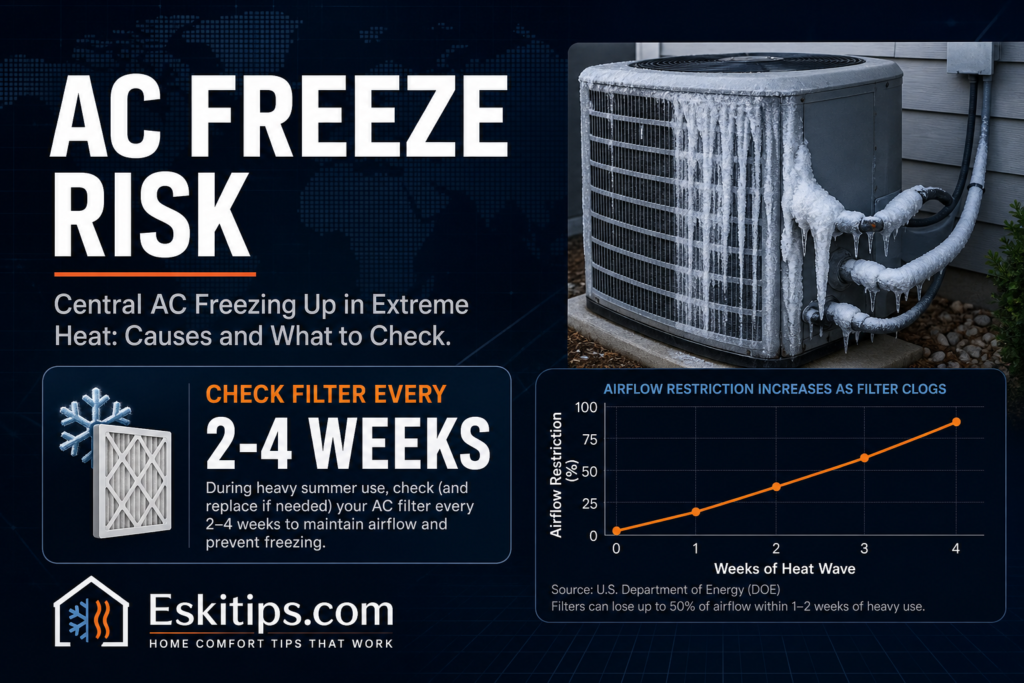
- Check the air filter. A clogged filter is the single most common cause of a frozen coil — it restricts airflow across the coil until it gets cold enough to freeze the moisture in the air.
- Look at the supply and return vents throughout the house — are any closed, blocked by furniture, or covered by rugs? Restricted airflow anywhere in the system can cause the same freeze.
- Let the system thaw completely before restarting — this can take several hours. Running it again while ice remains just refreezes the coil and can push liquid refrigerant back to the compressor, which can damage it.
- Check the outdoor unit for debris, overgrown vegetation, or anything blocking airflow around the condenser coil — this restricts heat exchange especially during extreme outdoor temperatures.
- Once thawed, restart and monitor. If ice returns within a day, the cause is not the filter alone and needs a technician.
What Not to Do
- Do not run the AC continuously while ice is visible on the coil or lines — this worsens the underlying problem and risks compressor damage.
- Do not assume extreme outdoor heat alone caused the freeze — a properly functioning system with adequate airflow and correct refrigerant charge does not freeze regardless of outdoor temperature.
- Do not close vents in unused rooms to “save cooling” for other areas — this is a common cause of airflow-restriction freezing.
- Do not delay filter changes during heat wave weeks — the system runs far more hours per day, and a dirty filter clogs faster under heavier use.
Common Causes of a Frozen AC Coil
| Cause | What it usually means | What to do |
|---|---|---|
| Dirty or clogged air filter | Restricted airflow drops coil temperature below freezing | Replace filter; this resolves the majority of freeze cases |
| Closed or blocked supply/return vents | Same airflow restriction, different location | Open all vents; clear furniture and rugs away from returns |
| Low refrigerant charge (leak) | System pressure too low, coil runs abnormally cold | Call an HVAC technician — requires licensed refrigerant work |
| Failing blower motor or fan | Not enough air moving across the coil | Call an HVAC technician to inspect the blower assembly |
| Running AC at very low outdoor temperatures relative to setpoint | Thermostat set unusually low, or system running in unusually mild weather | Adjust setpoint; monitor if freezing recurs |
| Dirty outdoor condenser coil | Poor heat rejection outside, straining the whole system | Clear debris and vegetation; hose off gently if accessible |
Safe DIY Checks
- Replace or clean the air filter — during heavy summer use, check it every 2 to 4 weeks rather than the usual quarterly schedule.
- Walk through the house and confirm every supply and return vent is open and unobstructed.
- Look at the outdoor unit for grass clippings, leaves, or overgrown shrubs within 2 feet of the condenser.
- Listen for unusual sounds (hissing, gurgling) once the system restarts after thawing — these point toward refrigerant issues rather than airflow.
When to Call a Professional
Call a licensed HVAC technician if:
- The coil refreezes within a day or two of a full thaw and restart, even after replacing the filter and clearing vents.
- You notice a hissing sound, oily residue on refrigerant lines, or a chemical smell — signs of a refrigerant leak.
- The system runs constantly without reaching the set temperature — see our AC running but not cooling guide for related diagnosis.
- You suspect a failing blower motor, which requires diagnostic equipment to confirm.
Prevention Tips
- Change or clean the air filter more frequently during heat wave weeks, when the system runs many more hours per day than usual.
- Schedule annual HVAC maintenance before peak summer heat, including a refrigerant charge check.
- Keep at least 2 feet of clearance around the outdoor condenser unit, free of plants, mulch, and debris.
- Avoid closing more than a few vents in the house at once, even in unused rooms.
Recommended Next Step
If your AC has frozen during this heat wave, shut it off, switch the fan to “on,” replace the filter, and let it thaw fully before restarting — most freeze cases resolve at this point. If the ice comes back after a clean restart with a fresh filter and open vents, the cause is refrigerant or mechanical, and a licensed HVAC technician should diagnose it before you run the system again.
Related Guides
- AC Running but Not Cooling: Causes and Safe Checks
- Window AC Unit Dripping Water Inside
- Thermostat Not Working: What to Check
Frequently Asked Questions
Can extreme outdoor heat by itself freeze a central AC unit?
No. A properly functioning system with clean airflow and a correct refrigerant charge does not freeze regardless of how hot it is outside. Extreme heat simply makes the system run more hours, which exposes an existing airflow restriction or low refrigerant issue faster than it would in milder weather.
How long does it take for a frozen AC coil to thaw?
Thawing typically takes several hours with the system off and the fan set to “on.” Do not restart the cooling function until all visible ice is gone, since restarting while ice remains can push liquid refrigerant into the compressor and cause damage.
Is a dirty filter really enough to freeze an entire AC system?
Yes, a clogged filter is the most common single cause. It restricts the volume of warm room air passing over the evaporator coil, which allows the coil to drop below freezing and ice over, even though the system itself is otherwise working correctly.