
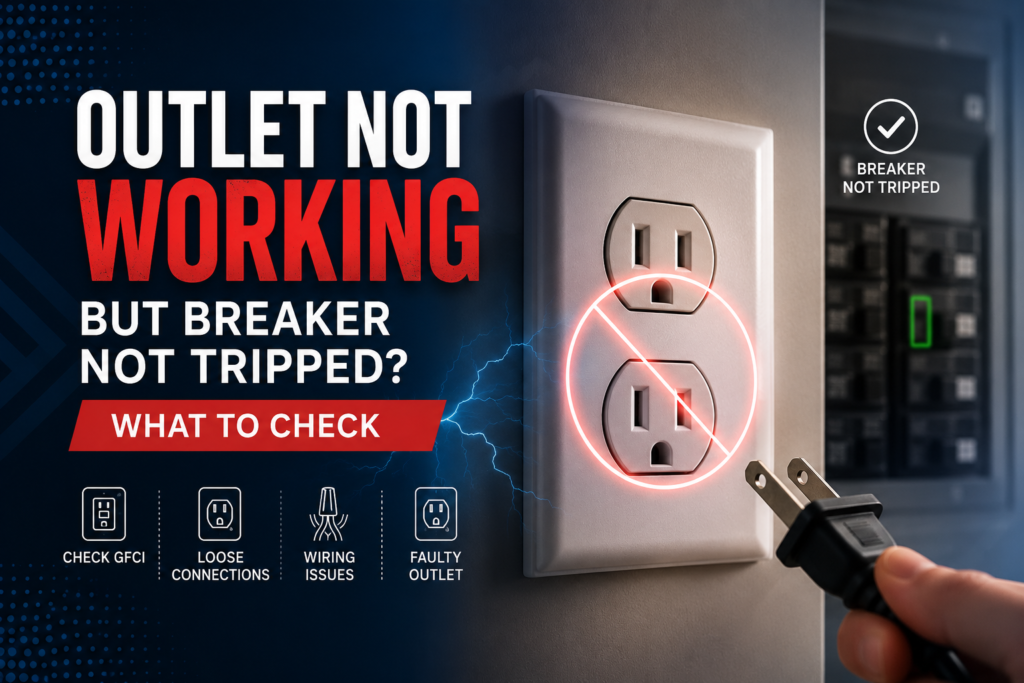
Quick Answer
An electrical outlet that has no power while the circuit breaker has not tripped most commonly has one of these causes: a tripped GFCI outlet elsewhere on the circuit, a loose or failed wire connection (often at the outlet itself or an upstream outlet), a worn-out outlet, or a partially tripped breaker that looks normal. Start by checking every GFCI outlet in the home — this resolves a large share of dead outlets that confuse homeowners because the breaker appears fine.
Safety First
- Do not remove an outlet cover or touch wiring unless you have turned off the circuit at the breaker and confirmed the power is off with a non-contact voltage tester.
- If you see scorch marks, smell burning plastic, or feel heat at an outlet, turn off the circuit breaker for that area immediately and call a licensed electrician. A hot or scorched outlet is a fire risk.
- Electrical work beyond resetting GFCIs and checking breakers — including replacing outlets or repairing connections — should be done by a licensed electrician in most situations, and is required by code in many jurisdictions.
- Do not use an outlet that sparks, is loose in the wall, or does not hold a plug firmly.
The Most Common Cause: An Upstream GFCI
This is the answer that surprises most homeowners. A single GFCI outlet protects not just itself but every standard outlet wired downstream of it on the same circuit. If that GFCI trips, every outlet after it goes dead — including outlets in other rooms — while the breaker stays on and looks completely normal.
This is why a dead outlet in a bedroom can be caused by a tripped GFCI in the bathroom, garage, or basement. See our GFCI outlet guide for the full explanation.
What to Do First
- Check every GFCI outlet in the home. Walk through bathrooms, kitchen counters, garage, basement, laundry, and outdoor areas. Press the RESET button firmly on each GFCI — even ones that look fine. A tripped GFCI may not look any different from a working one.
- Check the breaker panel carefully. A breaker can trip to a middle position that looks like “on” but is not. Firmly push the suspect breaker fully OFF, then fully ON. Do this for the breaker serving the dead outlet’s area.
- Test whether other outlets nearby are also dead. Use a phone charger or lamp to test surrounding outlets. This tells you whether it is one outlet or a whole section — a section points to an upstream GFCI or connection.
- Check whether the outlet is switch-controlled. Some outlets (often half of an outlet) are controlled by a wall switch. Confirm a nearby wall switch is not simply turned off.
- Unplug high-draw devices. A space heater, hair dryer, or appliance that overloaded the circuit can cause issues — unplug everything and retest.
Cause Diagnosis Table
| Situation | Most likely cause | Action |
|---|---|---|
| One outlet dead, others on same circuit work | Failed outlet, or loose wire at that outlet | Electrician replaces outlet or repairs connection |
| Several outlets dead, breaker not tripped | Tripped upstream GFCI, or loose connection at an upstream outlet | Reset all GFCIs; electrician if that fails |
| Outlet dead, controlled by wall switch | Switch is off — not a fault | Turn on the wall switch |
| Outlet was warm or scorched before dying | Failed connection, arcing, or overload — fire risk | Turn off breaker; electrician immediately |
| Outlet dead after using a high-draw appliance | Overload tripped a GFCI or loosened a connection | Reset GFCI; reduce load; electrician if recurring |
| Half the outlet works, half does not | Switch-controlled half, or failed outlet | Check wall switch; electrician if not switched |
About Loose Connections — A Hidden Common Cause
Outlets are often wired using “backstab” connections (wires pushed into holes on the back) rather than screw terminals. These backstab connections loosen over time, especially on circuits with heavy loads. A loose connection at one outlet can kill power to that outlet and every outlet downstream of it — with the breaker showing no problem at all. This is a frequent cause of mysterious dead outlets and is a job for a licensed electrician to diagnose and repair safely, as a loose connection can also be a fire hazard.
What Not to Do
- Do not repeatedly reset a GFCI that immediately trips again — this indicates an active fault that needs investigation, not repeated resetting.
- Do not remove the outlet and attempt to rewire it unless you are qualified and have confirmed the power is off — incorrect wiring is a shock and fire hazard.
- Do not ignore an outlet that was warm or showed scorching before it died — this is a fire risk that needs an electrician promptly.
- Do not overload circuits with high-draw devices (space heaters, multiple appliances) on a single outlet — this is a common cause of both tripped GFCIs and loosened connections.
- Do not assume the breaker is fine just because it looks on — push it fully off then on to be sure.
Related Guides
- GFCI Outlet Won’t Reset: The Upstream GFCI Concept
- Breaker Keeps Tripping: Causes and Safe Checks
- Electrical, Lighting & Smart Home
Safe DIY Checks
- Reset every GFCI outlet in the home — bathrooms, kitchen, garage, basement, outdoors.
- Push the relevant breaker fully OFF then fully ON.
- Test nearby outlets to determine if one outlet or a section is dead.
- Check whether a wall switch controls the outlet.
- Unplug high-draw devices and retest.
When to Call a Licensed Electrician
- You have reset all GFCIs and checked the breaker, and the outlet is still dead.
- The outlet was warm, scorched, or smelled like burning before it failed.
- A GFCI trips again immediately every time you reset it.
- Multiple outlets are dead and resetting GFCIs does not restore them — likely a loose connection upstream.
- The outlet is loose in the wall, sparks, or does not hold a plug.
- You suspect a wiring fault, which requires a qualified diagnosis.
Prevention Tips
- Test GFCI outlets monthly by pressing the TEST button, then RESET — this confirms they work and exercises the mechanism.
- Avoid overloading outlets with high-draw appliances; distribute heavy loads across circuits.
- Have an electrician convert backstab connections to screw-terminal connections during any electrical work — they are far more reliable.
- Replace outlets that no longer hold plugs firmly — worn outlets cause arcing and connection problems.
- Label your breaker panel clearly so you can quickly identify which breaker serves which area.
Recommended Next Step
Check every GFCI outlet in the home first — this is the single most common cause of a dead outlet with a normal-looking breaker, and it resolves a large share of cases in minutes. Then push the relevant breaker fully off and on. If the outlet is still dead after these checks, the cause is most likely a failed outlet or a loose connection — both jobs for a licensed electrician, especially given the fire-risk potential of loose connections.
Frequently Asked Questions
Why is my outlet dead but the breaker is not tripped?
The most common reason is a tripped GFCI outlet elsewhere on the circuit — a single GFCI protects multiple downstream outlets, and when it trips, those outlets go dead while the breaker stays on. Walk through the home and reset every GFCI. Other causes include a loose wire connection or a failed outlet.
Can a dead outlet be a fire hazard?
It can be a sign of one. A loose connection or arcing — which can cause an outlet to stop working — generates heat and is a genuine fire risk. If the outlet was warm or showed any scorching before it died, turn off the breaker and call an electrician promptly. A simple tripped GFCI is not a fire hazard, but a failed connection is.
How do I know which GFCI controls a dead outlet?
There is no visual indicator on the dead outlet itself. The practical approach is to reset every GFCI in the home — bathrooms, kitchen, garage, basement, laundry, and outdoor outlets. GFCIs often protect outlets in other rooms, so the controlling GFCI may be far from the dead outlet.
Is it safe to replace a dead outlet myself?
Replacing an outlet involves working with live electrical wiring and is regulated by code in many areas. If you are not experienced and qualified, and have not confirmed the power is off with a tester, it is safer and often legally required to have a licensed electrician do it — particularly because a loose or failed connection can be a fire hazard that needs proper diagnosis.
Why did several outlets stop working at once?
This points to either a tripped upstream GFCI (which kills all downstream outlets) or a loose connection at an outlet that feeds the others. Reset all GFCIs first. If that does not restore power, a loose connection at an upstream outlet is the likely cause — an electrician can locate and repair it safely.