Quick Answer
Hardwood floors that buckle (lift up), cup (edges higher than centers), or develop gaps between boards are responding to changes in humidity. Wood absorbs moisture and expands in humid summer conditions, and releases moisture and contracts in dry winter conditions. Buckling and cupping point to too much moisture; gaps point to wood that is too dry. The fix is controlling indoor humidity — and identifying any water source if the movement is severe or localized.
The Three Types of Movement and What Each Means
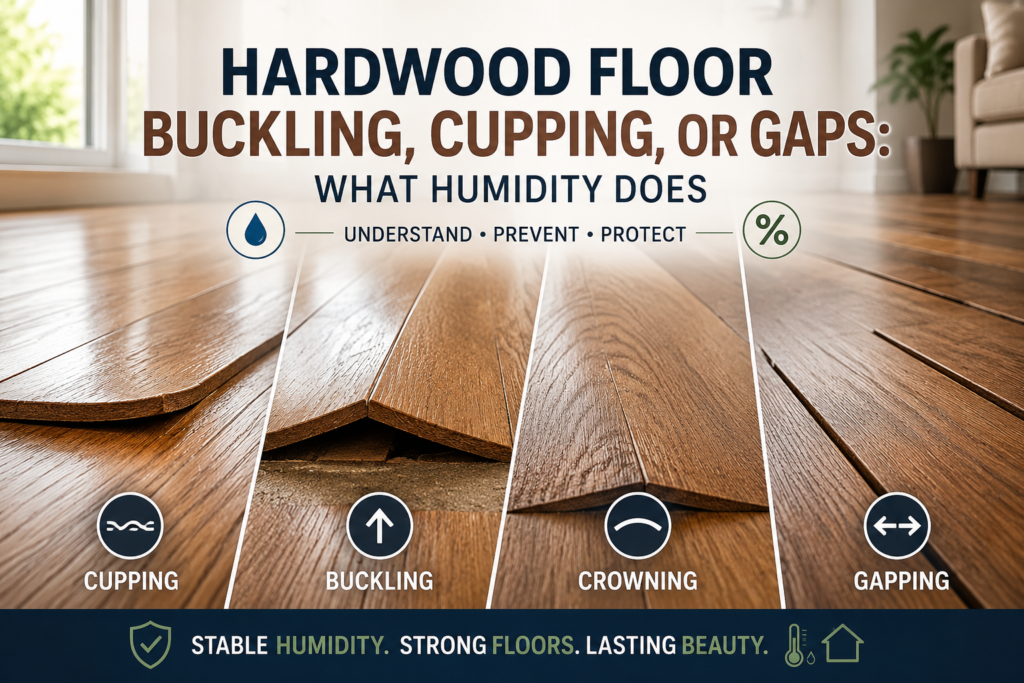
| Symptom | What it looks like | Cause |
|---|---|---|
| Cupping | Board edges higher than the center, washboard look | Moisture from below or high humidity — bottom of boards wetter than top |
| Crowning | Board centers higher than edges | Often follows cupping that was sanded too early, or top-side moisture |
| Buckling | Boards lift completely off the subfloor | Severe moisture — a leak, flooding, or extreme humidity |
| Gapping | Visible gaps between boards | Wood too dry — low indoor humidity, usually winter |
Summer Specifically: Why It Happens in June Through August
Wood is hygroscopic — it constantly exchanges moisture with the surrounding air. In humid summer conditions, hardwood absorbs moisture from the air and expands. If indoor humidity is not controlled, the boards swell, push against each other, and can cup or buckle. Homes without air conditioning or dehumidification, homes over crawl spaces, and rooms over unconditioned basements are most prone to summer hardwood movement.
Safety First
- Severe buckling can create trip hazards and lifted boards with exposed fasteners. Keep traffic off badly buckled areas.
- If buckling is sudden and localized, suspect an active water source — a plumbing leak, an appliance leak, or water intrusion. Find and stop the water before addressing the floor. See our hidden water source guide.
- Do not attempt to sand or repair actively moving wood — wait until moisture conditions stabilize, or you may lock in damage.
What to Do First
- Measure indoor humidity. Use a hygrometer. Hardwood floors are happiest at 35 to 55% relative humidity. Summer cupping usually means humidity is too high (above 55 to 60%).
- Determine if it is gradual or sudden. Gradual, whole-room cupping in summer points to ambient humidity. Sudden, localized buckling points to a water leak. The distinction changes everything.
- Check for water sources if localized. Look for nearby plumbing, appliances (dishwasher, refrigerator, washing machine), or signs of a leak from above or below. See our guides on dishwasher leaks and refrigerator issues.
- Check the basement or crawl space below. High moisture below the floor (an unconditioned, humid crawl space or a damp basement) drives moisture up into the flooring. See our basement moisture guide.
- Run air conditioning or a dehumidifier. Bringing indoor humidity into the 35 to 55% range allows mildly cupped wood to gradually release moisture and often return to flat over weeks.
The Most Important Principle: Wood Moves, and That Is Normal
Some seasonal movement in hardwood is normal and expected. Slight gapping in winter (dry) and slight tightening in summer (humid) is part of how wood behaves. The goal is not zero movement — it is keeping humidity in a stable range so the movement stays minor and the wood returns to normal each season. Problems arise when humidity swings are extreme or when a water source introduces moisture the wood cannot handle.
Can Cupped Wood Recover?
- Mild cupping from seasonal humidity: Often recovers on its own once humidity is brought back into range. Be patient — it can take weeks to months for the wood to re-equilibrate.
- Cupping from a resolved leak: May recover partially once fully dried, but severe cases may need board replacement.
- Buckling: Usually requires professional repair or board replacement, as the boards have lifted from the subfloor and the bond is broken.
- Do not sand cupped wood until it has fully dried and stabilized — sanding cupped wood flat while it is still swollen results in crowning (centers higher than edges) once it dries.
What Not to Do
- Do not sand or refinish cupped or buckled wood while it is still actively swollen — wait for full stabilization, or you lock in permanent damage.
- Do not use a heat source or fans to “dry out” wet hardwood rapidly — fast, uneven drying causes cracking and additional movement.
- Do not ignore sudden localized buckling — it almost always means an active water source that will keep causing damage.
- Do not install or repair hardwood without acclimating the wood to the home’s humidity first — improper acclimation is a leading cause of future movement.
- Do not assume gaps in winter mean a defect — minor seasonal gapping is normal and often closes again in summer.
Related Guides
- Basement Walls Sweating: Humidity Below the Floor
- Water Stain on Ceiling: Finding Hidden Leaks
- Interior Repairs, Finishes & Living Spaces
Safe DIY Checks
- Measure indoor humidity with a hygrometer — target 35 to 55%.
- Determine if movement is gradual/whole-room (humidity) or sudden/localized (leak).
- Check for nearby water sources if movement is localized.
- Inspect the basement or crawl space below for high moisture.
- Run AC or a dehumidifier to bring humidity into range.
- Allow time for mildly cupped wood to recover before any repair.
When to Call a Professional
- Boards have buckled and lifted from the subfloor — professional repair or replacement is needed.
- The movement is sudden and localized and you cannot find or stop the water source.
- Cupping does not improve after humidity is brought into range for several weeks.
- You need cupped or buckled flooring sanded or refinished — timing this correctly requires professional judgment.
- A crawl space or basement moisture problem needs to be addressed at the source.
Prevention Tips
- Keep indoor relative humidity in the 35 to 55% range year-round — a dehumidifier in summer, a humidifier in dry winter.
- Run air conditioning during humid months — it dehumidifies as it cools.
- Address crawl space and basement moisture, which drives humidity up into the flooring from below.
- Wipe up spills on hardwood immediately — standing water is quickly absorbed.
- Use a hygrometer to monitor humidity, especially in homes with valuable or large hardwood installations.
- When installing new hardwood, acclimate it in the home for the manufacturer-recommended period before installation.
Recommended Next Step
Measure your indoor humidity first. Summer cupping almost always means humidity is too high — running air conditioning or a dehumidifier to bring it into the 35 to 55% range allows mild cupping to recover over time. If the movement is sudden and localized rather than gradual and widespread, look for a water leak immediately, because that will keep damaging the floor until it is stopped. For buckled boards that have lifted, a flooring professional is needed.
Frequently Asked Questions
Will my cupped hardwood floor flatten out on its own?
Mild cupping from seasonal humidity often does recover on its own once indoor humidity is brought back into the 35 to 55% range — but it takes patience, sometimes weeks to months, for the wood to slowly release the absorbed moisture. Do not rush it with heat or aggressive drying, and do not sand it flat while it is still swollen.
Why does my hardwood floor have gaps in winter but not summer?
This is normal seasonal wood movement. In dry winter air, the wood releases moisture and contracts, opening small gaps. In humid summer air, it absorbs moisture and expands, closing the gaps. Minor seasonal gapping is expected. Keeping winter indoor humidity from dropping too low (with a humidifier) minimizes it.
What humidity level is best for hardwood floors?
Most hardwood flooring is designed for 35 to 55% relative humidity. Staying in this range year-round minimizes movement. Summer problems usually come from humidity above 55 to 60%; winter gaps come from humidity below 35%. A hygrometer lets you monitor and respond.
How do I know if buckling is from humidity or a leak?
Pattern and speed are the clues. Humidity-driven movement is gradual and affects whole rooms or areas evenly. Leak-driven buckling is sudden and localized — concentrated near a specific spot like under a dishwasher, near a bathroom, or along one wall. Sudden localized buckling almost always means an active water source.
Can I prevent hardwood movement entirely?
No — some seasonal movement is inherent to wood and is normal. The goal is to keep it minor by maintaining stable indoor humidity in the 35 to 55% range. Extreme humidity swings, water leaks, and improperly acclimated flooring are what turn normal minor movement into damaging cupping, buckling, or large gaps.