
Quick Answer
A toilet that flushes weakly or incompletely but is not actually clogged usually has one of these causes: clogged rim jets under the bowl rim, a low water level in the tank, a flapper closing too early, or a partially blocked vent. The flush works but is weak — water swirls sluggishly rather than clearing the bowl with force. Each has a specific homeowner fix. This is different from a clogged or overflowing toilet.
Weak Flush vs Clog — How to Tell
A clog causes water to rise and drain slowly or not at all. A weak flush clears eventually but without force — the bowl does not fully empty, waste is left behind, or you need to flush twice. If a plunger and auger find no blockage, the problem is flush power, not a clog.
Cause Diagnosis Table
| Symptom | Most likely cause | Fix |
|---|---|---|
| Weak swirl, water enters slowly around the rim | Clogged rim jets (mineral buildup under the rim) | Clean rim jets with vinegar and a wire |
| Flush starts then stops short | Flapper closing too early; chain too long | Adjust flapper chain; replace worn flapper |
| Low water in the tank | Fill valve shutting off too early; float set too low | Adjust float to raise tank water level |
| Low water in the bowl itself | Partial blockage in the trap or a venting issue | Check vent; auger the trap; refill bowl |
| Flush is weak on a low-flow toilet from the start | Older first-generation low-flow design limitation | Optimize all components; consider modern replacement |
| Gurgling during flush, slow bowl refill | Partial vent stack blockage | See venting section; may need a plumber |
The Most Overlooked Cause: Clogged Rim Jets
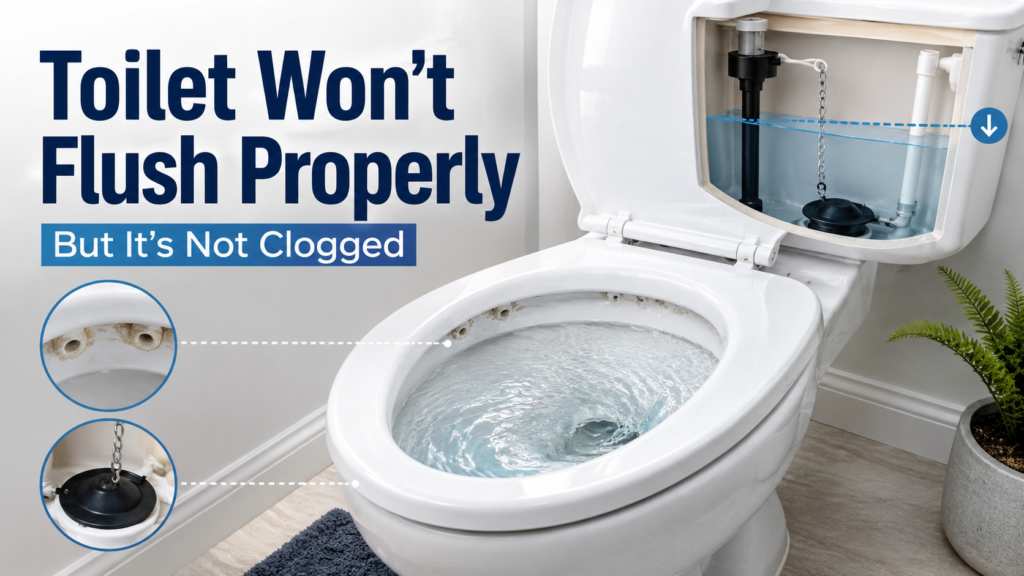
Under the rim of the toilet bowl are a series of small holes (rim jets) that release water during a flush, creating the swirling action that clears the bowl. Over time, mineral deposits — especially in hard water areas — clog these holes, weakening the flush significantly. Most homeowners never think to check them.
- Use a small mirror or your fingers to feel under the bowl rim for the jet holes.
- If they are crusty or partially blocked with white mineral deposits, they are restricting flush water.
- To clean: pour white vinegar into the overflow tube in the tank (the vinegar travels through the rim jets), or apply vinegar directly under the rim and let it sit.
- Use a small wire, a thin Allen wrench, or a toothpick to clear each individual jet hole.
- Flush and assess the improvement in swirl strength.
Safety First
- This is a low-risk repair, but turn off the water supply valve before removing or adjusting tank components.
- Do not mix cleaning products — vinegar alone is sufficient and safe for cleaning rim jets and tank components.
- If you remove the toilet to access a deeper clog, you will need a new wax ring to reseal it — see our notes on toilet seals in the sewer smell guide.
Fix 2 — Check the Tank Water Level
The flush is powered by the volume of water dropping from the tank. If the tank water level is too low, the flush is underpowered.
- Remove the tank lid and look at the water level. It should be about 1 inch below the top of the overflow tube.
- If the water is well below that line, the flush has less power than designed.
- Adjust the float upward: for a cylinder float, pinch the clip and slide it up; for a ball float, adjust the screw or gently bend the arm up.
- Flush and confirm the tank now fills to the correct level.
Fix 3 — Adjust the Flapper and Chain
If the flapper closes before the tank fully empties, the flush is cut short. The chain connecting the flush handle to the flapper should have only about 1/2 inch of slack.
- Too much slack: the flapper does not lift fully, releasing less water. Shorten the chain.
- A worn or warped flapper closes too early — replace it (a $5 to $10 part). See our running toilet guide for flapper replacement steps.
About Venting — When the Flush Gurgles
A toilet needs proper venting to flush with full force. If the vent stack (which runs up through the roof) is partially blocked, the flush pulls a partial vacuum that weakens it and causes gurgling. Signs of a vent issue: gurgling during or after flush, slow bowl refill, and multiple fixtures draining slowly. A blocked vent is usually a plumber job, as it often requires roof access to clear the stack.
What Not to Do
- Do not repeatedly flush a weak toilet hoping it clears — if it is not a clog, repeated flushing does not help and wastes water.
- Do not pour chemical drain cleaner into a toilet — it is ineffective for flush-power issues and can damage components.
- Do not ignore clogged rim jets — they are the most common cause of gradual flush weakening and the most overlooked.
- Do not assume a weak flush means you need a new toilet — most causes are inexpensive component or cleaning fixes.
Related Guides
- Toilet Overflowing: What to Do First
- Toilet Runs Constantly: Flapper and Fill Valve
- Plumbing & Water Systems
Safe DIY Checks
- Confirm it is a weak flush, not a clog — a plunger and auger find no blockage.
- Check and clean the rim jets under the bowl rim — most overlooked cause.
- Check the tank water level — should be 1 inch below the overflow tube.
- Adjust the flapper chain to about 1/2 inch of slack.
- Listen for gurgling during flush — points to a vent issue.
When to Call a Licensed Plumber
- Cleaning the rim jets, adjusting the tank level, and checking the flapper do not restore flush power.
- The flush gurgles and multiple fixtures drain slowly — likely a vent stack blockage requiring roof access.
- You suspect a partial blockage deep in the trap or drain line that an auger does not reach.
- The bowl water level is consistently low despite a full tank — a possible trap or venting issue.
Prevention Tips
- Clean the rim jets every 6 months in hard water areas to prevent mineral buildup.
- Do not use in-tank drop-in bleach tablets — they degrade rubber flappers and seals, leading to weak flushes over time.
- Keep the tank water level at the correct mark.
- Replace the flapper every 4 to 5 years preventively.
Recommended Next Step
Confirm it is a weak flush rather than a clog. Then check the rim jets first — clogged jets are the most common and most overlooked cause of gradual flush weakening. Clean them with vinegar and a wire, then check the tank water level and flapper. If gurgling is present and these fixes do not help, a vent stack issue may need a plumber.
Frequently Asked Questions
Why does my toilet need two flushes to clear the bowl?
The most common causes are clogged rim jets (reducing swirl power), a low tank water level, or a flapper closing too early. All three reduce the volume or force of water in a single flush. Check the rim jets and tank level first — these resolve the majority of double-flush issues.
How do I clean toilet rim jets?
Pour white vinegar into the tank’s overflow tube and let it sit for several hours — it travels through the jets and dissolves mineral buildup. For stubborn deposits, apply vinegar directly under the rim and clear each jet hole with a small wire, thin Allen wrench, or toothpick.
Could a weak flush be a venting problem?
Yes. If the flush gurgles, the bowl refills slowly, and other fixtures drain slowly too, a partially blocked vent stack may be the cause. The vent allows air into the drain system for proper flushing. A blocked vent usually requires a plumber to clear from the roof.
Are low-flow toilets just weaker?
First-generation low-flow toilets (1990s) had genuine performance issues. Modern low-flow toilets (post-2010) are engineered to flush effectively with less water. If you have an older low-flow toilet that has always flushed weakly, optimizing the components helps, but a modern replacement performs significantly better.
Can hard water cause a weak flush?
Yes — directly. Hard water deposits minerals in the rim jets, gradually clogging them and weakening the flush over months and years. This is the single most common cause of a flush that has slowly gotten weaker over time. Regular cleaning with vinegar prevents it.