What This Guide Helps With
This guide explains how to run a portable generator safely during a power outage, with a strong focus on the carbon monoxide risk that causes injuries and deaths every year when generators are used incorrectly. It covers placement, wiring, fuel handling, and the checks to do before you ever need one in an emergency.
Quick Answer
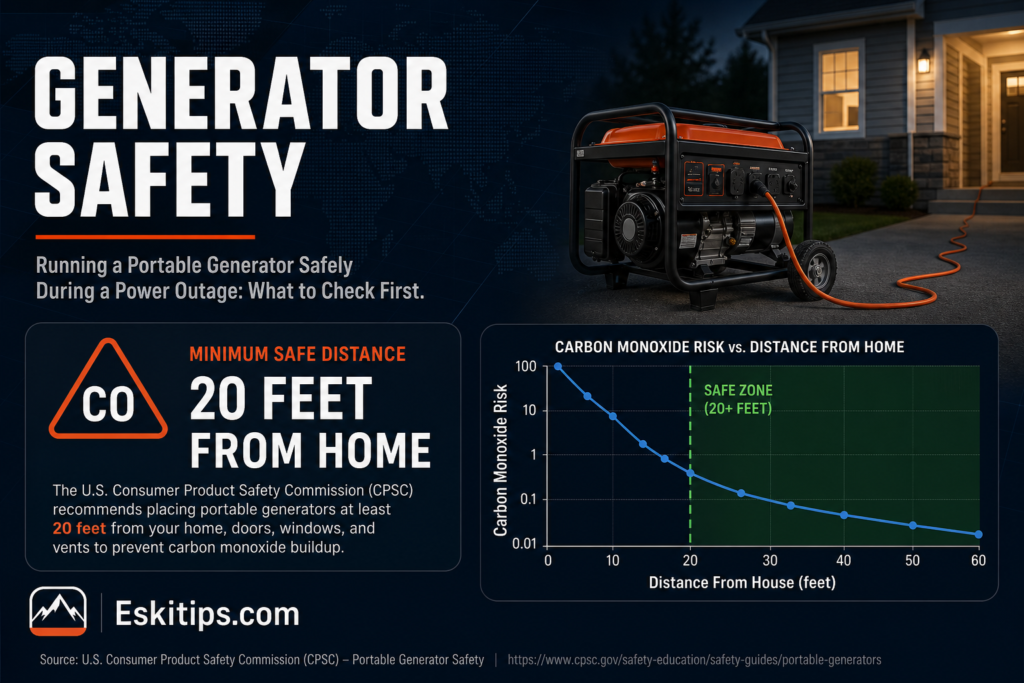
A portable generator must run outdoors, at least 20 feet from any door, window, or vent, with the exhaust pointed away from the house. Never run one in a garage, carport, basement, crawlspace, or under a covered porch — open garage doors and fans do not make it safe. Connect appliances directly with heavy-duty outdoor-rated extension cords, or use a properly installed transfer switch for whole-circuit power. Never plug a generator directly into a wall outlet — this can send power backward into utility lines and electrocute repair crews.
Safety First
Carbon monoxide from generator exhaust is colorless, odorless, and can be fatal within minutes at high concentrations.
- Install battery-powered carbon monoxide alarms on every level of the home before you ever need to run a generator — see our CO alarm guide for what an alarm means if it sounds.
- Never run a generator inside any enclosed or partially enclosed space, including a garage with the door open, a porch, a shed, or under an eave.
- Keep the generator dry and never touch it with wet hands or while standing in water.
- Let the generator cool completely before refueling — spilled gasoline on a hot engine is a fire risk.
What to Do First
- Place the generator outdoors on a dry, level surface at least 20 feet from the house, with the exhaust directed away from windows, doors, and vents — including neighboring homes if you live close together.
- Let the generator run for a minute or two before connecting anything to stabilize its output.
- Use heavy-duty, outdoor-rated extension cords rated for the wattage of what you’re connecting, run through a window or door gap without pinching them, never underwater or through standing water.
- Add appliances one at a time, starting with the highest-draw item (usually the refrigerator or a window AC unit), and check the generator is not overloaded before adding the next.
- If you have a transfer switch installed, follow its labeled sequence exactly — this is the only method that safely powers built-in circuits and prevents backfeed into utility lines.
- Keep a log of run time and refueling so you don’t run the tank dry unexpectedly or lose track of maintenance needs mid-outage.
What Not to Do
- Do not run a generator in a garage even with the door open — CO can still build to lethal levels and drift into the home.
- Do not “backfeed” power by plugging the generator into a wall outlet with a double-male cord — this is illegal in most jurisdictions and can kill utility workers repairing lines they believe are dead.
- Do not overload the generator by connecting more than its rated wattage; this can damage both the generator and connected appliances.
- Do not refuel a hot or running generator.
- Do not run extension cords through standing water or where they can be pinched by doors and windows.
- Do not store gasoline for the generator inside the house — keep it in an approved container in a detached, ventilated space.
Common Generator Problems and What They Mean
| Symptom | What it usually means | What to do |
|---|---|---|
| Generator won’t start | Stale fuel, dead battery, or fouled spark plug | See our generator won’t start guide |
| CO alarm sounds while generator is running | Exhaust is entering the home through a door, window, or vent | Evacuate immediately, shut off the generator once outside, do not re-enter until aired out |
| Appliances shut off or trip breaker while on generator | Generator is overloaded past its rated wattage | Disconnect one appliance at a time until load is within rated capacity |
| Generator runs but connected devices get no power | Faulty extension cord, tripped generator breaker, or GFCI outlet issue on the unit | Check generator’s own breaker and outlet before assuming a device fault |
| Lights flicker or dim under load | Generator near its wattage limit, or engine speed regulation issue | Reduce connected load; have the unit serviced if it persists on light loads |
Safe DIY Checks
- Confirm your generator’s rated and surge wattage, and add up the wattage of everything you plan to run before an emergency, not during one.
- Test-run the generator for a few minutes every month or two so you know it starts when you need it.
- Check that CO alarms in the home have fresh batteries and are not past their replacement date (usually 5 to 10 years).
- Inspect extension cords for cracks, exposed wire, or damaged plugs before storing them for the season.
When to Call a Professional
Call a licensed electrician if:
- You want to power specific house circuits (not just individual devices) — this requires a properly installed transfer switch, not extension cords.
- You’re considering a standby generator wired directly into your home’s electrical system.
- You notice any burning smell, sparking, or damaged wiring on the generator or its cords.
Call emergency services immediately and evacuate if a carbon monoxide alarm sounds while any fuel-burning equipment is running, and do not re-enter until the space has been ventilated and checked.
Prevention Tips
- Install a transfer switch before the next outage season if you plan to power circuits rather than individual cords — this is safer and far more convenient during an actual emergency.
- Keep fresh, stabilized fuel on hand and rotate your stored gasoline supply according to the stabilizer’s rated shelf life.
- Place CO alarms on every level of the home, including near sleeping areas, regardless of whether you own a generator.
- Keep the generator’s manual accessible — wattage ratings and startup sequences vary by model.
Recommended Next Step
Before the next outage, walk through your generator setup in daylight: confirm placement 20 feet from the house, check your extension cords, and add up the wattage of what you plan to run. If you want whole-circuit power rather than a tangle of cords, have an electrician install a transfer switch — it’s a one-time cost that removes the most dangerous mistakes people make with portable generators during a real emergency.
Related Guides
- Carbon Monoxide Alarm Going Off: What to Do
- Backup Generator Won’t Start When the Power Goes Out
- Rolling Blackouts and Planned Power Outages: How to Prepare
Frequently Asked Questions
How far from the house does a generator need to be?
At least 20 feet, with the exhaust pointed away from windows, doors, and vents. This distance also applies to neighboring homes if you live close together — carbon monoxide can drift and accumulate in a neighbor’s home just as easily as your own.
Can I run a generator in my garage with the door open?
No. An open garage door does not provide enough ventilation to prevent carbon monoxide from building to dangerous levels, both inside the garage and inside the attached home. Generators must run outdoors in the open air.
What is generator backfeeding and why is it dangerous?
Backfeeding is plugging a generator into a home’s wall outlet to power circuits, which sends electricity backward through the meter and out onto utility lines. Utility workers repairing what they believe is a dead line can be electrocuted. A licensed transfer switch is the only safe way to power house circuits from a generator.