What This Guide Helps With
This guide explains why patio pavers or concrete slabs crack, sink, or heave, how to tell a cosmetic issue from a drainage or soil problem underneath, and the safe steps to assess it before deciding on a repair.
Quick Answer
Patio cracking and heaving is almost always a symptom of what’s happening underneath the surface, not a defect in the pavers or concrete itself — unstable, poorly compacted base material, water pooling and eroding the base, tree roots pushing up from below, or seasonal freeze-thaw and expansive soil movement are the most common causes. A single hairline crack in a large concrete slab is often just normal control-joint behavior; sections that have visibly sunk, heaved, or separated at the joints point to a base or drainage problem that will keep recurring until it’s addressed.
Safety First
- Treat any raised or uneven paver as a trip hazard and mark or block it off, especially along walkways used at night.
- If cracking or heaving is near the home’s foundation, check whether it lines up with any foundation cracks inside — see our foundation crack guide for what different crack patterns mean.
- Call 811 before any excavation to repair a base, especially near utility lines running through the yard.
What to Do First
- Look at where water goes during rain. Standing water on or near the patio, or water pooling against the house foundation nearby, is one of the most common root causes of both cracking and heaving.
- Check for a pattern related to trees. Cracking or heaving that radiates from one direction, especially toward a large tree, often means root growth is lifting the base from below.
- Distinguish sinking from heaving. Sunken sections point to erosion or settling of the base material; raised or heaved sections point to expansive soil, frost action, or root intrusion pushing upward.
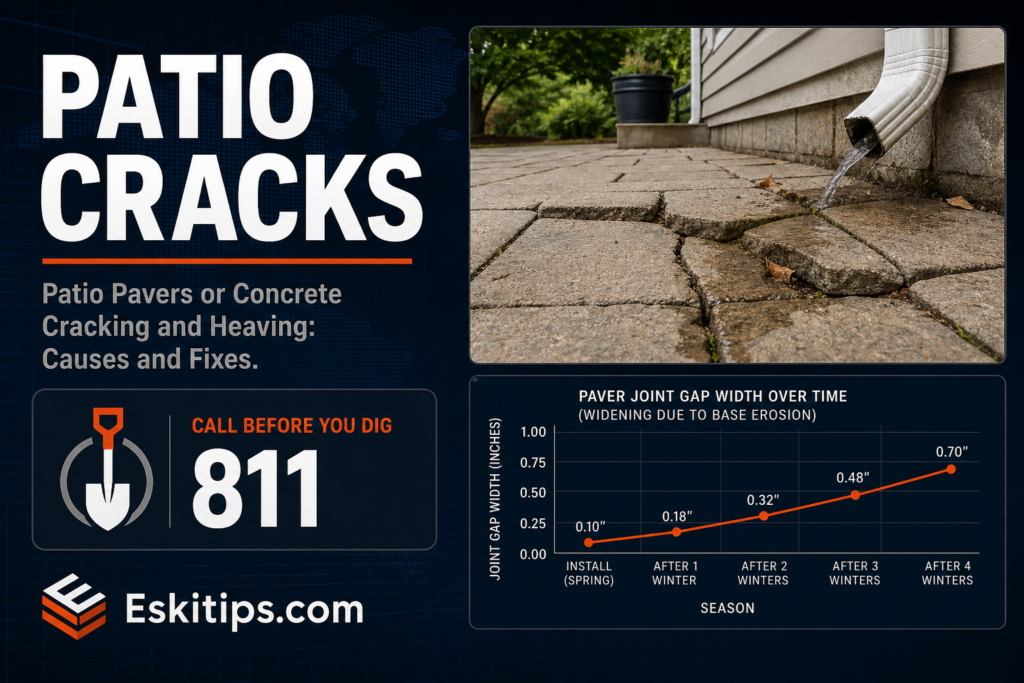
- Check paver joints specifically — for paver patios, widened or uneven joints with sand washing out are an early sign of base erosion before individual pavers visibly shift.
- Look at nearby downspouts and grading — a downspout draining directly onto or near the patio base is a common, fixable cause of localized erosion and settling.
What Not to Do
- Do not simply fill cracks or relevel pavers without addressing the underlying drainage or base issue — the same problem will resurface within a season or two.
- Do not ignore a downspout draining onto the patio — this is one of the most overlooked and easiest-to-fix causes of recurring settling.
- Do not cut visible tree roots near a patio without consulting an arborist first — removing the wrong roots can destabilize or kill a mature tree.
- Do not assume all cracking is cosmetic — cracks that continue to widen over successive seasons indicate an active, ongoing base problem.
Common Causes of Patio and Concrete Damage
| Symptom | Likely cause | What to do |
|---|---|---|
| Section sunk lower than surrounding area | Eroded or poorly compacted base material, often from water infiltration | Correct drainage first; then have the section re-based and releveled |
| Section heaved or pushed upward | Expansive soil, frost heave, or tree root growth beneath | Identify the cause before repair; root barrier or drainage correction may be needed |
| Paver joints widening, sand washing out | Base erosion beginning, often from a nearby drainage issue | Address drainage; refill joints and consider polymeric sand |
| Cracking radiating from one direction | Root intrusion from a nearby tree | Consult an arborist before any root removal; consider a root barrier for future work |
| Cracking along the same lines every season | Normal control joints doing their job in concrete, if hairline and stable | Monitor; seal minor cracks to prevent water infiltration |
Safe DIY Checks
- Watch where water flows during the next rain and note any pooling near or on the patio.
- Measure crack width with a coin or ruler and recheck seasonally — growing cracks indicate an active problem, stable ones are lower priority.
- Check downspout extensions to confirm they direct water at least several feet away from the patio and foundation.
- Look for visible root growth breaking the surface near affected sections.
When to Call a Professional
Call a hardscape or concrete contractor if:
- Multiple sections are sinking, heaving, or separating, suggesting a base-wide issue rather than one isolated spot.
- Cracking is near the foundation and you’re unsure whether it’s related to a structural issue — pair this with a look at our foundation crack guide.
- You suspect tree root involvement, since this often requires an arborist’s input before any repair to avoid harming the tree or having the problem recur.
Prevention Tips
- Direct all downspouts and grading away from patio areas, ideally at least several feet clear of the edge.
- Choose paver systems with proper base preparation (compacted gravel, geotextile fabric) over slabs poured directly on unprepared soil.
- Have large trees near hardscaping assessed by an arborist periodically, especially fast-growing or shallow-rooted species.
- Reapply polymeric sand to paver joints every few years as routine maintenance to prevent early-stage base erosion.
Recommended Next Step
Before repairing any cracked or heaved section, trace the problem back to its cause — water flow, root growth, or base erosion — since fixing the surface without addressing what’s underneath means the damage will likely return. If multiple sections are affected or the cause isn’t obvious, a hardscape contractor can assess the base and recommend a lasting fix.
Related Guides
- Foundation Crack Width Chart: When to Worry and What to Do
- Gutters Overflowing in Heavy Rain: Causes and What to Check
- Deck Boards Rotting or Soft: How to Assess and What to Do
Frequently Asked Questions
Is cracked concrete on a patio always a structural problem?
No, hairline cracks along control joints are often a normal part of how concrete manages shrinkage and temperature changes, and they’re generally low concern if they stay stable in width. Cracks that continue widening, run diagonally across a large section, or accompany visible sinking or heaving indicate an active underlying problem worth addressing.
Can tree roots really lift a concrete patio?
Yes, tree roots seeking moisture and oxygen can grow directly beneath a patio’s base and gradually push sections upward as they thicken, which is why cracking that radiates from one direction, especially toward a large nearby tree, is a common pattern worth investigating.
Will fixing my downspout drainage actually stop my patio from sinking further?
In many cases, yes — a downspout draining directly onto or near a patio base is one of the most common and fixable causes of erosion-driven sinking. Correcting the drainage doesn’t undo existing damage, but it does stop the ongoing erosion that would otherwise continue undermining a repair.