Quick Answer
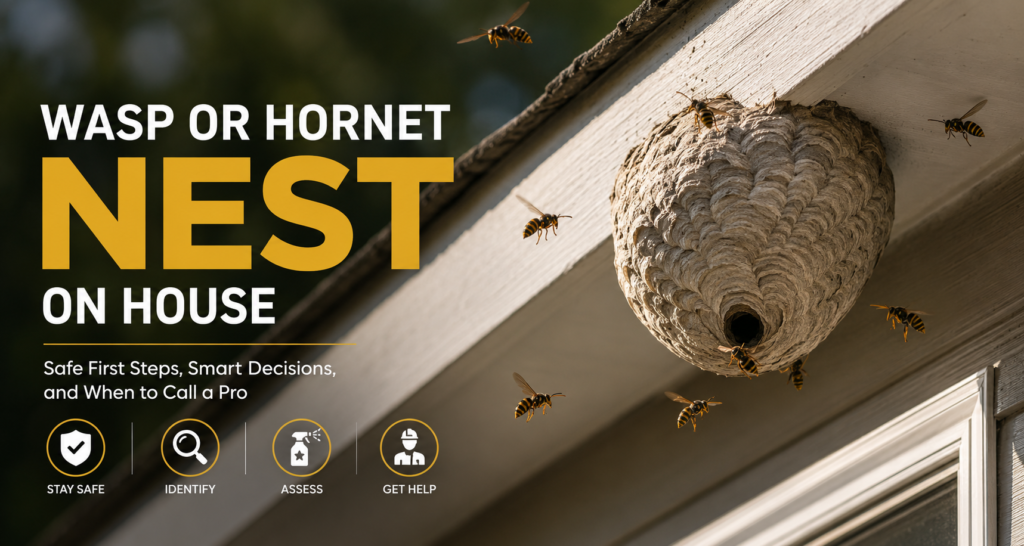
If you find a wasp or hornet nest on your house, the safest approach depends on the nest size and location. Small, new nests (golf-ball size, early summer) can often be handled by a homeowner with proper precautions and timing. Large nests, nests inside walls, or nests of aggressive species like yellowjackets and bald-faced hornets are best left to a professional. Never knock down a nest during the day or without an escape plan — this is how most stings happen.
Safety First — Read This Before Anything Else
- If anyone in the household has a known allergy to bee or wasp stings, do not attempt removal yourself. A single sting can be a medical emergency. Hire a professional.
- Never remove a nest during the day when wasps are active and the colony is at full strength. Wasps are least active and mostly inside the nest at night and in cool early morning.
- Always have a clear, unobstructed escape path before approaching a nest. Most stings happen when people panic and cannot retreat.
- Do not stand on a ladder while treating a nest. A defensive swarm while you are on a ladder can cause a fall — a more serious injury than the stings. Treat only nests you can reach with both feet on the ground.
- Never seal a nest entry point inside a wall while the colony is alive — trapped wasps will chew through drywall into the living space looking for another exit.
Identify the Insect First — It Changes the Approach
| Insect | Nest appearance | Aggressiveness | Approach |
|---|---|---|---|
| Paper wasps | Open, umbrella-shaped honeycomb under eaves | Moderate — defensive near nest | Small nests: DIY possible with caution |
| Yellowjackets | Enclosed nest, often in ground, wall voids, or eaves; rapid in-and-out traffic | Very aggressive | Professional recommended, especially in walls |
| Bald-faced hornets | Large gray football-shaped enclosed nest, often in trees or on walls | Very aggressive | Professional recommended |
| Mud daubers | Small tube-like mud structures | Very docile — rarely sting | Easy DIY; often just scrape off |
| Honeybees | Wax comb, large swarm | Defensive but beneficial | Call a beekeeper — do not exterminate |
Honeybees Are Different — Do Not Exterminate
If you have identified honeybees (not wasps or hornets), do not kill them. Honeybees are vital pollinators and many are protected or in decline. Contact a local beekeeper or bee removal service — many will relocate a honeybee swarm for free or a small fee. Honeybees in a wall cavity require professional removal to extract the comb and honey, which would otherwise rot and attract pests.
What to Do First (Small Wasp Nest, Homeowner-Appropriate)
- Confirm the species and nest size. Only proceed yourself for small paper wasp nests or mud daubers within easy ground reach. Anything large, enclosed, or aggressive: call a professional.
- Wait until night or cool early morning. Wasps are inside the nest and least active. Do not use a bright white flashlight directly — it can rouse them. Use a red-filtered light or position a light to the side.
- Wear protective clothing. Long sleeves, long pants tucked into socks, gloves, closed shoes, and ideally a hat and face covering. Wasps target dark openings and exposed skin.
- Plan your escape route. Know exactly where you will walk away to, with no obstacles.
- Use a wasp spray with a long-distance jet (15 to 20 feet range). Stand at the edge of the spray range, aim at the nest opening, and saturate it. Do not stand directly under the nest.
- Retreat immediately after spraying — do not wait to watch. Leave the area.
- Wait 24 hours and observe from a distance. If activity continues, repeat treatment at night. Only remove the physical nest once you confirm no live activity for a full day.
What Not to Do
- Do not knock down or spray a nest during daytime when wasps are active and numerous.
- Do not use a ladder to reach a high nest — treat only ground-reachable nests yourself, and call a professional for high ones.
- Do not seal a wall void entry point while the colony is alive — trapped wasps chew into the living space.
- Do not use fire or gasoline on a nest — this is extremely dangerous, a fire hazard, and ineffective.
- Do not attempt removal at all if anyone in the home is allergic, or if the nest is large or belongs to an aggressive species.
- Do not swat at wasps near the nest — crushed wasps release alarm pheromones that trigger the colony to attack.
Related Guides
- Ants in the House: First Steps
- Caulk Around Windows: Sealing Entry Points
- Yard, Landscaping & Outdoor Living
Safe DIY Assessment
- Identify the species — wasp, hornet, mud dauber, or honeybee.
- Assess nest size and location — only small, ground-reachable nests are DIY-appropriate.
- Confirm no one in the household has a sting allergy.
- Treat only at night or cool early morning with protective clothing and an escape plan.
- Use long-range spray from the edge of its range — never directly underneath.
When to Call a Pest Professional
- The nest is large, enclosed (football-shaped), or belongs to yellowjackets or bald-faced hornets.
- The nest is inside a wall void, attic, or any space you cannot directly access.
- The nest is high up and would require a ladder to reach.
- Anyone in the household has a sting allergy.
- You have treated a nest twice and activity continues.
- You are unsure of the species or unsure whether you can do it safely.
Prevention Tips
- In early spring, inspect eaves, soffits, and overhangs for the start of new nests — small early nests are far easier to handle than established summer colonies.
- Seal gaps and cracks around the roofline, soffits, and utility penetrations where wasps enter wall voids.
- Keep outdoor trash bins sealed — they attract yellowjackets searching for food.
- Hang a decoy nest — some wasp species are territorial and avoid building near an existing nest.
- Repair torn screens and seal openings to prevent indoor entry.
Recommended Next Step
Identify the species and assess the nest size and location before deciding. Small paper wasp nests within ground reach can be treated at night with proper protection and an escape plan. Anything large, enclosed, in a wall, high up, or involving an aggressive species or a household allergy is a job for a professional. When in doubt, the cost of a professional is far less than an emergency room visit.
Frequently Asked Questions
What time of day is safest to remove a wasp nest?
Night or very early morning, when temperatures are cool and wasps are inside the nest and least active. Never treat a nest during the warm, active daytime hours. Use a side-positioned or red-filtered light rather than shining a bright white light directly on the nest.
Is it safe to spray a wasp nest myself?
For a small paper wasp nest within ground reach, with proper protective clothing, the right long-range spray, an escape plan, and no household allergies — yes, with caution. For large nests, enclosed hornet or yellowjacket nests, nests in walls, or high nests requiring a ladder, professional removal is safer and recommended.
What happens if I seal a wasp nest in my wall?
Trapped wasps will look for another exit — and that often means chewing through the interior drywall into your living space. Never seal a wall-void entry point while the colony is alive. The colony must be eliminated first, then the entry can be sealed.
How do I tell wasps from honeybees?
Wasps have smooth, shiny bodies with a narrow waist and bright yellow-and-black or white-and-black markings. Honeybees are fuzzier, more golden-brown, and rounder. Honeybees build wax comb; wasps build paper nests. If you have honeybees, contact a beekeeper rather than exterminating them — they are beneficial pollinators.
Why are there so many wasps around my house in late summer?
Wasp colonies grow throughout the summer, reaching peak population in late summer and early fall. At the same time, their natural food sources decline, making them more aggressive and more likely to scavenge around homes, trash, and outdoor eating areas. Early-season nest removal prevents large late-summer colonies.