Quick Answer
A garage door that will not open and a garage door that will not close have two almost completely different sets of causes. Not opening: most likely a dead remote battery, a tripped circuit, the door being manually locked, or a broken torsion spring. Not closing: most likely a blocked or misaligned safety sensor — the most common cause, and the one homeowners almost always overlook. Identify which direction the door fails in before troubleshooting anything.
The Won’t Open vs Won’t Close Distinction
| Problem | Most likely cause | First check |
|---|---|---|
| Door will not open — remote does not work | Dead remote battery; signal range issue; remote not paired | Replace battery; try wall button instead |
| Door will not open — wall button also fails | Opener not receiving power; tripped breaker; disconnect cord pulled | Check outlet power and breaker; check disconnect cord |
| Door will not open — opener runs but door does not move | Broken torsion spring; disconnect cord engaged | Look for broken spring above door; check disconnect |
| Door will not close — remote and wall button work but door reverses | Safety sensor blocked, dirty, or misaligned — most common cause | Clean sensor lenses; confirm sensors face each other |
| Door will not close — closes part way then reverses | Close-limit setting too short; obstruction in track; force sensitivity too high | Check track for debris; adjust limit settings |
| Door closes very slowly or struggles | Spring tension low; track misalignment; rollers worn | Check track alignment; spring assessment by professional |
| Summer heat specific: door reverses or sticks | Thermal expansion of metal tracks; direct sunlight confusing sensor | See summer heat section below |
Safety First
- Never attempt to adjust or replace garage door torsion springs yourself. These springs are under extreme tension — a failed spring can cause serious injury. Torsion spring work is a licensed garage door technician job.
- Do not operate a door with a broken spring. The opener is not designed to lift the full door weight without spring assist and the door can fall.
- Do not bypass the safety sensors permanently. The infrared safety sensors exist to prevent the door from closing on a person, pet, or vehicle. Operating with bypassed sensors is a serious safety hazard.
- If the door is stuck partially open and you need to use the garage: pull the red disconnect cord to release the door from the opener, manually open the door fully, and support it in the up position with locking pliers on the track below the bottom roller to prevent it from falling while you retrieve your vehicle.
Fix 1 — Safety Sensor Check (Most Common Won’t-Close Cause)
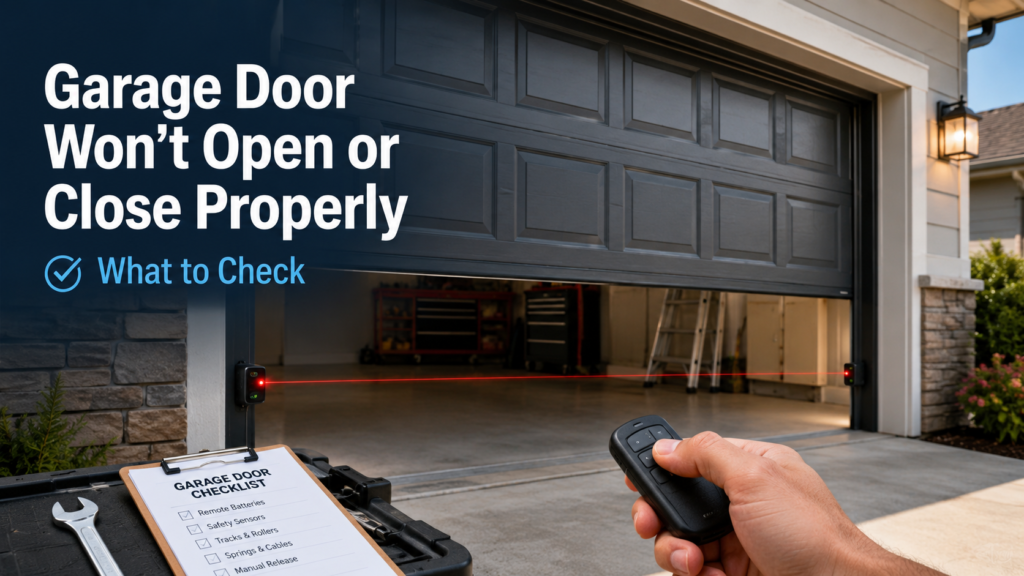
Every garage door opener made since 1993 has two safety sensors near the bottom of the door tracks — one sender (usually yellow LED) and one receiver (usually green LED). The green LED must be solid for the door to close. A blinking green LED or an unlit LED means the circuit is broken.
- Look at both sensors — one on each side of the door opening, about 4 to 6 inches off the ground.
- The sender (yellow) should show a steady LED. The receiver (green) must show a steady LED for the door to close.
- If the green LED blinks or is out:
- Remove any object between the sensors — the beam is broken by debris, a hose, a child’s toy, or stored items.
- Clean both sensor lenses with a dry cloth — dust and spider webs trigger false breaks.
- Check alignment: sensors must point directly at each other. If a sensor has been knocked out of alignment, loosen its wing nut, aim the sensor until the LED turns solid, and retighten.
- Check wiring at both sensors for pinched, chewed, or disconnected wires.
Fix 2 — Remote Battery and Range Check
- If the remote does not work but the wall button does, replace the remote battery first (CR2032 or 9V depending on the model).
- If the remote only works close to the opener (within 5 feet), the antenna on the opener may be damaged or a new LED bulb in the opener is interfering with the frequency. Try removing the LED bulb and testing the range.
- If neither remote nor wall button works: check the outlet the opener is plugged into, and check the breaker. The opener circuit may have tripped.
Fix 3 — The Disconnect Cord Check
Every garage door opener has a red rope hanging from the carriage (the trolley that moves along the rail). Pulling this cord disengages the door from the opener for manual operation. If the cord was accidentally pulled, the opener motor runs but the door stays put.
- Look at the carriage on the rail above the door. There should be a visible connection point between the carriage and the trolley arm that connects to the door. If the cord was pulled, this connection is disengaged.
- To reengage: pull the disconnect cord toward the motor (not down, but toward the back of the garage) until you hear or feel a click. Then try opening the door with the wall button.
Summer Heat: Why Garage Doors Fail More in June and July
Thermal expansion of metal tracks, direct sunlight hitting sensors, and heat affecting the opener’s internal components are all summer-specific issues.
- Track expansion: Metal tracks expand in high heat, sometimes enough to cause the rollers to bind. If the door works in the morning but fails in afternoon heat, check whether the tracks have any visible bowing or whether the door hesitates in a specific spot during movement.
- Sensor interference from sunlight: In summer, direct afternoon sunlight can overwhelm the infrared sensor receiver and make it appear as if the beam is broken. If the door only fails to close during specific afternoon hours, shade the sensors temporarily to confirm. A sun shield (a small cardboard deflector) can be added to the sensor until the sun angle changes seasonally.
- Opener overheating: Garage openers in hot garages can develop thermal protection shutoffs. If the opener stops working after prolonged use on hot days, ventilating the garage and allowing the opener to cool typically resolves it temporarily — but consider the opener’s age and condition.
What Not to Do
- Do not attempt to adjust or replace torsion springs. One spring holds hundreds or thousands of pounds of tension — improper handling causes serious injury.
- Do not tape over or disable safety sensors to force the door to close.
- Do not continue operating a door that reverses partway down repeatedly without investigating the cause — the safety system is detecting something.
- Do not force the door manually if a spring has broken — without spring counterbalance, the door is very heavy and can fall rapidly.
Related Guides
- Breaker Keeps Tripping: Could Affect Garage Circuit
- GFCI Outlet Won’t Reset: Garage Outlets
- Interior Repairs, Finishes & Living Spaces
Safe DIY Checks
- Identify whether the door fails to open or fails to close — these are different problems.
- Check safety sensor LEDs — green LED must be solid for door to close.
- Clean sensor lenses and confirm sensors aim directly at each other.
- Check remote battery and confirm wall button also works.
- Confirm outlet and breaker for the opener have power.
- Check whether the disconnect cord was accidentally pulled.
- Look above the door for a broken torsion spring (visible gap in the spring coil).
When to Call a Garage Door Technician
- Broken torsion spring — always a technician job, no exceptions.
- Door moves unevenly, one side higher than the other — cable or spring tension issue.
- Opener motor runs but door does not move despite the disconnect being reengaged.
- Tracks are visibly bent, separated, or out of alignment.
- Rollers are broken, worn down, or have come off the track.
- Opener is 10 to 15 years old and failing repeatedly — replacement evaluation.
Prevention Tips
- Test safety sensors monthly — place a 2×4 block of wood under the door and activate close. The door should reverse on contact. This confirms the mechanical reversal system is also working.
- Lubricate torsion springs, rollers, and hinges with white lithium grease or a dedicated garage door lubricant spray twice a year — spring and fall. Do not use WD-40 as a lubricant on these components; it is a cleaner, not a lasting lubricant.
- Check and tighten all nuts and bolts on tracks and mounting hardware annually.
- Replace remote batteries proactively every 1 to 2 years — do not wait for failure.
- Test manual operation (disconnect cord) annually so you know how it works before you need it in an emergency.
Recommended Next Step
Identify whether the door fails to open or close. For not closing: check the safety sensor LEDs immediately — this resolves the majority of garage door closing failures in under 5 minutes at no cost. For not opening: check the remote battery, wall button, and breaker in sequence. For any broken spring: stop using the door and call a technician.
Frequently Asked Questions
Why does my garage door reverse right before it touches the ground?
The close-limit setting or the force sensitivity setting needs adjustment. The close-limit sets how far down the door travels before stopping. If it is set too short, the door reverses just before fully closing because the opener thinks it has hit an obstruction. Most openers have adjustment screws labeled “close limit” on the back or side of the motor unit — turn slightly clockwise to increase the close distance. Consult your opener manual for the specific adjustment method.
My garage door closes but then immediately opens again. What is happening?
This is a classic close-limit setting issue — the door has traveled past the limit, the opener interprets it as hitting an obstruction, and it reverses as a safety response. Adjust the close-limit setting slightly. If this does not resolve it, the up-limit setting may be interfering. Again, consult the opener manual for your model.
Is it safe to use an old garage door opener from the 1980s or early 1990s?
Openers manufactured before 1993 may not have the required safety reversal sensors. These are a safety requirement for all garage door openers in the US since January 1993. If your opener lacks the infrared sensors at the bottom of the door opening, it does not meet current safety standards and replacement is strongly recommended.
Why does my garage door opener light stay on for only a few seconds?
Most modern openers have a timer-controlled light that stays on for 1 to 5 minutes after operation. The duration is typically adjustable in the opener settings. A light that turns off too quickly is a settings issue, not a malfunction.
Can heat damage my garage door opener?
Prolonged high temperatures in un-air-conditioned garages can shorten opener component life, particularly the circuit board and motor capacitor. If your garage consistently reaches extreme temperatures, consider a garage ventilation fan, and keep the opener out of direct sunlight. Openers in very hot garages typically have shorter service lives than those in climate-controlled spaces.