What This Guide Helps With
This guide explains why vinyl siding warps, buckles, or melts during extreme heat, when this points to a heat-reflection problem from a nearby window rather than the heat wave itself, and what steps to take to assess and address the damage.
Quick Answer
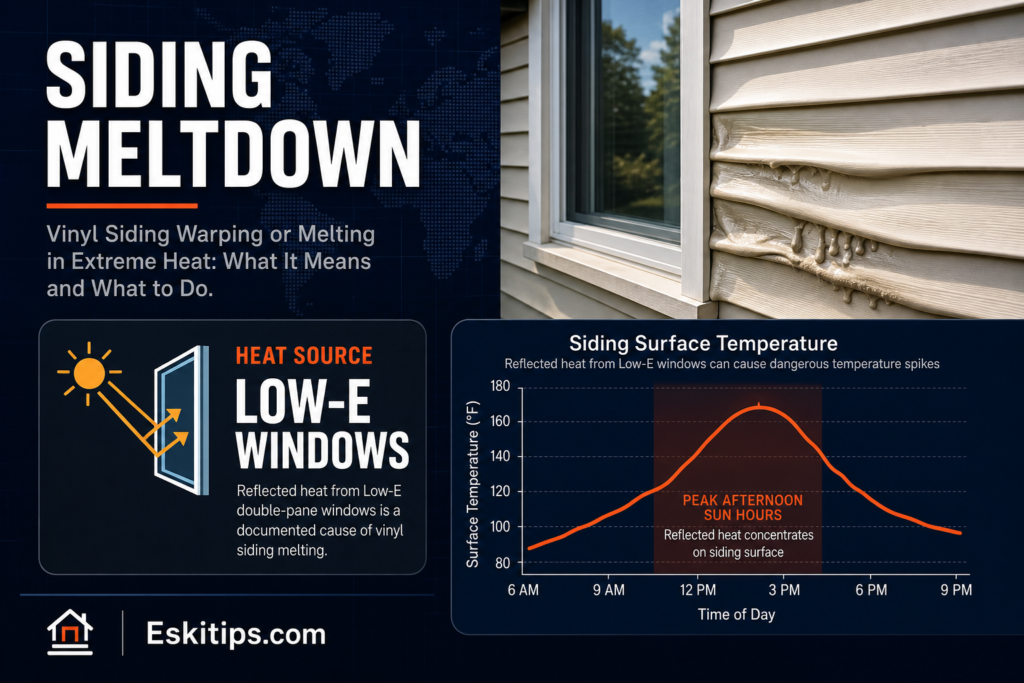
Vinyl siding is rated to withstand normal outdoor temperatures, but it can warp, buckle, or melt when it is exposed to concentrated, reflected heat — most commonly sunlight bouncing off an energy-efficient window on your own home or a neighbor’s, which can focus enough heat on one spot to exceed vinyl’s distortion point even on a day that isn’t the hottest of the year. Widespread warping across large areas, rather than one localized spot, is more likely a general heat-wave and installation-tolerance issue. Either way, damaged sections should be assessed for water and pest intrusion behind the panel, not just cosmetically.
Safety First
- Do not attempt to force warped or melted siding back into shape while it is still hot and soft — this can crack the material and worsen the damage.
- If siding has pulled away enough to expose the house wrap or sheathing underneath, treat this as a moisture-intrusion risk, not just a cosmetic issue, especially before the next rain.
- Be cautious on ladders in extreme heat — schedule any inspection for early morning or evening hours.
What to Do First
- Identify the pattern of the damage. Is it one section or a small cluster, or is it widespread across a whole wall? A localized melt pattern points toward reflected heat from a specific window; widespread warping points toward general heat exposure.
- Check for a reflective window nearby. Low-E (low-emissivity) double-pane windows, both on your home and neighboring homes, can reflect and concentrate enough solar heat to melt vinyl siding at certain times of day and year — this is a documented, known phenomenon, not user error in siding choice.
- Photograph the damage from multiple angles and note the time of day, since reflected-heat damage often only happens during a specific window of hours when the sun angle lines up.
- Check behind and around affected panels for gaps, separation from the house, or exposed underlying material, without forcing anything back into place.
- Note whether the damage is new or worsening — vinyl that has already warped once is more prone to further distortion in subsequent heat events.
What Not to Do
- Do not use a heat gun, hair dryer, or open flame to try to reshape warped vinyl — this is more likely to damage it further than restore it.
- Do not paint over vinyl siding with a dark color, which absorbs more heat and increases the risk of future warping.
- Do not ignore gaps or separation at panel joints — these are entry points for water and pests even if the siding looks mostly intact.
- Do not assume the cause was simply “too hot outside” if the damage is isolated to one area — check for a nearby reflective window before ruling that out.
Common Causes of Vinyl Siding Heat Damage
| Damage pattern | Likely cause | What to do |
|---|---|---|
| Localized melting facing a specific window | Reflected heat concentrated by a low-E energy-efficient window | Document sun angle and timing; consult a window or siding professional about window film or awnings |
| Widespread warping across a whole wall | General extreme heat exposure, often combined with a dark siding color | Assess whether panels need replacement; consider a lighter-color vinyl for future replacement |
| Warping near a grill, dark-colored surface, or reflective object | Direct or reflected heat source close to the siding | Relocate the heat source; replace affected panels |
| Panels pulling away from the house at joints | Repeated expansion and contraction cycles loosening the fastening | Have a siding contractor inspect and refasten or replace |
Safe DIY Checks
- Note the exact time of day when reflected sunlight seems most intense on the affected wall — this helps a professional confirm a window-reflection cause.
- Check for gaps at the bottom and side edges of affected panels where water could enter during the next rain.
- Look at the color of your siding — darker colors absorb significantly more heat than white or light tones and are more prone to warping in extreme heat.
- Check nearby windows (yours and a neighbor’s, if visible) for the double-pane, coated look associated with Low-E glass.
When to Call a Professional
Call a siding contractor if:
- Multiple panels are warped, melted, or separated from the wall.
- You see exposed house wrap, sheathing, or insulation behind the siding.
- Damage is recurring in the same spot every summer, which points to an ongoing reflected-heat source that needs a permanent fix like window film, an awning, or landscaping changes.
Consult a window professional if reflected heat from a specific window appears to be the cause — solutions can include exterior shading, window film, or repositioning outdoor furniture and reflective surfaces away from that sun path.
Prevention Tips
- Choose lighter-colored vinyl siding for any future replacement — it reflects rather than absorbs heat and is far less prone to warping.
- Keep grills, reflective furniture, and mirrored or metallic decor away from areas that already receive intense afternoon sun against the siding.
- If you’re installing new energy-efficient windows, ask about coatings and orientation relative to neighboring siding, since some Low-E coatings reflect more concentrated heat than others.
- Inspect siding each spring for early signs of warping before a new heat wave season begins.
Recommended Next Step
Document the damage with photos and the time of day it seems worst, then check whether a nearby reflective window lines up with the affected wall. If the damage is limited to one or two panels, a siding contractor can typically replace just those sections; if it’s widespread, treat it as a signal that the siding’s color or age is no longer holding up to the current level of summer heat in your area.
Related Guides
- Caulk Around Windows and Doors Cracking: When and How to Recaulk
- Attic Too Hot in Summer: Why It Happens and What to Do
- Summer Storm Damage: What to Inspect After a Storm
Frequently Asked Questions
Can a neighbor’s window really melt my siding?
Yes. Modern energy-efficient windows with Low-E coatings can reflect and concentrate solar heat onto a fixed point, and there are documented cases of this melting or warping vinyl siding on nearby homes at specific times of day when the sun angle aligns with the window’s reflection path.
Is warped vinyl siding covered by a manufacturer warranty?
This depends on the manufacturer and the documented cause. Some manufacturers exclude damage caused by external reflected heat sources, while general product defects may be covered. Check your specific warranty documentation and consider a professional assessment to document the cause before filing a claim.
Does the color of vinyl siding actually affect how likely it is to warp?
Yes. Darker colors absorb significantly more solar heat than lighter colors, which raises the surface temperature of the siding and increases the risk of warping during extreme heat. Manufacturers typically rate darker vinyl products with lower maximum recommended exposure limits for this reason.