What This Guide Helps With
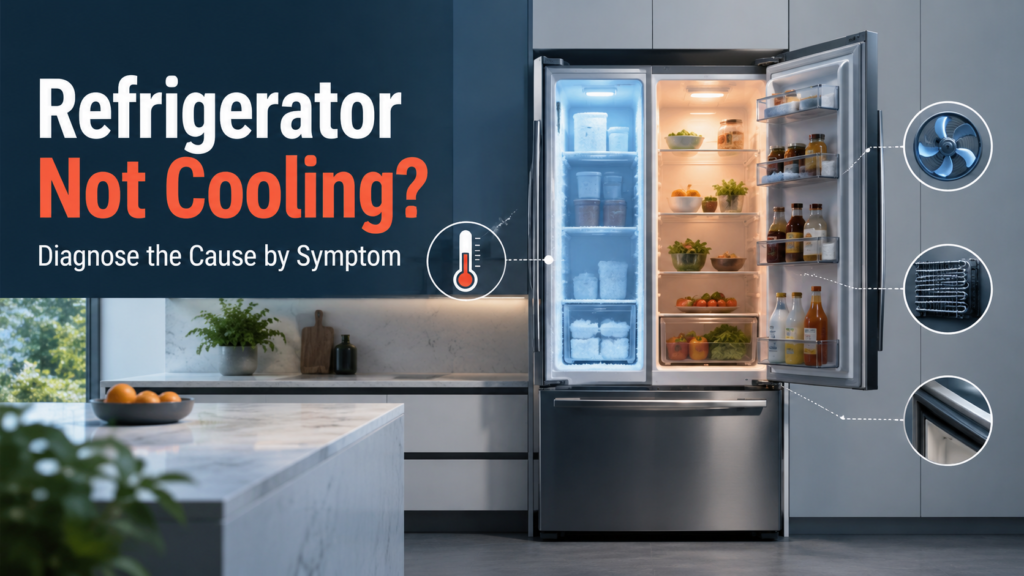
This guide helps diagnose a refrigerator that is not cooling properly by using specific symptoms. “Fridge warm but freezer cold” points to a different cause than “both sections warm.” Matching the symptom to the cause avoids unnecessary repair calls and identifies when homeowner-safe checks can resolve the issue.
Quick Answer
The most important first check is whether the freezer is working. Freezer cold but fridge warm usually means a blocked evaporator fan or a clogged defrost system — not a refrigerant problem. Both sections warm with the compressor still running may mean a refrigerant issue or a failing compressor. Both sections warm with no sounds from the compressor means check the power, temperature settings, and start relay first.
Safety First
- Do not attempt to service refrigerant lines yourself. Refrigerant handling requires EPA certification and specialized equipment. This is a licensed technician’s job.
- If you smell a chemical or sweet odor near the refrigerator, ventilate the area and call a refrigerator technician. Some older refrigerants are hazardous.
- If the refrigerator has been running warm for more than 4 hours, assume food safety is at risk. The FDA recommends discarding perishable foods after 4 hours at temperatures above 40°F (4°C).
- Do not plug and unplug the refrigerator repeatedly. Each compressor restart draws a surge — excessive cycling can damage the compressor.
Symptom Diagnosis Table
| Symptom | Most likely cause | Homeowner check |
|---|---|---|
| Fridge warm; freezer still cold | Evaporator fan not circulating cold air to fridge section; or defrost system failure causing ice blockage | Listen for fan behind freezer back wall; check vents between freezer and fridge |
| Both sections warm; compressor running | Dirty condenser coils; failing compressor; refrigerant leak | Clean condenser coils; if still warm, call technician |
| Both sections warm; no compressor sounds | Power issue; tripped breaker; failed start relay; thermostat set to OFF | Check power, settings, breaker, and start relay |
| Compressor runs constantly; fridge barely cold | Dirty condenser coils; door seal failure; heavy frost buildup | Clean coils; check door seals; defrost manually |
| Fridge cools intermittently | Defrost timer or thermostat issue; condenser fan cycling off | Observe if it cools at night but not during day — defrost timer may be stuck |
| Water pooling inside fridge | Clogged defrost drain — not a cooling issue but a symptom of defrost system | Clear the drain with warm water; see below |
Homeowner Check 1 — Power and Settings
- Confirm the temperature dial has not been accidentally turned to the OFF or warmest setting. This happens more often than expected.
- Pull the refrigerator forward and confirm the power cord is fully plugged in.
- Check the breaker panel for a tripped kitchen or appliance breaker. A tripped breaker cuts power completely.
- Confirm the outlet has power by plugging in another device.
Homeowner Check 2 — Condenser Coils (Most Impactful DIY Fix)
Condenser coils release heat from the refrigerant. When coated in dust and pet hair, they cannot release heat efficiently and the entire cooling system struggles. Cleaning them takes 15 minutes and can restore cooling in many cases.
- Unplug the refrigerator.
- The condenser coils are usually at the bottom front behind a kick plate (most models) or at the back. Remove the kick plate or pull the unit away from the wall.
- Use a coil cleaning brush or vacuum with a narrow attachment to remove dust and lint from the coils and the surrounding fan blades.
- Plug back in and wait 2 to 4 hours for temperatures to stabilize.
Refrigerators with heavy dust on coils often cool 5 to 10 degrees better within hours of cleaning.
Homeowner Check 3 — Door Gaskets
The door gasket (rubber seal around the door edge) must seal tightly. A failing gasket lets warm air in constantly, making the compressor work harder without the fridge ever getting cold.
- Test: Close the door on a dollar bill. It should hold the bill with firm resistance. If the bill slides out easily, the gasket is failing at that point.
- Check all four sides and all corners — corners fail first.
- Clean the gasket with soapy water — a dirty gasket that is otherwise intact seals poorly.
- If the gasket is torn, cracked, or deformed, replacement is possible. Many refrigerator gaskets can be ordered by model number.
Homeowner Check 4 — Manual Defrost (Ice Blockage)
If the fridge section is warm but the freezer is cold, the evaporator coils (inside the freezer, behind the back panel) may be covered in ice. The defrost system usually handles this automatically, but when it fails, ice blocks airflow from the freezer to the fridge.
- Empty both sections.
- Unplug the refrigerator for 24 to 48 hours with the doors open. Place towels under and around it.
- Let it defrost completely — all ice inside the freezer section melts.
- Plug it back in and monitor. If the fridge section cools normally for a few days before the problem returns, the automatic defrost system is failing and a technician is needed.
What Not to Do
- Do not overfill the refrigerator. Blocking air vents inside prevents cold air circulation.
- Do not place the refrigerator directly against a wall with no rear ventilation space. Minimum 1 to 2 inches clearance on all sides.
- Do not use an ice pick or sharp tool to remove frost from inside the freezer. This can puncture the evaporator coils — a costly repair.
- Do not ignore a refrigerator that runs constantly at normal or warm temperatures. The compressor working overtime without results means a technician is needed soon.
- Do not assume a refrigerator making noise is “fine” — unusual sounds (clicking, buzzing, rattling) each point to specific component issues.
Related Guides
- Breaker Keeps Tripping: What to Check
- Garbage Disposal Not Working: Symptom Guide
- Kitchens, Bathrooms & Major Appliances
Safe DIY Checks Summary
- Check power, breaker, and temperature settings first.
- Clean condenser coils — most impactful DIY fix.
- Test door gaskets with the dollar bill test on all sides.
- Listen for the evaporator fan running inside the freezer section.
- Try a manual defrost if the freezer is cold but fridge is warm.
- Check vents between freezer and fridge sections for ice blockage.
When to Call a Refrigerator Technician
Call a licensed appliance technician if:
- The compressor does not run at all after power and settings are confirmed.
- The compressor runs constantly but the fridge still cannot reach below 45°F.
- Manual defrost resolves the issue temporarily but the problem returns — automatic defrost system has failed.
- You smell a chemical or sweet odor — possible refrigerant leak.
- The fridge is 10 to 15 years old and failing — repair vs replacement math often favors replacement.
- Start relay replacement (a small clip-on component near the compressor) did not restore compressor operation.
Repair vs Replace Decision
| Situation | Likely recommendation |
|---|---|
| Fridge under 8 years, compressor works | Repair — coils, gasket, defrost system relatively inexpensive |
| Fridge 8–12 years, compressor works | Get repair estimate — compare to 50% of replacement cost |
| Fridge over 12 years, compressor failing | Replace — compressor replacement often costs more than a new unit |
| Refrigerant leak confirmed | Evaluate age and repair cost — leaks on older units often favor replacement |
Prevention Tips
- Clean condenser coils every 6 to 12 months, especially with pets in the home.
- Test door gaskets annually with the dollar bill test.
- Keep the refrigerator 60 to 80% full — completely empty fridges lose cold faster; overfull fridges block airflow.
- Set the fridge to 37°F (3°C) and the freezer to 0°F (-18°C) for optimal efficiency.
- Maintain proper clearance around the unit for ventilation.
Recommended Next Step
Use the symptom table to identify the category of problem. If it is power or settings, check those first. If the compressor runs but cooling is poor, clean the coils today — this is free and resolves a significant percentage of gradual cooling loss. If you confirm a defrost system failure or compressor issue, schedule a technician and document the fridge model, age, and symptom for them.
Frequently Asked Questions
How long can a refrigerator go without cooling before food is unsafe?
The FDA recommends discarding perishable foods (meat, dairy, leftovers) that have been above 40°F (4°C) for more than 4 hours. A closed, full refrigerator stays below 40°F for about 4 hours without power. A closed full freezer stays below 0°F for 24 to 48 hours.
Why is the fridge warm but the freezer completely fine?
This is almost always the evaporator fan or a defrost system failure. Cold air is generated in the freezer section and circulated to the fridge by the evaporator fan. If the fan fails or ice blocks the airflow duct, the freezer stays cold but the fridge warms up.
My refrigerator is making a clicking noise and not cooling. What is it?
Repeated clicking from the compressor area often indicates a failing start relay — a small inexpensive component that helps the compressor start. The compressor tries to start, clicks, fails, and retries. A technician can test and replace the start relay. If the compressor itself has failed, the clicking continues after relay replacement.
Does a refrigerator use more energy when it is not cooling properly?
Yes. A refrigerator with dirty coils, a failing gasket, or a struggling compressor runs longer cycles to try to reach the set temperature. This increases energy consumption significantly and can shorten the compressor’s remaining life.
Should I put a thermometer in my fridge?
Yes. A simple appliance thermometer (inexpensive at any hardware or kitchen store) lets you verify actual temperature rather than relying on the dial setting. The target is 37°F (3°C) in the fridge and 0°F (-18°C) in the freezer.