What This Guide Helps With
This guide explains how to prepare your home for a rolling blackout or a planned power outage — the kind utilities schedule during heat waves when demand on the grid outpaces supply. It covers what to do in the hours before a scheduled outage, what to shut down safely, and how to protect food, medication, and sensitive equipment while the power is out.
Quick Answer
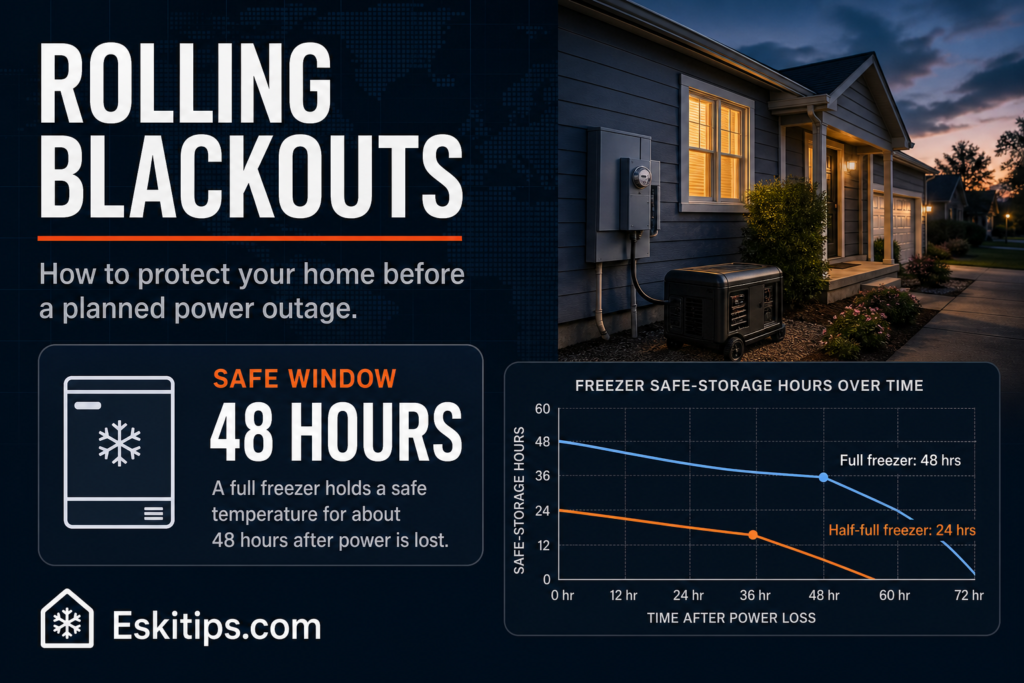
If your utility has announced a rolling blackout or a planned outage, unplug or power down sensitive electronics before it starts, set your refrigerator and freezer to their coldest settings a few hours in advance, fill containers with water in case well pumps or low-pressure areas are affected, and charge phones, medical devices, and any backup batteries. Keep refrigerator and freezer doors closed once the power cuts out — a full freezer holds safe temperature for about 48 hours, a half-full one for about 24. Never run a generator indoors or in a garage, and never use gas stoves or ovens for heat.
Why Utilities Schedule Rolling Blackouts
Rolling blackouts are not equipment failures — they are a deliberate, controlled response utilities use to prevent a total grid collapse. When extreme heat pushes air conditioning demand close to or beyond the grid’s capacity, utilities rotate short outages across different areas rather than risk an uncontrolled, longer-lasting failure. They are typically announced hours in advance through utility alerts, local news, or state grid operator notices, which gives homeowners a window to prepare that a random storm outage does not.
What to Do Before a Scheduled Outage
- Lower your refrigerator and freezer temperature two to three hours ahead of time. A colder starting point buys extra hours of safe storage once the compressor stops running.
- Fill a few containers or jugs with water. Homes on well water lose water pressure entirely without power, and even municipal water customers may see reduced pressure during grid-wide events.
- Charge phones, laptops, medical devices, and power banks fully. If anyone in the home depends on powered medical equipment (oxygen concentrators, CPAP machines, refrigerated medication), have a plan and backup power source confirmed before the outage window starts.
- Unplug or power down sensitive electronics — computers, TVs, routers, and anything with a sensitive circuit board. This protects them from the power surge that often occurs when service is restored, not just from the outage itself.
- Set a garage door manual release if you have an electric opener, so you are not locked out of a garage-access entry.
- Freeze water bottles or ice packs in advance and have a cooler ready in case the outage runs longer than expected.
What Not to Do
- Do not run a portable generator inside a garage, basement, or near windows and doors — carbon monoxide from generator exhaust is deadly and odorless. See our carbon monoxide alarm guide for what to do if an alarm sounds.
- Do not use a gas oven, gas stovetop, or charcoal grill indoors for heat or light.
- Do not open the refrigerator or freezer repeatedly to check on food — every opening lets cold air escape and shortens safe storage time.
- Do not assume a short blackout means no risk to food — track how long the door stayed closed, not just the outage length.
- Do not leave well pumps, sump pumps, or sensitive equipment plugged directly into an outlet without surge protection once power is restored.
Common Rolling-Blackout Problems and What They Mean
| Situation | What it usually means | What to do |
|---|---|---|
| Power out longer than the utility’s stated window | Grid demand still exceeds supply, or a separate local fault occurred | Check your utility’s outage map; report if not already listed |
| No water pressure during the outage | Well pump has no power, or municipal booster pumps are affected | Use stored water; do not run well pump on backup power without checking amperage needs |
| Sump pump not running during a storm-related outage | No power to the pump, which is a flood risk if rain is also falling | Use a battery backup sump pump if you have one; monitor the basement |
| Lights flicker or dim right before restoration | Grid stabilizing power flow as service resumes | Keep sensitive electronics unplugged until power is steady for a few minutes |
| Backup generator won’t start when needed | Dead battery, stale fuel, or maintenance issue | See our generator troubleshooting guide |
Safe DIY Checks
- Confirm your phone can receive text alerts from your utility and local emergency management before the next heat event.
- Locate your electrical panel and know how to identify which breakers feed the refrigerator, sump pump, and any medical equipment.
- Test any battery backup or UPS units on a normal day, not during an actual outage.
- Check that surge protectors on major electronics and appliances are not older than their rated lifespan — most lose protection capacity after a few significant surges.
- If you are on well water, confirm whether your pump can run on a portable generator and what wattage it draws.
When to Call a Professional
Call your utility provider if:
- The outage extends well beyond the announced window with no updated timeline.
- You see downed power lines, sparking equipment, or damaged transformers near your property — stay back and report it, do not approach.
- Power returns but is unstable — flickering, dimming, or partial power to only some outlets, which can indicate a service-line or meter problem.
Call an electrician if power returns but specific circuits stay dead, breakers won’t reset, or you notice a burning smell — see our guide on a buzzing or humming breaker panel for related warning signs.
Prevention Tips
- Sign up for your utility’s outage and rolling-blackout alert system before heat season, not during it.
- Keep a small emergency kit — flashlights, batteries, a battery or hand-crank radio, and a list of emergency contacts — somewhere easy to reach in the dark.
- Consider a whole-home or portable battery backup system for medical equipment if anyone in the household depends on powered devices.
- Install whole-home surge protection at the panel if you live in an area prone to grid instability — this protects everything downstream, not just individually plugged-in items.
- Keep a paper copy of important phone numbers; cordless phones and cell towers can lose function during extended outages.
Recommended Next Step
If a rolling blackout is announced for your area, use the hours beforehand to prep food storage, charge devices, and secure anyone dependent on medical equipment — do not wait until the power actually cuts out. If outages in your area have become more frequent this summer, talk to an electrician about whole-home surge protection and consider whether a backup power source makes sense for your household’s specific needs.
Related Guides
- Backup Generator Won’t Start When the Power Goes Out
- Carbon Monoxide Alarm Going Off: What to Do
- Power Outages & Electrical Safety
Frequently Asked Questions
How long is food safe in the refrigerator during a rolling blackout?
An unopened refrigerator keeps food cold enough to be safe for about 4 hours. A full freezer holds safe temperature for about 48 hours, and a half-full freezer for about 24 hours, as long as the door stays closed. Rolling blackouts are usually shorter than this window, but track the total time without power, not just one outage period.
Should I unplug my refrigerator during a rolling blackout?
No — leave it plugged in but keep the door closed. Unplugging does not protect it from a power surge when service resumes; a dedicated surge protector or whole-home surge protection does. The bigger risk to the refrigerator is repeated door-opening, which lets cold air escape.
Can I run my central air conditioner on a portable generator during an outage?
Most portable generators do not have the wattage to start a central air conditioner’s compressor, which draws a large surge on startup. Check your generator’s rated and surge wattage against your AC unit’s requirements before attempting this, or consult an electrician about a transfer switch sized for your system.
Why does my area have rolling blackouts if my own bill is paid and my house has no faults?
Rolling blackouts are a grid-wide demand management tool, not a response to any individual household. Utilities rotate outages across neighborhoods to keep total demand below what the grid can safely supply during extreme heat, regardless of any single customer’s account status.