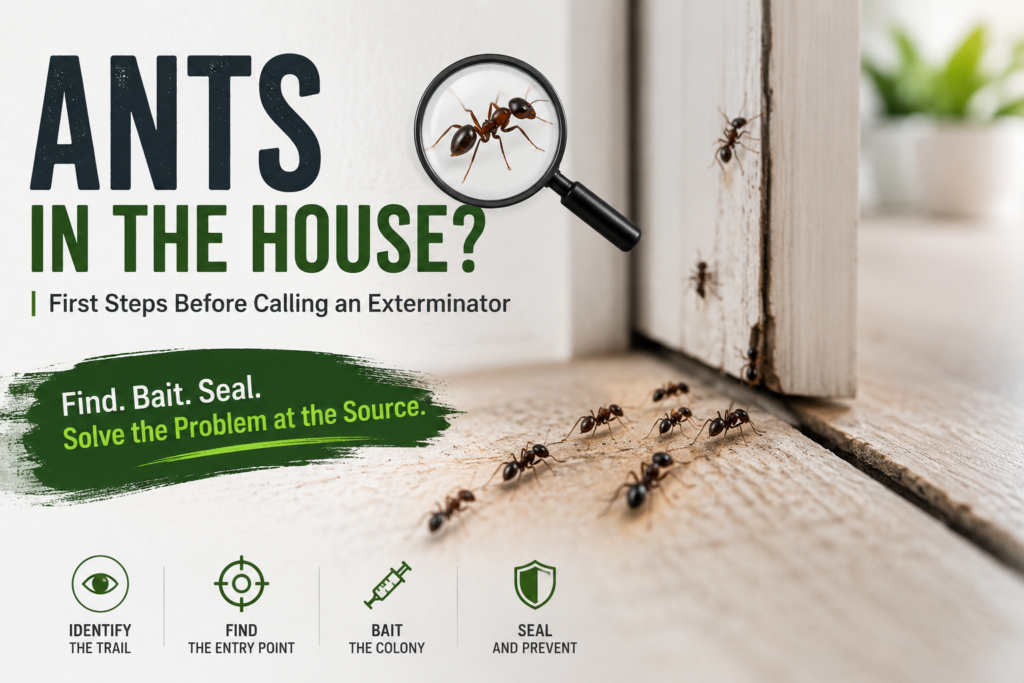
What This Guide Helps With
This guide explains the most effective homeowner first steps when ants appear inside, why the instinct to spray them immediately often backfires, and how to find and eliminate the entry point before deciding whether professional treatment is needed.
Quick Answer
When you see ants inside, do not spray them immediately. Spraying the visible trail scatters the colony and makes it much harder to trace back to the entry point. Instead: watch where the trail leads, identify the species if possible, place slow-acting bait near (not on) the trail, and find and seal the entry point. Most small ant problems are resolved without a professional if you follow the right sequence.
The Most Common Mistake — Why Spraying Backfires
Contact ant spray kills the ants you see in seconds. That feels satisfying. But the forager ants you see are a tiny fraction of the colony. Killing them:
- Destroys the trail you need to trace back to the entry point
- Triggers the colony to split and start using multiple new routes
- Leaves the queen, eggs, and 90% of the colony completely unharmed
- Creates alert pheromones that cause the colony to treat the area as a threat zone
The right approach uses the ants’ behavior against them — slow-acting bait that foragers carry back to the colony.
Common Types of Ants and What They Mean
| Ant type | Appearance | What it means | Key response |
|---|---|---|---|
| Odorous house ant | Small, dark brown, smells like blue cheese when crushed | Most common household ant; nests inside walls or under floors | Gel bait stations near trails |
| Pavement ant | Small, brown-black, often near concrete or foundation | Nests under slabs, sidewalks, or foundations; enters through cracks | Granular bait outside + seal cracks |
| Carpenter ant | Large (1/4–1/2 inch), black or black-and-red, often winged | Nests in moist or damaged wood — can signal a moisture problem | Find the moisture source; call a professional |
| Fire ant | Reddish-brown, aggressive, common in Southeast US | Usually outdoor nests migrating in | Granular bait outside the home; professional if colony is near structure |
| Pharaoh ant | Very small, pale yellowish, in kitchens and hospitals | Difficult species; baiting is the only reliable method | Gel bait stations only — spraying causes budding (splitting) |
Safety Note on Carpenter Ants
If you identify large black ants, especially in bathrooms, around windowsills, or near any area with past water damage, treat this differently from small household ants. Carpenter ants nest in moist or soft wood. Their presence often indicates a hidden moisture problem — roof leak, plumbing leak, or condensation inside a wall. See our guides on ceiling water stains and moisture in bathrooms. Resolve the moisture source before or alongside pest treatment.
What to Do First — The Right Sequence
- Watch the trail without disturbing it. Follow the ant trail from where you see them to where it leads. Both ends matter: where they are going (food source) and where they are coming from (entry point). Take a photo of the trail path.
- Find the entry point. Ants typically enter through: gaps around pipes under sinks, cracks in the foundation, poorly sealed doors or windows, utility line entry points, and gaps around conduit on exterior walls. A thin line of ants along a baseboard points directly to the entry area.
- Place slow-acting gel bait near the trail. Use a gel bait product (borax-based or similar) placed in small amounts near (not directly on) the trail. Foragers carry the bait back to the colony and feed it to the queen. Do not spray or disturb the trail while bait is active — this disrupts the process. Give it 3 to 5 days to work.
- Remove food and moisture sources. Ants enter because something inside is worth returning for. Food debris, open bins, standing water, grease around the stove, and pet food left out are common attractants. Remove them while bait is active.
- Seal the entry point. Once the trail is gone or significantly reduced, seal the entry point with caulk, weatherstripping, or expanding foam depending on the gap type. Sealing while a live trail is active can cause ants to find new entry routes.
- Clean the trail path. After the colony is reduced, clean the trail path with soapy water. This removes the pheromone trail that other ants follow.
What Not to Do
- Do not spray contact killer on an active trail while trying to trace it or while bait is active.
- Do not use bait and spray at the same time — spray kills the foragers before they can carry bait back to the colony.
- Do not seal the entry point before reducing the colony — this traps ants inside and they find alternative exits.
- Do not use granular pesticides inside the home on kitchen or food-prep surfaces.
- Do not place bait directly on the trail or move the bait frequently — let foragers find and work it.
- Do not assume one treatment eliminates the problem permanently. Monitor for 2 weeks.
Entry Points to Inspect and Seal
| Location | What to look for | Sealing method |
|---|---|---|
| Under kitchen or bathroom sink | Gap around plumbing pipes through cabinet floor or wall | Silicone caulk or steel wool + caulk |
| Foundation crack or gap | Hairline cracks in foundation, sill plate gaps | Polyurethane caulk or hydraulic cement |
| Door and window frames | Gap between frame and wall, missing or damaged weatherstripping | Weatherstripping replacement, caulk exterior gaps |
| Utility entry points | Gaps around conduit, gas lines, dryer vents | Expanding foam rated for pest exclusion |
| Baseboard gaps | Separation between baseboard and floor | Paintable caulk |
Related Guides
- Sewer Smell in House but No Visible Leak
- Foundation Crack Width Chart
- Yard, Landscaping & Outdoor Living
Safe DIY Checks
- Follow and photograph the ant trail to both ends.
- Identify the ant species using the table above.
- Place gel bait near the trail without disturbing it.
- Inspect all under-sink cabinets for entry gaps around pipes.
- Check exterior door sweeps and window weatherstripping.
- Remove all open food sources and standing water.
- Clean the trail path with soapy water after colony is reduced.
When to Call a Pest Professional
Call a licensed pest control professional if:
- You identify carpenter ants — especially near any area with water damage history.
- The infestation covers multiple rooms or multiple trails.
- Gel bait shows no reduction after 5 to 7 days.
- You see winged ants (swarmers) indoors — this indicates a mature colony establishing nearby.
- Ants appear in electrical panels, walls, or in significant numbers in multiple areas.
- You suspect the entry is inside a wall or floor cavity you cannot access.
Prevention Tips
- Apply a perimeter caulk check annually — especially around all utility penetrations.
- Keep firewood at least 20 feet from the home exterior.
- Trim tree branches that touch the roofline or siding — ants use them as bridges.
- Fix any leaking faucets or pipes promptly. Moisture attracts carpenter ants.
- Use tight-sealing containers for food storage, especially sugar, honey, and pet food.
- Empty kitchen compost bins daily in summer months.
- Check door sweeps on all exterior doors in spring.
Recommended Next Step
If you see ants right now, resist the urge to spray. Watch where the trail leads, place slow-acting gel bait near it, and check under all sinks for pipe gaps. Most small household ant problems respond within a week using bait. If you see large black ants or the problem does not improve after 7 days of bait, call a pest professional.
Frequently Asked Questions
Why do I see more ants after I tried to get rid of them?
Spraying or disturbing the trail causes a behavior called budding in some species — the colony splits and creates new routes to avoid the threat. More ants in more places is often the result of aggressive contact spray treatment. Switch to slow-acting bait and give it time.
Why do ants seem worse in June and July?
Summer is peak ant foraging season. Colonies grow over spring, send out foragers in all directions to find food and water, and the heat drives them indoors looking for both. Hot dry spells are especially common triggers. Sealing entry points in spring reduces summer pressure significantly.
Is borax bait safe around pets and children?
Borax-based ant bait products contain low concentrations of borax in a sweet carrier. The small amounts used in bait stations are generally considered low risk for adults and larger pets in normal use. Keep bait stations out of reach of small children and pets by placing them inside a cabinet or behind appliances. Check the product label for specific guidance.
Do ants bite? Should I be worried?
Most common household ants (odorous house ants, pavement ants) rarely bite humans and pose no health threat. Fire ants are aggressive biters and can cause painful stings requiring attention. Carpenter ants can bite when handled but are not typically aggressive.
Why are ants specifically in my bathroom?
Bathrooms offer moisture and sometimes toothpaste or soap residue. Ants in bathrooms often point to a pipe gap under the sink or in the wall. Check the vanity cabinet for gaps around the plumbing and any soft spots on the floor or wall — carpenter ants specifically seek moist areas.