Quick Answer
Basement walls that appear wet or have droplets in summer — without any rain or obvious water intrusion — are almost always condensation, not a leak. Warm, humid outdoor air enters the basement and contacts cool concrete walls (which stay at ground temperature year-round), and the moisture in that warm air condenses on the cool surface. A simple tape test confirms condensation vs. actual water coming through the wall in 24 hours. Most summer wall sweating is condensation. The fix is dehumidification and air sealing — not waterproofing paint.
The Tape Test — Confirm the Cause in 24 Hours
- Dry a small area of the wall surface with a cloth or paper towel.
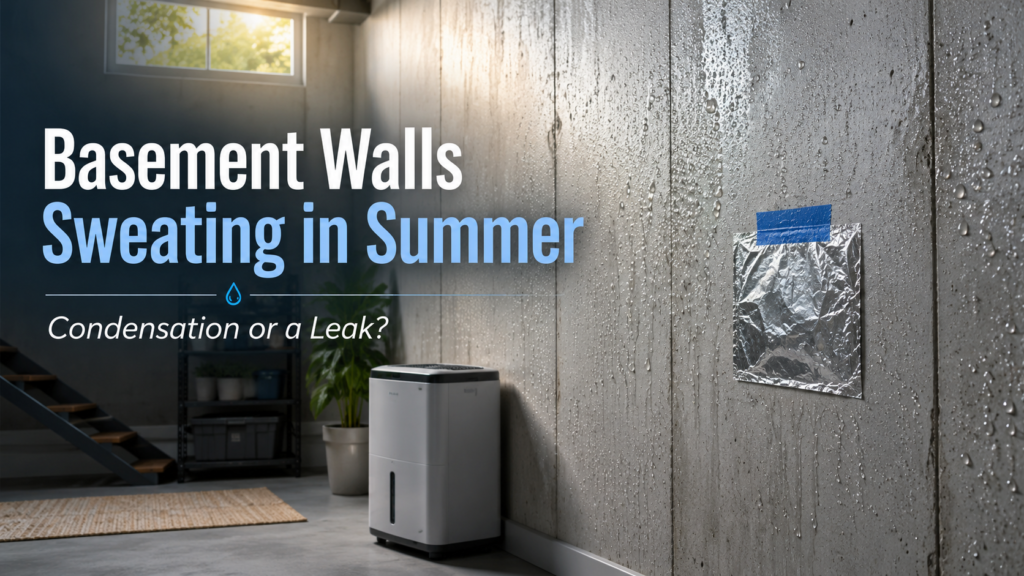
- Cut a 12-inch square of aluminum foil and tape it flat against the wall with duct tape, sealing all four edges tightly against the concrete.
- Leave it for 24 hours. Do not open windows or run fans during this period.
- After 24 hours, peel back the foil and check:
- Moisture on the room-side surface of the foil: Condensation. The moisture came from the basement air, not through the wall.
- Moisture between the foil and the wall surface: True water intrusion through the foundation wall.
- Both sides wet: Both problems are present simultaneously.
This test is a professional’s first step and costs nothing. It gives a definitive answer in 24 hours.
Safety First
- Persistent basement moisture — from either condensation or a real leak — creates conditions for mold growth. Dark spotting on walls, wooden framing, or stored materials warrants professional assessment if widespread or recurring.
- If water is confirmed coming through the foundation wall and the area contains electrical panels, outlets, or wiring, treat it as a potential electrical hazard and call a professional.
- Check whether the sump pump is functioning properly — a wet wall problem combined with a failing sump pump can escalate quickly during a heavy rain event.
Why Condensation Happens in Summer Specifically
Concrete basement walls stay at approximately 55 to 65°F year-round because the surrounding earth maintains that temperature regardless of outdoor conditions. Summer outdoor air at 80 to 90°F with high relative humidity carries significant moisture. When that warm, humid air enters the basement through open windows, door gaps, pipe penetrations, or other pathways, it contacts the cool concrete wall. The wall chills the air below its dew point — and moisture condenses on the surface. This is exactly the same physics that makes a cold drink glass sweat on a humid summer day.
This is why the problem appears in summer and not winter: cold winter air has very low absolute moisture content even at high relative humidity, and there is not enough moisture to condense on the walls.
If It Is Condensation — What to Do
- Close basement windows during summer. This is the single most counterintuitive but most important step. Opening windows for ventilation pumps warm, humid outdoor air directly onto cool wall surfaces — the opposite of helpful.
- Run a dehumidifier continuously. Set it to maintain relative humidity below 50%. In humid climates, this means continuous operation throughout summer — which is normal and necessary. Connect a drain hose or empty the reservoir daily.
- Seal air entry points. Gaps around basement windows, pipe penetrations through the rim joist, and the rim joist itself allow humid air in. Seal with caulk or expanding foam.
- Insulate cold water pipes. Cold supply pipes running through the basement condense moisture independently of the walls. Foam pipe insulation stops dripping from pipes and removes one moisture source.
- Keep organic materials away from walls. Cardboard boxes, fabric, and wood stored directly against cool concrete walls absorb moisture and develop mold within days during humid summer periods.
If It Is a True Leak — What to Do
Water confirmed through the wall (tape test moisture on wall side) indicates: a foundation crack allowing intrusion — see our foundation crack guide; failed waterproofing on the exterior foundation; hydrostatic pressure from saturated soil; window wells without drainage filling with water; or downspouts discharging too close to the foundation.
- Photograph all wet areas and the tape test result. Document for potential insurance or contractor discussions — our water damage documentation guide covers the full checklist.
- Confirm downspouts extend at least 6 feet from the foundation.
- Clear window wells and confirm drainage at the bottom of each well.
- For a hairline crack actively seeping water, hydraulic cement can provide a temporary stop while professional assessment is arranged.
- Call a licensed basement waterproofing contractor for evaluation. For any crack showing structural characteristics, have a structural engineer assess first.
What Not to Do
- Do not apply waterproofing paint to address condensation. Waterproofing paint addresses water pressure coming through the wall from outside — it does nothing for moisture condensing from the basement air on the inside surface.
- Do not open basement windows in summer to dry things out.
- Do not paint over wet or damp concrete walls. Paint applied to damp concrete bubbles and peels within weeks.
- Do not store furniture, rugs, or clothing directly on a concrete floor or against basement walls during summer months.
Related Guides
- What to Do If Your Basement Floods
- Sump Pump Not Working: What to Check
- Foundation Crack Width Chart: When to Worry
Safe DIY Checks
- Perform the tape test — wait the full 24 hours for a reliable result.
- Close all basement windows during humid summer days and nights.
- Run a dehumidifier set to below 50% relative humidity.
- Insulate all cold water pipes in the basement with foam sleeves.
- Confirm downspouts extend at least 6 feet from the foundation.
- Seal visible gaps and pipe penetrations around the basement perimeter.
When to Call a Professional
- The tape test confirms water is coming through the wall — not condensation.
- White powdery deposits (efflorescence) are visible on the wall surface — a sign that water has been moving through the concrete repeatedly.
- A dehumidifier running continuously cannot maintain humidity below 55% through the summer.
- Mold is present on walls, wooden framing, or stored materials.
- Water appears specifically during or after rain events — not during general summer humidity.
Prevention Tips
- Run the dehumidifier from late May through September in most North American climates.
- Maintain a minimum 6-foot downspout extension from the foundation.
- Grade the soil around the foundation to slope away at approximately 1 inch per foot for the first 6 feet.
- Keep window wells clear of leaves and debris and confirm drainage at the bottom of each well.
- Inspect and test the sump pump annually before the wet season begins.
Recommended Next Step
Do the tape test today. The result in 24 hours determines whether your solution is a dehumidifier and air sealing (condensation) or a waterproofing contractor evaluation (true leak). Most summer basement sweating is condensation — and treating condensation as a water intrusion problem leads to expensive interventions that do not address the actual cause.
Frequently Asked Questions
Why does this happen only in summer and not winter?
Cold winter air has very low absolute moisture content even at high relative humidity — not enough to condense on walls. Hot summer air carries significant moisture. The seasonal pattern is nearly diagnostic for condensation on its own.
Does condensation cause structural damage to the foundation?
Surface condensation does not significantly damage poured concrete foundations. It does damage: finished drywall, wooden framing at the wall base, stored organic materials, and it creates conditions for mold growth. Long-term unaddressed moisture can eventually affect framing in finished basements.
What humidity level is acceptable in a basement?
Below 50% relative humidity throughout summer is the target. A simple hygrometer (inexpensive at hardware stores) confirms whether the dehumidifier is keeping pace with conditions.
My walls have white powder on them. What is that?
Efflorescence — minerals left behind when water moves through concrete and evaporates on the surface. It indicates water has been moving through the wall, pointing toward intrusion rather than surface condensation. Do the tape test to confirm.
Can I finish my basement if it sweats in summer?
Only after fully resolving the moisture issue and confirming stable humidity below 50% through an entire summer. Finishing a basement over ongoing condensation or a true leak traps moisture behind drywall and insulation — creating invisible mold conditions within months.